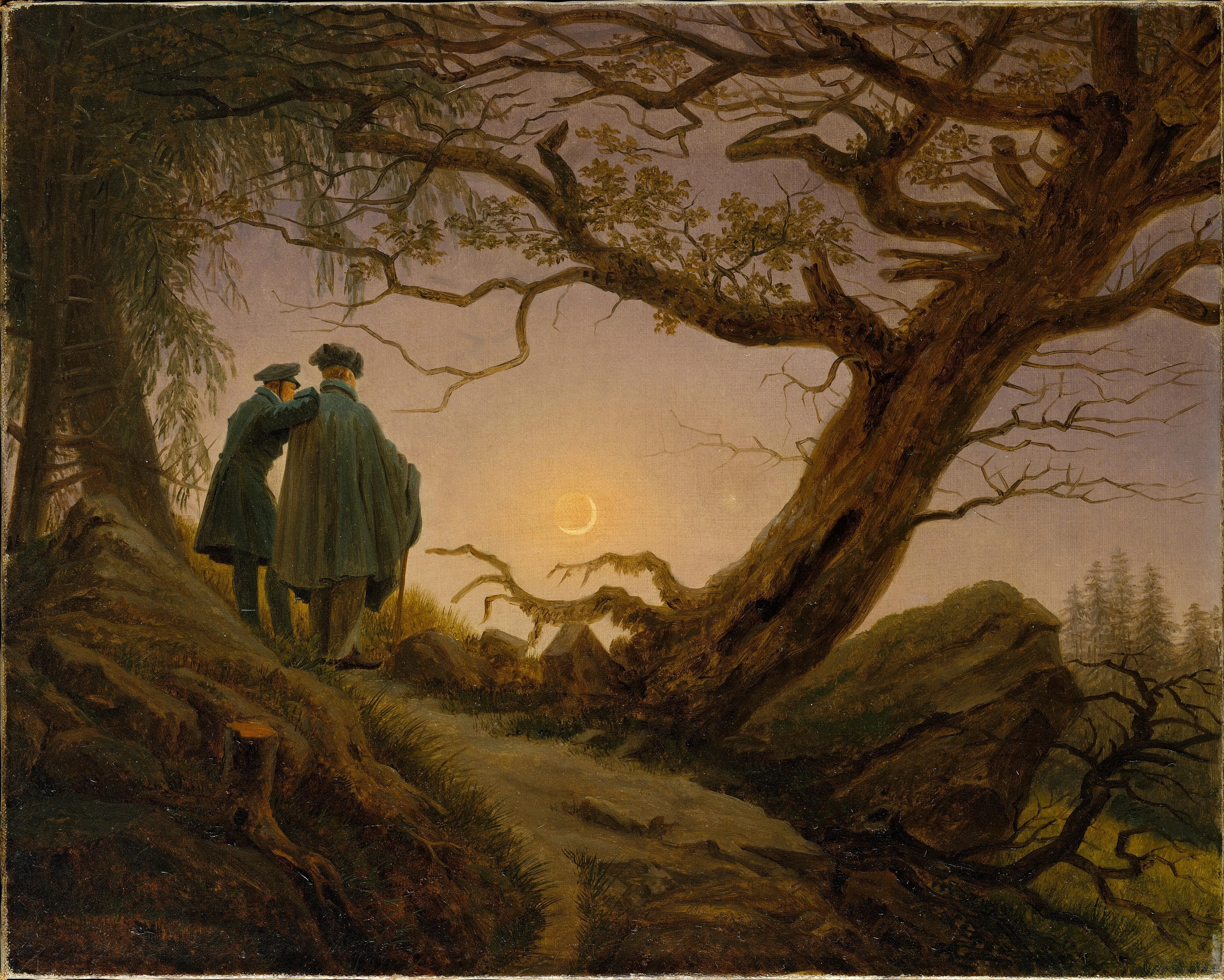
The quickest way to understand the painter Caspar David Friedrich is to notice who in his pictures is doing the looking. Canvas after canvas hands the foreground to a single person, or a close pair, who stands with their back to us and faces something far off: a ridge of mountains, the flat plate of the Baltic, a crescent moon caught in bare branches. Historians have a German word for the device, the Rückenfigur, the figure seen from behind. My argument is narrow, and I want to make it without hedging. Friedrich did not paint landscapes that happen to contain people. He painted the act of contemplation, and the landscape is what that contemplation throws off. The scenery is real, carefully observed, sometimes stitched together from separate studies, but its job is to register on a watching mind he has set down between us and the view.
That sounds like a small distinction. It is not. Accept it and a row of puzzles about his work settles at once: why his figures are so often faceless, why his skies carry more feeling than his ground, why a picture of two men in a wood can read as a religious painting without a single religious sign in it. To test the claim I will spend most of this essay inside one work, Two men contemplating the Moon, and let the rest of his output gather around it. The single work is the method here, not an illustration of a method. Friedrich pays the slow eye far better than he pays the wide survey, and a catalogue read at speed turns his paintings into a brand: lonely backs, big skies, German melancholy. Stand still in front of one and the brand falls away.
A late starter from the Baltic coast
Friedrich was born on 5 September 1774 in Greifswald, a harbour town on the Pomeranian coast then held by the Swedish crown, and he died in Dresden in 1840 (Wikipedia). The sea he grew up beside never leaves the work; harbours, sailing masts and low northern horizons recur for forty years. From 1794 to 1798 he trained at the Royal Danish Academy in Copenhagen, then one of the better schools in northern Europe, before settling in Dresden for good (National Gallery of Art). Two of the established painters working at that academy were the portraitist Jens Juel and the history and landscape painter Christian August Lorentzen, and the Copenhagen training shows in Friedrich's discipline of drawing even after he gave up topographical accuracy as a goal.
He came to oil paint late. For years he worked mainly in sepia and pencil, and only around 1807 did he begin painting in oils in earnest (The J. Paul Getty Museum). The first picture to make his name followed quickly. In 1808 he finished Cross in the Mountains, the so-called Tetschen Altar, a work that put a crucifix on a fir-covered peak and asked a landscape, rather than the usual biblical staging, to carry the weight of the Crucifixion (Wikipedia). It scandalised some critics, who felt that scenery had no business doing the devotional labour reserved for figures. They were right to sense a transfer of power. From that altar onward, the burden of meaning in Friedrich keeps migrating off the human body and into rock, water, weather and light.
Standing where the two men stand
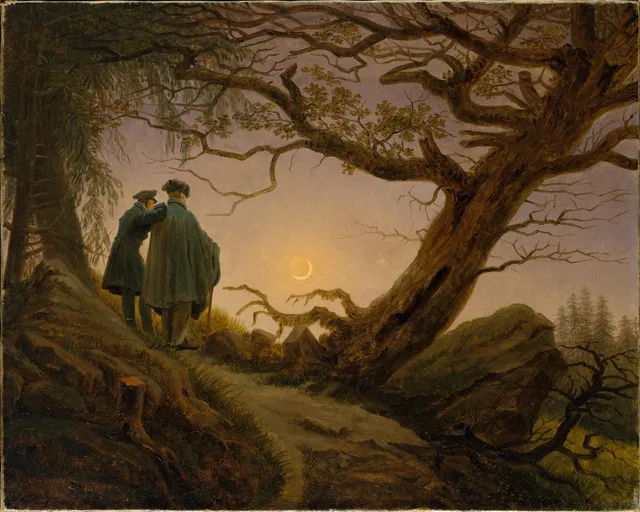
Look at Two men contemplating the Moon. A narrow path climbs from the lower right and stops where two men in old German coats have stopped, standing close, one with a hand laid on the other's shoulder, both turned away from us toward a thin crescent moon hung low in a fading sky. The dark part of the moon's disc is faintly filled in, the soft grey of earthshine, so the whole circle reads even though only a sliver burns. On the left a great oak has half come out of the ground, dead or nearly so, its roots clawing the bank, its bare limbs reaching across the men as though to roof them. Behind it a single fir stays green and upright. The path the men are on goes nowhere the picture will show us. It climbs and leaves the frame at the top. The light is doing something exact. Friedrich keeps the sky brightest at the horizon and lets it cool to a deeper blue as it climbs, so the crescent sits in the warmest pocket of the canvas while the men's coats read nearly black against it. The ground gets the opposite treatment, a brown bank and a scatter of stone laid in thinly and kept dim. He spends his finest attention on the air and the dead tree, and lets the earth fall away into near-monochrome shadow.
Nothing happens, and the stillness is the subject. Notice how little Friedrich gives the men as individuals. We get the back of two heads, the slope of two shoulders, the gentle lean of one body toward the other. No faces, no story, no errand. They are reduced almost to a single attentive posture, and that reduction is what lets us slide into the posture ourselves. The oak and the fir do the talking the men withhold. A dying pagan tree, twisted and rootless, leans over the watchers; a young evergreen, the old Christian shorthand for things that do not die, holds its line behind. The crescent gathers both men's gaze into one point, and because their gaze runs parallel to ours, we end up aimed at the same sliver of light. He has not painted two men we observe. He has painted two men whose looking we are pulled into completing.
This is the whole engine of his art shown in miniature. The Rückenfigur is not a quirk of staffage. It is a hinge. Put a faced figure in a landscape and you watch a person have an experience. Turn that figure around and the experience comes loose, looking for someone to land on, and the only candidate left is you. Friedrich understood this with unusual precision, and he was willing to build entire pictures around the transfer even when it cost him the comfortable furniture of narrative painting. The price is real. His works can feel withholding, even cold, to a viewer who wants to be told a tale. The reward is that, once you stop waiting for a tale, you find yourself doing the thing the painting is actually about.
Works discussed in this article
The same move, again and again
Once you have the moon picture in your eye, the rest of Friedrich starts to rhyme with it. Take On a Sailing Ship. A couple sits in the bow, backs to us, the rigging rising over their heads, and across the water a city floats up out of the haze, all spires and pale towers, never quite arrived. We are placed on the deck with them, aimed at a destination the picture refuses to deliver. The composition does to a sea voyage exactly what the wooded path did to an evening walk: it freezes the watchers at the threshold and lets the longing accumulate. The towers stay a promise. The boat does not dock inside the frame. Friedrich paints the rigging as a delicate black cage above the couple's heads, so even the means of travel becomes a lattice they look out through rather than a thing that carries them anywhere.
The night and ruin pictures press the same key in a lower register. Night in a Harbour sets masts as black verticals against a sky that does most of the emotional work, the way the moon-lit sky does in the wooded scene. Ruins of the Oybin takes a real Saxon monastery shell and lets sky pour through the empty window tracery, so the architecture frames absence rather than enclosing space. And in New Moon or Solar Eclipse above the Riesengebirge Mountains the band of distant peaks dissolves into a graded wash of light, the mountains he climbed in 1810 turned into a meditation on a darkened sun. Even the quieter Northern Landscape, Spring carries the signature: a low northern horizon, weather standing in for mood, the ground subordinate to the air above it. It is the one picture in this set without a watcher built into it, and the absence is instructive. With no back to step behind, the eye drifts and the longing has nowhere to gather. The painting is lovely and a little inert, and the contrast shows how much of the charge in the others is the figure's quiet work.
The clearest proof of the thesis is a painting outside our walls and worth naming for it. In Monk by the Sea, made around 1808 to 1810 and now in the Alte Nationalgalerie in Berlin, Friedrich strips the scene almost bare: a tiny figure, a sliver of dune, an enormous emptiness of sea and sky. The picture gives the eye almost nothing to hold, no path in, no framing repoussoir, just three bare horizontal bands of beach, water and enormous sky. It is built so that the viewer comes to occupy the position of that small lone figure rather than to observe him from a safe distance (Smarthistory). That is the moon picture's logic carried to its limit. Remove the oak, remove the second man, remove almost the whole earth, and the transfer still works. What is left is a watcher and a void, and the watcher is increasingly hard to tell apart from us.
What the archive holds
There is a reason a single-work reading suits Friedrich better than a sweep through everything he made. His range of motifs is deliberately small, and the variation lives in the handling, not the subject list. Our own holdings make the point in numbers. Artifact World Gallery gathers 34 paintings by Friedrich, drawn from nine separate collections and dated across roughly four decades, from about 1800 to 1838. Spread that count over the standard biography and a pattern appears: the same handful of motifs, moon and mast, ruin and fir, returned to and reworked rather than abandoned. He was not chasing new scenes. He was refining one encounter, between a still watcher and a charged distance, until it would hold. Set the 1800-to-1838 range against the life and it covers nearly his entire working career in oil, which begins only around 1807. So these thirty-four pictures are not early experiments giving way to a mature style. They are the mature style, held steady for three decades. He walked the same Saxon hills and the same northern shore, drew them in pencil, and recombined the studies indoors, which is why the motifs recur without ever quite repeating.
That refinement is also why catalogue surveys tend to mislead. Lined up in a grid, the works look repetitive, almost formulaic. Slowed down to one canvas at a time, the differences turn out to be the substance: how thinly the sky is graded in one, how the oak is allowed to interrupt the figures in another, where exactly the horizon sits relative to the watcher's eye. A nine-venue spread of thirty-four pictures is not a sprawling oeuvre. It is a tight, obsessive body of work, and tight bodies of work reward the patient look that this kind of close reading asks for. Hang nine of them in one room and a visitor walking past at normal pace would call them samey. Give any single one of them ten minutes and it stops being a type and becomes a particular evening, a particular weather, a particular distance held just out of reach.
Romanticism, and why the label undersells him
Friedrich is filed, fairly enough, under Romanticism, the movement that the early nineteenth century was already using as a name for a new appetite in art and writing: an interest in human psychology, the expression of personal feeling, and the natural world (Tate). All three terms fit him. The trouble with the label is that it can flatten him into a mood, the wistful German alone in nature, when his real contribution is structural rather than emotional. Plenty of Romantic painters felt deeply about mountains. Friedrich engineered a way to make the canvas feel on your behalf, by giving you a surrogate to stand inside. The feeling is not pasted onto the picture. It is produced by where he makes you stand. Strip the surrogate out and the same view would read as topography, a competent record of a place. Leave the surrogate in, facing away, and the place becomes a state of mind you are made to share.
That is also why his reach runs well past his own century. The single most reproduced image associated with him, Wanderer above the Sea of Fog, painted around 1818 and acquired by the Hamburger Kunsthalle in 1970, where it has hung since, is now a near-universal shorthand for the solitary confronting the vast (Wikipedia). Book covers, album sleeves and parodies keep borrowing it for one reason: the back of that figure is an open slot, and any viewer can step into it. The device Friedrich worked out on a wooded path with two moon-watchers turned out to be one of the most portable inventions in European painting.
Why one painting is enough
Return one last time to the moon. If you have followed the argument, the thirty-four works in our holdings should now look less like a checklist of scenic types and more like thirty-four attempts at the same demanding thing: to make stillness contagious, to hand the viewer a body to occupy and then point that body at something it cannot reach. The dead oak, the green fir, the filled crescent, the path that leaves the frame: each is a tool for keeping the watchers, and us, suspended at the edge of an arrival. Friedrich was a patient, even monkish technician of that suspension, and the patience is in the paint. Look long enough and the repetition reveals itself as discipline, a man returning to one problem because he had decided it was the only problem worth solving.
So the close look is not a substitute for the survey. It is the survey, done honestly. Walk the full set of Friedrich's works in our collection and you will keep meeting the back of a head and a charged horizon, and you will keep being asked to finish the looking yourself. The next time a Friedrich crescent hangs in front of you, do not ask what the men are thinking. Stand where they stand, aim where they aim, and wait. The painting is built to make the waiting feel like the only thing in the world worth doing.
Sources & further reading
- Caspar David Friedrich — Wikipedia
- Caspar David Friedrich, Artist Info — National Gallery of Art
- Caspar David Friedrich — The J. Paul Getty Museum
- Friedrich, Monk by the Sea — Smarthistory
- Romanticism (art term) — Tate
- Wanderer above the Sea of Fog — Wikipedia
- Caspar David Friedrich and the Subject of Landscape — Internet Archive (Joseph Leo Koerner, Yale University Press)