The color reaches you before anything else in a Jasper Francis Cropsey landscape, a scarlet and amber blaze that earned him the faintly diminishing nickname of the painter of American autumn. The reputation has done him a quiet disservice. It files a careful builder of pictures under the heading of a colorist, as if he simply owned a brighter box of paints than his peers and shook it harder. The argument here runs the other way. Cropsey was a structural thinker first and a colorist second, and the famous foliage is laid over an armature that was drawn before any pigment touched it. Look past the red and you find a draftsman. A landscape by him is engineered before it is felt, and the blaze is the last thing he applies though the first thing you notice, which is the inversion that has fooled a century of casual viewers.
That armature came from a real trade. Before he was a landscapist, Cropsey apprenticed as an architect under Joseph Trench in early-1840s New York, and he kept an architect's working habits for the rest of his life, drawing buildings and railway interiors alongside his canvases (Wikipedia). The formal break this essay tracks is not one dramatic rupture but a method. Cropsey builds a view the way a draftsman builds an elevation, fixing the bones of the composition, then flooding that structure with a light and a season that threaten to dissolve it. The friction between the two, the designed scaffold and the atmospheric burn, is the true subject of his strongest pictures, and it is what finally separates him from the master he revered.
The architect who painted weather
Cropsey came up under the long shadow of Thomas Cole, the founder of the Hudson River School and the man who taught a generation of Americans to read their own mountains as moral subjects. Smarthistory places Cropsey squarely in that lineage, an admirer of Cole who nonetheless pushed toward a cooler, more empirical rendering of nature than his teacher's allegories allowed (Smarthistory). That last clause holds the whole difference. Cole painted what a landscape meant. Cropsey, increasingly, painted what it looked like at four o'clock in late October, with the air going gold and the far ridge losing its edges to haze.
He began exhibiting watercolors at the National Academy of Design in 1844, and the early dependence on Cole's machinery is plain in a picture like The Spirit of War, an allegorical fantasy with a fortified citadel, storming sky, and armored figures that could have walked in from one of Cole's serial epics. It is a young painter's borrowed grandeur, and it is instructive precisely because it is unlike everything good that follows. The mature Cropsey discards the costume drama and keeps the one thing the allegory taught him, which is how to stage a deep space and march the eye back through it on a fixed plan. The theatrics fall away. The stagecraft stays.
Travel sharpened him. After going abroad again in 1856 he settled in London for seven years, until 1863, and the English interval matters more than the usual line about a colonial talent collecting European polish. It put him in front of John Constable's skies and J. M. W. Turner's dissolving light at the same moment he was being asked, repeatedly and skeptically, to defend the truth of American color to British eyes. The pressure was productive. It forced him to make the structure under the color carry the argument, because the color alone was the thing nobody on that side of the Atlantic believed.
Composition: the elevation under the meadow
The architect's training surfaces most clearly in how Cropsey organizes ground. He almost never lets a landscape simply spread. He frames it. A repoussoir tree or a dark bank holds one edge, a body of water carries the eye inward along a measured diagonal, and a far mountain seals the back of the box. Tourn Mountain, Head Quarters of Washington is a clinic in this discipline. The Rockland County peak is not dropped at the center for drama. It is set against a foreground plotted in clean recessional bands, meadow, treeline, water, slope, each plane established before the season is allowed to color it. The historical title, attaching the hill to Washington's wartime headquarters, is doing the kind of work Cropsey liked, anchoring a pretty view to a documented fact so the picture reads as record rather than reverie.
Give him a literal building and the instinct becomes undisguised. Warwick Castle, England, a souvenir of the London years, lets the architect off the leash. The masonry is described with a precision the meadows never get, every crenellation and buttress measured, the river acting as a mirror that doubles the elevation and tests whether the drawing holds upside down. It does. James McCullough's Leadmill works the same seam from the American side, an industrial structure planted in a worked landscape, the kind of made object Cropsey rendered with obvious relish. He is the rare Hudson River painter who is just as interested in the thing humans built as in the wilderness behind it, and the buildings give away how thoroughly he was constructing the wilderness too.
Close looking: Autumn, On the Hudson River
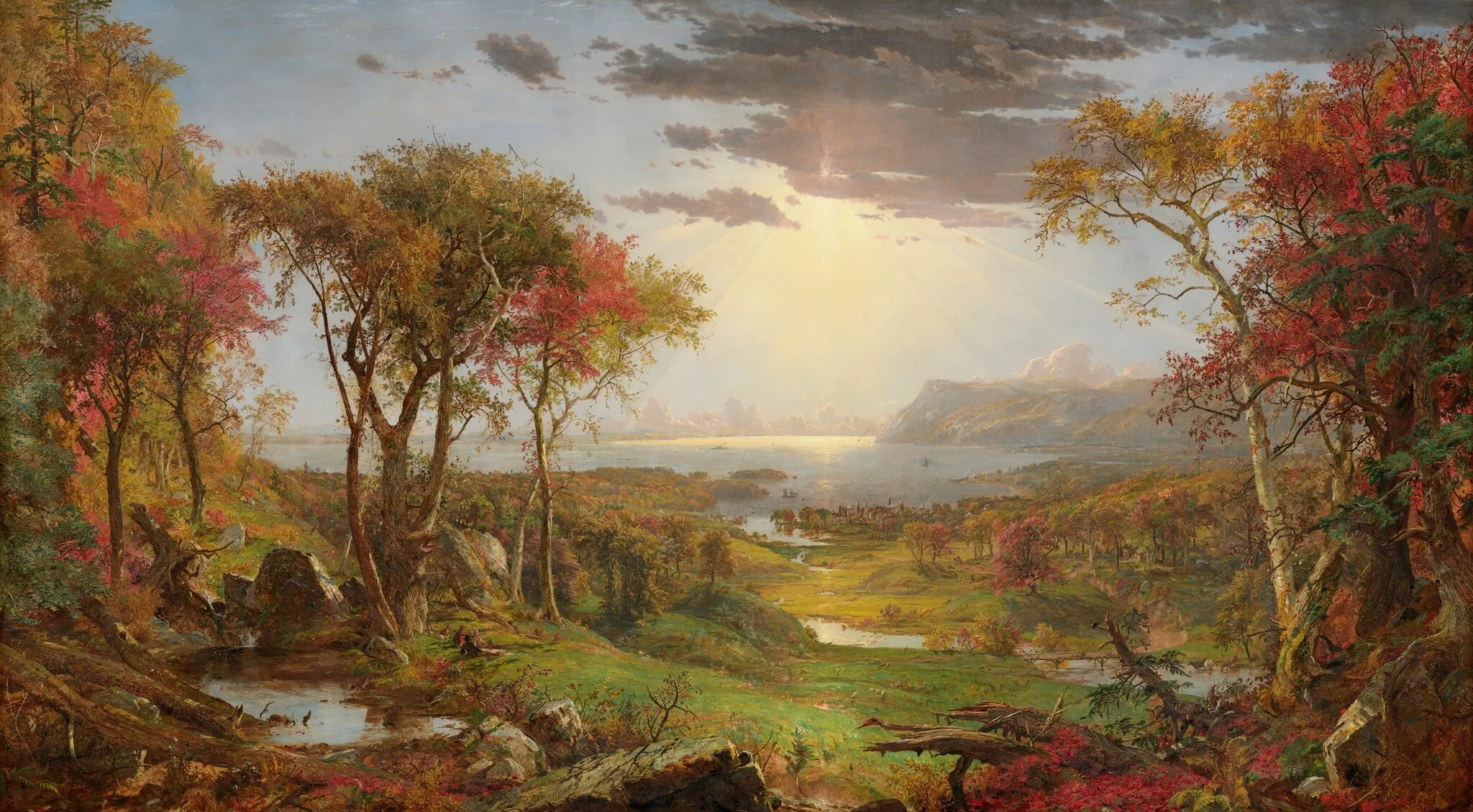
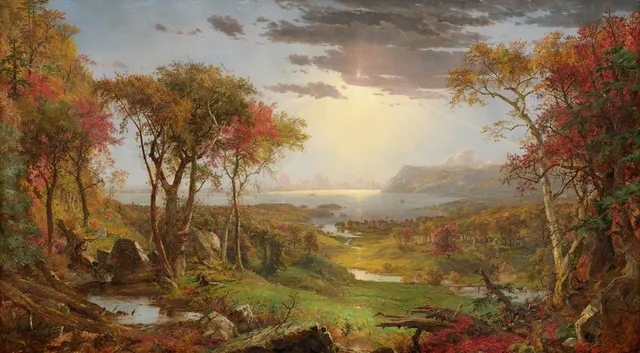
The case for Cropsey the structural colorist rests, finally, on one enormous picture. Autumn, On the Hudson River (1860) is an oil roughly five feet high and nine feet wide, painted entirely from memory and studies during the London years and now in the National Gallery of Art (National Gallery of Art). Stand back from it and the design is brutally simple. The river bends out of the lower right and swings back into a glowing distance, the whole valley pitched toward a low sun that sits almost on the picture's axis and burns a hole in the haze. Everything funnels to that light.
Now come closer, where the structure shows its work. Cropsey gates the entire nine-foot expanse with a stand of dark autumn trees at the right edge, a vertical brake that keeps the eye from sliding straight out the side. Beneath them, on a shelf of foreground he has deliberately kept in shadow, a sportsman pauses with his dogs, small enough to set the scale of the gorge and dark enough to throw the luminous middle distance even further back. Cattle and figures cluster near the water as quiet measuring sticks. Then the land begins to climb away in soft, overlapping screens of foliage, each one a half-step paler and bluer than the last, until the far mountains surrender their drawing completely and become pure tinted air. The architecture is all in the near third. The dissolution is earned by it.
Spend a minute on the water itself. The Hudson in this canvas is not painted as an even mirror but as a graded ramp of light, darker and more particular where it passes the shadowed foreground bank, then bleaching toward the sun until it reads as molten rather than wet. Cropsey uses the river the way he uses the foliage, as a measured gradient that carries the eye from drawn fact into dissolved light. It is the same recessional logic he learned plotting bands of meadow, only liquefied. A painter chasing prettiness would have silvered the whole surface evenly. Cropsey keys it to the structure, so the water deepens the box instead of flattening it.
The color, the thing his name is married to, is doing something subtler than blazing. It is graded. The hottest scarlets and oranges are concentrated in the framed foreground where the drawing is tight, and they cool by degrees as the valley recedes, so that intensity and structure fade together at exactly the same rate. That is not a colorist throwing paint. That is a designer using warmth as a tool of depth, the way an architect uses shadow to model a facade. When Cropsey first showed the canvas in London, British viewers found the foliage frankly unbelievable, and his answer was the answer of a man certain of his facts. He hung specimens of actual North American autumn leaves beside the painting so skeptics could match his reds against the originals (National Gallery of Art). He was not defending a mood. He was defending a measurement.
There is a usefully concrete way to see the shape of his career. The fifteen Cropsey works gathered in this archive, all drawn from a single collection, run from about 1844 to 1886, which is to say from the year of his Academy debut to a full and grizzled maturity. Set against the standard biographies, that span tracks the exact arc described above, the borrowed allegory of the start, the structural confidence of the middle, the late settling into landscape as plain record. One painter, one holding, four decades, and the through-line is visible across all of it.
Light: the sun as a load-bearing element
Cropsey's contemporaries among the so-called Luminists chased a still, even, almost silent light. His is louder and more directional. He likes a low sun placed near the center of the canvas, doing structural work, pulling the whole composition toward a single bright vanishing point so that recession and illumination become one gesture. In View of Mt. Washington the New Hampshire peak is built less from drawn contour than from the way light grades up its flank, the near slopes warm and particular, the summit bleeding into a sky that has been keyed to nearly the same value, so the mountain seems to evaporate at its own top. The drawing hands off to the atmosphere precisely where the architect decides it should.
This is the inheritance of the London years made good. From Turner he took the nerve to let a sun obliterate detail and to treat haze as a positive substance rather than an absence of focus. But he refused Turner's dissolve all the way down. There is always a kept floor of fact in a Cropsey, a foreground you could survey, a building you could measure, a near bank drawn with the patience of a man who once detailed cornices. The light is permitted to consume the distance only because the architect has bolted the foreground down. Atmosphere, in his hands, is a privilege the structure grants.
The handling of paint
Up close the surface tells the same divided story as the composition. Cropsey is a builder of foregrounds, working the near grasses, bark, and stone with small, dry, descriptive touches, a leaf-by-leaf attention that betrays the watercolorist he never stopped being. Then the distance is handled in broad, thin, blended films of paint, the brush nearly invisible, color floated rather than stroked. The eye reads the shift as space, but it is really a shift in facture, from drawn handling to washed handling, and the seam between them is where his pictures live. A weaker painter would have feathered the join. Cropsey, the architect, lets the change of method do the structural job of telling you how far away the mountain is. The transition is a tool, not an accident, and once you notice it you cannot stop reading depth as a record of how the brush was loaded.
His mature method was studio method, and he was unembarrassed about it. The grand machines were assembled indoors from sketches and memory, commissioned and priced like the architectural commissions of his other career. His major exhibition piece The Valley of Wyoming was ordered in 1864 by the railway man Milton Courtright, and Cropsey's own account book records payments from Courtright reaching $3,500 between the summer of 1864 and spring of 1865, before the canvas went on the wall at the National Academy of Design (Internet Archive). The figure is worth pausing on. It tells you these were engineered objects, planned, contracted, and constructed, closer in spirit to a building than to a sketch dashed off before a sunset.
Works discussed in this article
Where he sits among his peers
Set Cropsey beside his American contemporaries and the structural temperament stands out. William Stanley Haseltine drove geological precision into his coastal rocks with a draftsman's edge Cropsey would have admired, but Haseltine seldom let a whole picture pivot on a single burning light the way Cropsey did. George Catlin, working the same expanding continent, was a documentarian of peoples rather than a designer of weather, and the contrast clarifies what Cropsey was actually after, which was the engineered effect of a season on a built space. John Henry Hill, schooled in the leaf-counting fidelity the American disciples of Ruskin prized, shows you the descriptive pole Cropsey kept in his foregrounds but refused to let swallow the whole canvas.
The European comparison cuts the other way and is just as telling. While Cropsey was bolting his foregrounds down, Théodore Rousseau and the Barbizon painters were loosening theirs, dissolving structure into mood and matière, and Johan Barthold Jongkind was already breaking light into the quick, provisional notations that would feed Impressionism. Cropsey saw that road and declined it. He kept the drawing. That refusal is exactly why later modernist taste filed him as a conservative, and exactly why the structure under his color repays a second look now that the fashion for dissolve has had its century. The very habit that once read as timidity now reads as a discipline almost nobody else in his circle could sustain.
Begin with the nickname and you get a minor painter of pretty leaves. Begin with the architect and the order reverses. The autumn is the surface event. Underneath every good Cropsey is a drawn world, surveyed, framed, and pitched toward a sun he placed as deliberately as a keystone, and the color does its blazing only on the terms that structure allows. Stand in front of the Hudson canvas long enough and the red stops being the point. What holds you is the engineering of the recession, the way a man trained to make buildings stand taught a landscape to hold its distance while the season tried to burn it down.
Sources & further reading
- Jasper Francis Cropsey — Wikipedia
- Autumn, On the Hudson River (1860) — National Gallery of Art
- The Valley of Wyoming, object record — Internet Archive / The Metropolitan Museum of Art
- Jasper Francis Cropsey — Smarthistory
- Cropsey, Jasper Francis, Union List of Artist Names — Getty
- Pompton Plains, New Jersey (1867) — The Metropolitan Museum of Art
- Pompton Plains, New Jersey, object record — Internet Archive / The Metropolitan Museum of Art