The argument: an American style built indoors
The pictures we now file under the Hudson River School landscape tradition are usually sold to us as acts of devotion: a painter standing bareheaded before the Catskills, transcribing God's handwriting onto canvas. That story flatters the work and misreads how it was actually made. The Americanness these painters are famous for was not found in the field. It was manufactured in lower-Manhattan studios, out of optical notes gathered on steamboat trips and railway excursions, then reassembled over a winter on a white lead ground under layers of amber glaze. The wilderness supplied the raw material. The style supplied the rest.
My claim is narrow and material. What made a Cole or a Bierstadt look the way it does, and look unmistakably like itself, is a method: small oil and pencil sketches taken on the spot for facts of color and weather, carried home, and then rebuilt at a scale no plein-air session could ever produce, using a specific kit of grounds, transparent browns, and final varnish that gave the school its honeyed, lit-from-within glow. The Met's own survey of the movement dates its flourishing to roughly 1850 onward, around the orbit of the English émigré Thomas Cole, and stresses that these were New York City painters first, field travelers second (Metropolitan Museum of Art). Hold onto the order of those two facts. The studio came first. The mountain was a supplier.
The sketch, the steamboat, and the long way home
Begin with how the motif arrived. Cole, born in Lancashire in 1801 and only lately an American, took a steamboat up the Hudson in the autumn of 1825 and stepped off at the Catskill landing. Within weeks a New York paper had reviewed the canvases that trip produced. The technology matters here as much as the temperament: the river steamer and, soon after, the rail line turned the upper Hudson and the Catskills into a place a working painter could reach, sketch, and leave inside a week. The wilderness these men celebrated as untouched was, in practice, accessible precisely because it was being opened up. They painted the frontier from the deck of the thing that was closing it.
On site, the painters worked small and fast. Graphite studies fixed the structure of a ridge or the fall of a riverbank; oil sketches on paper or thin panel caught the harder thing, the exact temperature of a sky at five in the afternoon, the green of a wet meadow, the particular bruise-color of a clearing storm. These were data, not pictures. Cole filled notebooks. Asher B. Durand, who carried the school forward after Cole's early death, pushed the field study further than anyone, painting finished-looking foreground rocks and tree trunks out of doors and treating them almost as a botanist treats a specimen. But the exhibition object, the thing that went on the wall and got sold, was built later, indoors, from those gathered parts.
Cole said as much in print. His 1836 manifesto, the Essay on American Scenery, ran in the January issue of The American Monthly Magazine, and the period volume is readable today in full (Internet Archive). Read it as a working document rather than a hymn and you find a painter arguing that the American landscape deserved the dignity European critics reserved for ruins and old masters, and that the way to grant it that dignity was through composition. Selection, arrangement, the editing of a real valley into an ideal one. The essay is a defense of the studio as much as the wilderness.
Close looking: the seam in The Oxbow
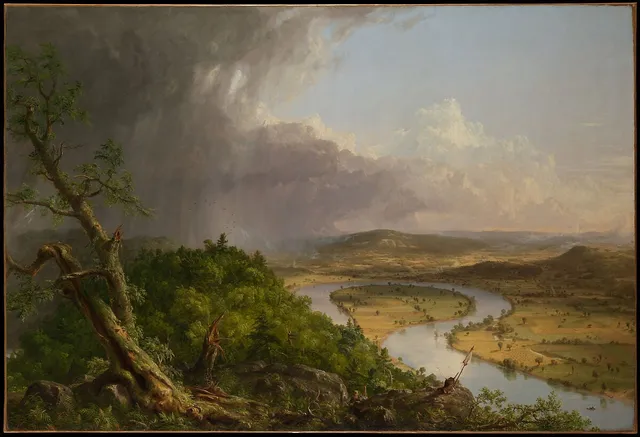
You can watch the method operate inside a single picture. Look at what Cole built in View from Mount Holyoke, Northampton, Massachusetts, after a Thunderstorm, The Oxbow. The canvas splits along a diagonal. The left third is wilderness in foul weather: a blasted, broken tree leans in from the edge, the storm clouds are still dragging rain across the hillside, and the paint there is loaded and scrubby, brushed so the weather itself feels unresolved. Then the diagonal crosses and everything changes. On the right the Connecticut River loops back on itself in the slow calm oxbow that gives the painting its name, and the handling goes thin and smooth, the cultivated fields laid in as tidy patchwork that recedes without any drama at all.
Cole then did something a survey would hurry past. Down near the bottom edge, dwarfed, he painted himself at his easel, parasol and portfolio set beside him on the slope. The little self-portrait is the argument of the whole picture in miniature: the painter sits exactly on the seam between storm-wild nature and ruled farmland, and his presence announces that the division is a choice he is making, not a thing he found. Two weathers, two paint handlings, one decision. That is not transcription. That is an essay about America composed out of two contradictory studies, welded at a diagonal a real hilltop never offered.
The kit: white grounds, brown glazes, and a coat of honey
The school's signature light has a physical recipe. Most of these painters built up over a pale ground, commonly lead white, which sits under the upper paint and throws light back through it. Distances and skies were then developed in thin, semi-transparent passages so that the brightness of the ground reads as atmosphere rather than pigment. The deep, glowing browns of foreground rock and foliage came from transparent earth colors and, in many hands, from bitumen and asphaltum, glaze-like blacks that look gorgeous wet and warm. Painters loved them. Conservators curse them, because asphaltum never fully dries and pulls the surface into the wide alligator cracking you can see today across many mid-century American canvases.
Over the finished work went a heavy natural-resin varnish, often a mastic or copal megilp that the period prized for its depth and that yellows with age. Some of the amber warmth we now read as the school's mood is the varnish talking, not the painter. The point is that the famous luminosity was constructed in stages, each stage a material decision: a reflective ground first, controlled translucency in the middle, saturated darks at the bottom of the value scale, and a unifying golden film on top. A glance that takes in a whole valley at once, bathed in even light, is among the hardest things to fake outdoors and among the easiest to engineer at a studio easel with these tools.
This is also why the field studies and the finished pictures can look like different species. The sketch is fresh, blunt, sometimes ugly, made for accuracy. The exhibition canvas is smooth, graded, and theatrical, made for an audience. The continuity between them is information, not appearance: the studio painting is the sketch's facts, dramatized.
Engineering for the room: the Great Picture
By the 1860s the method scaled up into something close to mass entertainment. Albert Bierstadt, trained in Düsseldorf and fluent in its slick finish, joined western survey expeditions, came home with crates of sketches and stereographs, and turned them into enormous machines. The Rocky Mountains, Lander's Peak is the type specimen: a canvas big enough to dominate a room, a Shoshone encampment composed across the foreground, and behind it a peak stacked up into impossible alpine grandeur. The mountain as painted does not match the survey; Bierstadt edited the range upward, because the picture's job was not cartography. It was awe sold by the ticket.
Canvases like this were shown one at a time, framed like a proscenium, sometimes behind a curtain, lit by gas, with a printed pamphlet to guide the viewer. People paid to file past a single painting as they would a panorama or a play. The National Gallery of Art notes that these painters ranged far past the Hudson Valley that named them, working up subjects from across the United States, South America, and Europe (National Gallery of Art). The brand stayed local. The supply chain went global, because the method travels: gather sketches anywhere, rebuild them under glaze in New York.
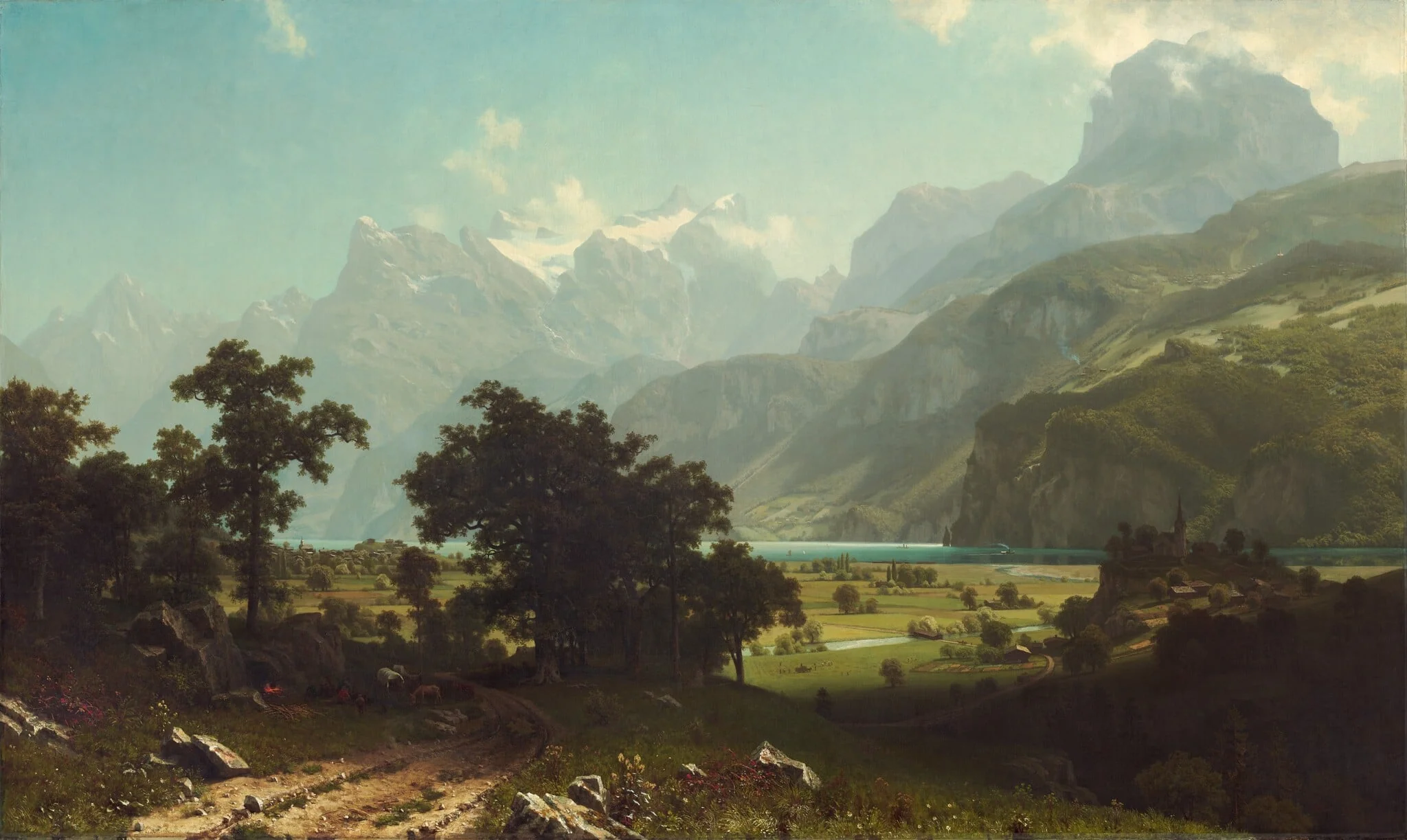
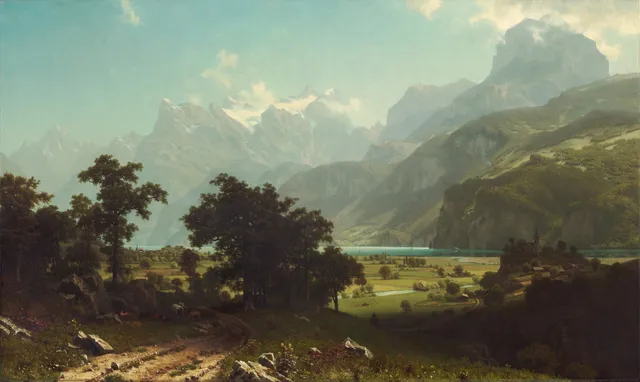
That portability is plain in Lake Lucerne, which is not American ground at all. Bierstadt staged the Swiss subject in the same three-deck way he staged the Rockies. The foreground is a shelf of wet rock and a scatter of small figures along the shore path, painted with enough crisp detail to give the eye a foothold. The middle distance is the flat steel sheet of the lake. Behind it the peaks climb and then deliberately dissolve, the snow and sky kept soft and high-keyed so distance reads as something closer to infinity than to miles. Set Lucerne beside Lander's Peak and the continuity is obvious. Same architecture, same graded light, same machinery, different mountains fed into it.
What our archive shows about the spread
The reach of that method is legible in our own holdings. Artifact World Gallery carries 653 works tied to the Hudson River School, by 146 artists, scattered across 29 venues, with attached dates running from roughly 1670 to 1917. Two numbers in there tell the real story. A movement conventionally dated to the 1820s through the 1870s leaving a documentary trail that wide, well past the deaths of its founders, is the footprint of a style that was taught, copied, and reproduced long after it stopped being fashionable. And 146 hands working a recognizably shared manner is the signature of method over genius. You do not get a stylistic consensus that broad from individual inspiration. You get it from a transmissible procedure: sketch in the field, build under glaze in the studio, finish for the exhibition wall.
Autumn was the procedure's showpiece, because American fall color was the one optical fact European landscape could not match and the one a studio painter could heighten almost without limit. Jasper Francis Cropsey built a career on it. Autumn, On the Hudson River is, by reputation, a picture he painted from memory and field notes while living in London, and he is said to have produced pressed American leaves to convince skeptical English viewers that the reds were real. Whether or not that anecdote is exact, it captures the working logic precisely: the scarlet is built indoors, across an ocean, from gathered evidence, then defended as fact. The Valley of Wyoming is the same engine pointed at a Pennsylvania panorama, the whole valley laid out in warm graded light from a composed foreground rise.
Works discussed in this article
The patrons and the parlor
The studio system had a buyer at the other end. These were expensive objects made for the walls of a rising merchant class that wanted its new wealth wrapped in the dignity of nature. You can see that audience looking back at you in Seymour Joseph Guy's portrait of the Robert Gordon family in their New York dining room. It is a genre picture, not a landscape, but it is useful evidence: it shows the kind of interior, and the kind of money, that hung the Great Pictures. The patron network ran through New York dealers, the National Academy of Design, and the lavish Tenth Street Studio Building, where Bierstadt, Church, and many others worked within doors of one another. Proximity bred a house style. So did competition for the same collectors.
Reproduction widened the market beyond the few who could buy an original. Cropsey's autumn scenes circulated as chromolithographs; engravings after the famous canvases reached parlors that would never see the paintings. The method, in other words, had a final stage the painters cared about deeply: translation into print, where the carefully graded studio light had to survive being mechanically copied. A style optimized for a single gaslit wall was also being optimized, quietly, for the page.
The name, and the turn against the method
None of these painters called themselves the Hudson River School. The phrase surfaced in print in 1879 and was thrown at the work as an insult once a younger generation, back from Paris and Munich with looser brushes and Barbizon mood, decided the older men were fussy and provincial (Wikipedia). The very thing the school had perfected, the high-finish studio rebuild with every leaf accounted for, was what the new taste rejected. Tonalists and Impressionists wanted the sketch's freshness left visible. They wanted you to see the hand and the weather, not the seamless graded surface that had hidden both.
There is a real judgment buried in that reversal, and I think the moderns were half right and half wrong. They were right that the method could harden into formula; the lesser Hudson River canvas is a checklist of stock devices, a blasted tree here, a luminous gap there, executed without conviction. They were wrong to mistake the procedure itself for insincerity. Cole composing two weathers into one hilltop, Bierstadt raising a peak for effect, Cropsey defending his reds with pressed leaves, all of it was deliberate construction, and the best of it is powerful exactly because it is constructed. The smoothness is not a failure of looking. It is the look of a particular idea about what a young country's land could be made to mean.
Stand again in front of the Oxbow and the lesson holds. The painter is down in the corner at his easel, on the line between storm and farm, and what he is doing is not copying the view. He is deciding it, color by color and plane by plane, and the next time someone tells you these pictures are simple windows onto God's country, point at that tiny figure. He is the whole method, sitting in plain sight, choosing.
Sources & further reading
- The Hudson River School (Heilbrunn Timeline of Art History) — The Metropolitan Museum of Art
- The American Monthly Magazine, January 1836 (Vol. 7), Cole's 'Essay on American Scenery' — Internet Archive
- Hudson River School — National Gallery of Art
- Hudson River School — Wikipedia
- Hudson River school (art term) — Tate
- The Hudson River School — Smarthistory