Artwork
The Rocky Mountains, Lander's Peak
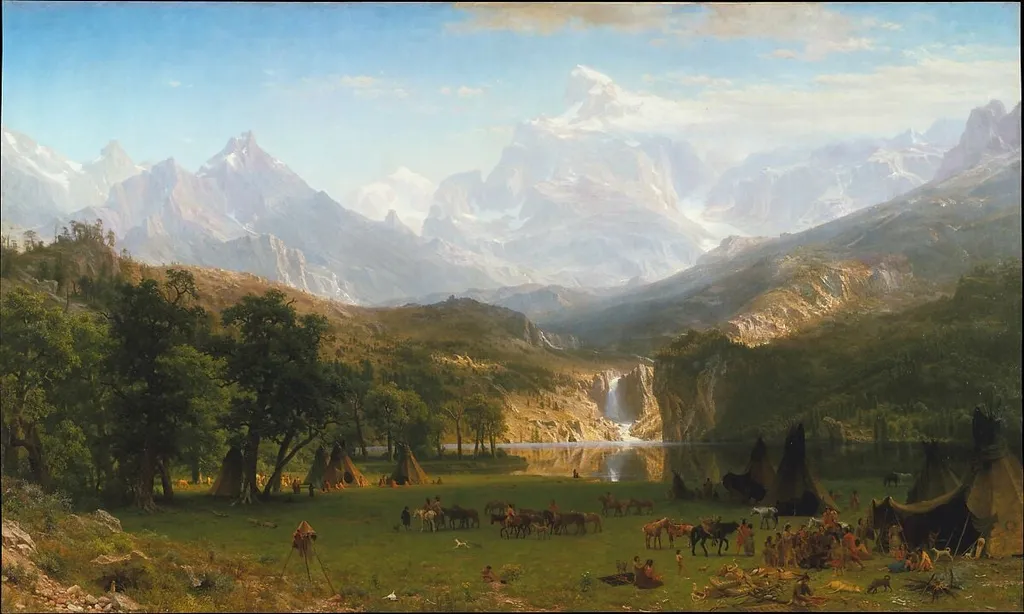
The Rocky Mountains, Lander's Peak is an oil painting by the Düsseldorf school of painting artist Albert Bierstadt. It dates from 1863 and is held in the collection of the Metropolitan Museum of Art.
- Accession no.
- 07.123
- Credit line
- Rogers Fund, 1907
About this work
In 1865 British railway magnate James McHenry paid $25,000 for Albert Bierstadt's 1863 canvas, then a record for any American painting.
In 1865 British railway magnate James McHenry paid $25,000 for Albert Bierstadt's 1863 canvas, then a record for any American painting. It grew from sketches Bierstadt made while traveling with Frederick W. Lander's survey party through present-day Wyoming in 1859. Over ten feet wide, the oil on canvas sets a Shoshone encampment in a green foreground while snow-capped Lander's Peak rises beyond, named by Bierstadt after the explorer's Civil War death. It entered the Metropolitan Museum of Art in 1907.
Subject & Meaning
The painting presents a panoramic view of the Rocky Mountains with Lander's Peak as the central geographic feature. In the foreground, a Shoshone encampment, with tipis, a campfire, a cradleboard, horses, and dogs, is set beside a lake, while mountain sheep and a marmot inhabit the rocky slopes. This combination of untamed wilderness and Native American life reflects the 19th-century ideal of the American West as a sublime, pristine landscape.
Bierstadt’s inclusion of both monumental geology and indigenous habitation symbolizes the perceived harmony between nature and native peoples, reinforcing contemporary notions of Manifest Destiny and the nation’s westward expansion. The vast scale and meticulous detail elevate the scene from mere topography to a nationalistic allegory of America’s destined dominance over the continent.
Technique & Style
Albert Bierstadt painted 'The Rocky Mountains, Lander's Peak' using oil paint on canvas, a medium well-suited to the grand scale of the work (186.7 × 306.7 cm). The painting aligns with the Hudson River School and Luminist movements, emphasizing naturalistic detail, luminous atmosphere, and dramatic topography. Bierstadt's handling is evident in the meticulous rendering of snow-capped peaks, rocky slopes, still water, and the varied activities of the Shoshone camp.
The overall composition combines a sweeping vista with intimate foreground elements, characteristic of Bierstadt's panoramic style. No explicit condition information is available from the sources.
Overview
Albert Bierstadt's monumental oil painting, The Rocky Mountains, Lander's Peak, completed in 1863, presents a sweeping vista of the American West. This expansive canvas, measuring over ten feet wide, captures the dramatic scale of the Rocky Mountains, featuring a prominent snow-capped peak. In the foreground, a tranquil encampment of Native Americans is depicted, grounding the sublime natural spectacle with a human element. The work quickly garnered significant attention, establishing Bierstadt's reputation for grand Western landscapes.
History & Provenance
Bierstadt created The Rocky Mountains, Lander's Peak based on sketches he made during an 1859 expedition with Frederick W. Lander's survey party through what is now Wyoming. Upon its completion in 1863, the painting was met with immediate critical and popular acclaim. In 1865, it achieved a record-breaking sale for an American painting, fetching $25,000 from British railway magnate James McHenry.
The Metropolitan Museum of Art acquired this significant work in 1907, where it remains a cornerstone of its American Wing.
Context
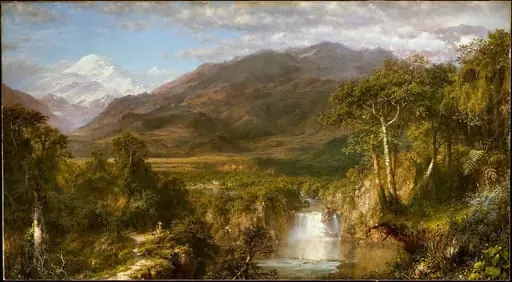
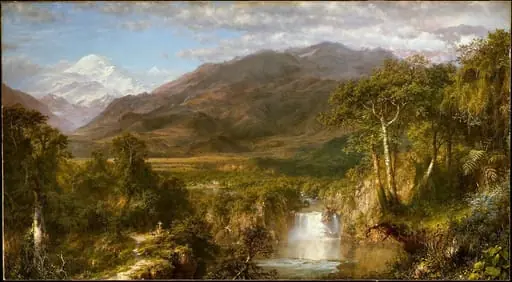
This work emerged during a period of intense national interest in the American West and its natural wonders. Bierstadt's grand landscapes, often exhibited alongside those of contemporaries like Frederic Edwin Church, resonated with a public eager to visualize the nation's expanding territories. The Rocky Mountains, Lander's Peak was even shown in conjunction with Church's The Heart of the Andes, highlighting a shared artistic ambition to depict vast, awe-inspiring natural environments. It contributed to shaping the visual identity of the American frontier.
Artist & collection

Artist
Albert Bierstadt (January 7, 1830 – February 18, 1902) was a German-American painter best known for his lavish, sweeping landscapes of the American West.

 Compared in the Color & Light course