Impressionism is remembered as a revolution in looking: a loosening of the brush until a field of poppies dissolves into a haze of red touches, until a river becomes a lattice of broken color. That is true, and it is only half the story. The other half is a ledger. The painters who organized the first group show in 1874 were not only inventing a way to register sunlight on water. They were inventing a way to sell pictures the official system had refused to hang, and the soft, unfinished surface we now prize was underwritten by a thin and nervous network of dealers and middle-class buyers who took a financial risk the French state would not.
Here is the claim this essay defends: Impressionism was a market experiment before it was a style anyone trusted, and you cannot separate how these canvases look from who was willing to pay for them. The freedom in the paint corresponds to a freedom from the Salon jury, and that freedom had to be financed. Follow the money and the movement stops reading as a manifesto about light. It becomes a small company of artists, a scattering of bourgeois patrons, and one obstinate dealer, all betting that a private market could do the work a public institution had always done.
The wall the Salon built
To understand the gamble, start with the institution the Impressionists walked away from. In mid-century Paris a painter's career ran through the Salon, the state-sponsored annual exhibition whose jury decided what got shown and, by extension, what got bought. Acceptance meant reviews, medals, government commissions, and a price. A medal could lift a painter's rates overnight; a refusal could erase a year of income. Rejection meant near-invisibility. The jury rewarded a particular finish: smooth surfaces, literary or historical subjects, modelled form, a varnish of high seriousness. A loosely brushed view of a suburban riverbank, painted quickly out of doors with the weather still wet in it, read to that jury as a sketch someone had failed to finish.
The younger painters who would become Impressionists kept being turned away or hung badly. They had grown up on the cheap new tube paints that made working outdoors practical, on the railways that put the Seine villages an hour from the city, and on a taste for the ordinary present: a boating party, a station roof, a woman on a windy rise. None of it flattered the Salon's idea of a picture. The Metropolitan Museum frames the rupture plainly, dating the break to the independent exhibition these artists mounted for themselves in 1874 rather than to any single canvas, as set out in the Heilbrunn essay on Impressionism and modernity.
1874: a company of painters, not a movement
Late in 1873 some thirty artists incorporated themselves as a joint-stock cooperative, with shares and dues, and in the spring of 1874 they opened a show of their own in a former photographer's studio on the Boulevard des Capucines. Wikipedia's record of the first Impressionist exhibition describes a society formed to sell pictures directly, splitting any proceeds among its members and bypassing the jury entirely. This was a business with bylaws, not a salon of rebels declaiming a cause.
Tate's account of the movement notes that this Paris show of 1874 was the first of eight the group would mount at intervals through 1886, which means the cooperative model held together, barely, for a dozen years of recurring loss. The membership shifted from show to show, debts were carried over, and more than once the venture nearly collapsed. That it survived at all says less about solidarity than about how few other doors were open.
The label itself came from a single canvas. Monet hung a hazy harbor view whose title gave the critics their weapon, the picture Wikipedia catalogues as Impression, Sunrise. A reviewer seized on the word to mock the whole group as mere impressionists, painters of sketches. A term coined to ridicule a sketch became, within a few years, the label a collector would pay a premium to own. That inversion, from slur to selling point, is the movement's economic history in miniature.
Close looking: a figure built from weather
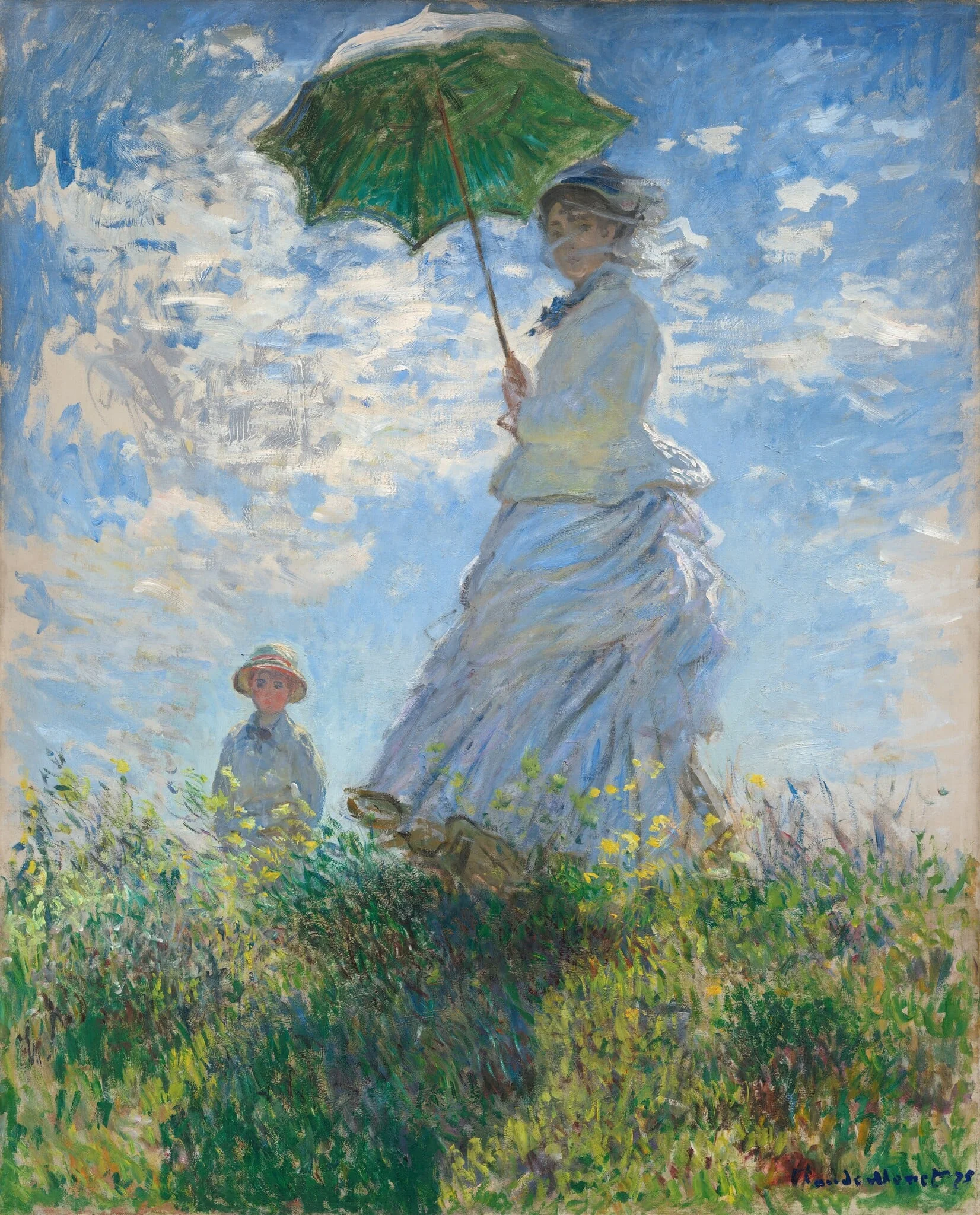
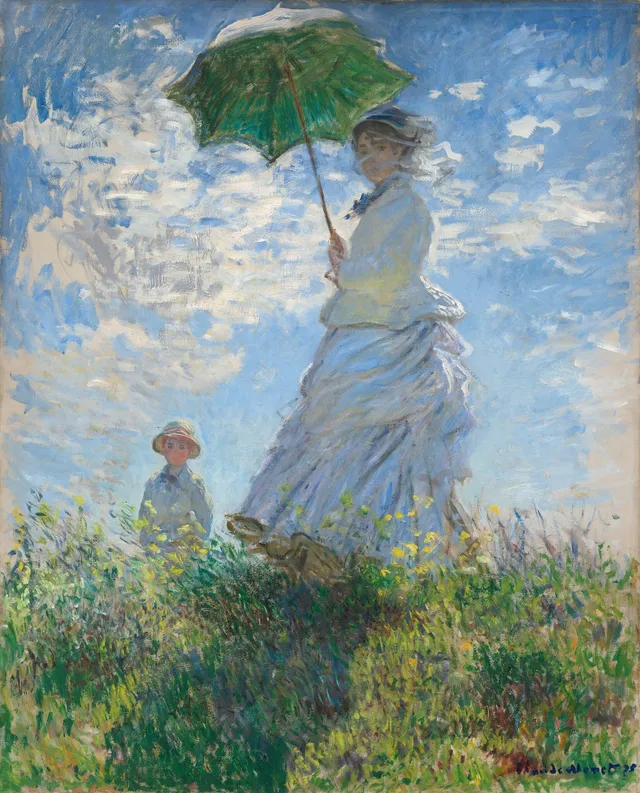
Stand in front of Monet's Woman with a Parasol, Madame Monet and Her Son and you can see the bet being placed. Monet sets the viewpoint low, on the ground, so his wife Camille rises against open sky and a few hurried clouds. There is almost no landscape to anchor her, only a green slope flecked with quick yellow-white touches for grass and wildflowers, painted so loosely the field reads as wind more than meadow. Her dress balloons to the left, her veil streams the same way, and the parasol tilts to catch the breeze that is plainly moving the whole picture. The boy stands lower and farther back, cut off by the rise, more than half hidden so the eye keeps returning to her.
Now look at her face, which is the part a Salon painter would have labored over. Monet leaves it in shadow under the parasol and tints that shadow green and violet, the colors of light bouncing up off the grass, not the flesh tones a jury expected. There is no firm contour anywhere. The hem of the dress and the grass exchange the same strokes; figure and field are made of one substance, which is paint moving fast while the light lasted. The whole canvas is a wager that a buyer will accept a picture that looks made in twenty minutes and means to. That buyer was not the state. It was a private collector who wanted his own weather on his own wall, and the looseness that the Salon read as failure is exactly what that collector was learning to want.
The dealer who absorbed the risk
A private market needs a middleman willing to carry stock through years of doubt, and the Impressionists found one in Paul Durand-Ruel. He did the thing dealers are supposed to fear: he bought deep, held, and waited. He took Monet, Pissarro, Sisley, Renoir, and Degas onto his books, sometimes buying canvases by the armful, often when there was no immediate buyer in sight. He paid stipends that functioned as advances against future sales, which meant a painter could keep working without a Salon medal or a state commission. He was effectively converting his own credit into the artists' freedom.
This was not charity and it nearly ruined him. For long stretches the inventory did not move, and a glut of unsold Impressionist pictures sat in his Paris gallery as a liability rather than an asset. He borrowed against his stock and ran the business close to insolvency more than once. The market that eventually rescued him was not even French. American collectors, primed by exhibitions Durand-Ruel sent across the Atlantic in the 1880s, began buying the work the Paris bourgeoisie still hesitated over. The story usually told as French artistic triumph was, in its decisive financial chapter, an export rescue. The paint dried in Argenteuil; the checks that made it pay often came from New York and Boston.
Around the dealer stood the critics who supplied the language a buyer needs to feel intelligent about a purchase. Théodore Duret, himself a collector, published Les peintres impressionnistes in 1878, a short, sympathetic account that took Monet, Sisley, Pissarro, Renoir, and Berthe Morisot seriously as a coherent group years before the public did. A pamphlet like Duret's does quiet commercial work. It hands a hesitant patron a vocabulary, a roster, and the reassurance that the pictures already have a history. The full text survives and can be read today; it is listed in the references below.
Who paid: the bourgeois interior
Edgar Degas is the sharpest case. He disliked the term Impressionist and never painted out of doors by preference, yet he exhibited with the group in nearly every show and shared its central project: the modern present, caught from an unexpected angle. His patrons wanted the spectacle of the modern city, and he gave them its labor.
His The Dancing Class is a picture about work disguised as a picture about grace. The floor rakes up steeply, the way a real rehearsal room looks when you stand at its edge, and the dancers are scattered off-center: one adjusts a slipper, others wait, a few sag at the margins while the ballet master commands the open middle. Degas builds the composition the way a photographer crops, leaving dead space where a Salon painter would have centered a heroine. The ballet was a marketplace too, and his buyers knew it. They were the men who subscribed to the Opéra and could read this room as both an entertainment and an industry.
A different register of the same patron world shows in Henry Lerolle's The Organ Rehearsal. Lerolle moved in the same circles and was himself a collector who bought Degas and Renoir, and the canvas is a portrait of his own world: a gallery loft, a singer at the rail, an organ filling the height of the church with sober grey light. It is more finished than a Monet, more anchored, a reminder that the buyers of Impressionist painting were rarely radicals. They were cultivated professionals who wanted modern life rendered with feeling, and the loose Monet and the polished Lerolle could hang in the same apartment without quarreling.
Cross the Atlantic and the buyer himself comes into the frame in Seymour Joseph Guy's The Contest for the Bouquet, which shows the family of the New York collector Robert Gordon at play in their own dining room. This is the buyer photographed, in effect: the panelled walls, the children, the comfortable interior that the new art was meant to furnish. Guy was a genre painter rather than an Impressionist proper, and that is the point. He marks the outer edge of the same patron class, the moneyed household whose appetite for modern pictures of its own life paid for the whole enterprise on both sides of the ocean.
Works discussed in this article
The American account
An American landscape such as Jasper Francis Cropsey's The Valley of Wyoming belongs to the Hudson River tradition, a grand panoramic view sold to patrons who wanted the American land rendered as moral spectacle. Set it beside Monet and the difference is a difference of finish and of intent: Cropsey itemizes every distant tree, where Monet would have dissolved the lot into a green murmur. Yet both men were solving the same problem, which was how to make a landscape a private buyer would pay to live with.
Closer to the French mood is Alfred Thompson Bricher's Marine Landscape, a quiet stretch of coast and water painted with a restraint that edges toward the broken light the Impressionists were after. American collectors who bought Bricher were being trained, picture by picture, to enjoy exactly the qualities Durand-Ruel was about to ship them from Paris. The taste did not arrive overnight from abroad. It was cultivated at home first, and the French imports landed in a market already softened up.
Our own Artifact World Gallery holds 24,436 works gathered under the Impressionism heading, spread across 173 venues and credited to 4,148 artists, with dates running from roughly 1500 to 1950. Read those numbers against the historical fact and a tension appears. The movement was a company of about thirty exhibitors in 1874. The catalogue of works that now travels under its name is a vast, loosely bordered field of more than four thousand hands, most of them never near the Boulevard des Capucines. The market that the original cooperative invented turned out to be far larger and far hungrier than the cooperative itself, and the wide net of attribution is the long financial echo of that first rented room.
What the money explains about the paint
Once you hold the two histories together, the optical one and the financial one, several familiar puzzles resolve. Why are the canvases so often small and quick? Because a cooperative selling to private apartments needs work that fits an apartment and a modest budget, not a museum wall. Why the suburban riverbanks, the gardens, the rehearsal rooms? Because that was the buyer's own life, and people pay to see themselves reflected back with a little glamour. Why the unfinished surface? Because, freed from the jury, the artists could let the speed of the making stay visible, and because a market was being taught to read that speed as freshness rather than failure.
Monet was a brilliant tactician of his own market as well as a great painter, and the two facts are not in competition. He chose subjects that sold, cultivated the dealers who could carry him, and timed his shows against the Salon. The looseness of his hand and the shrewdness of his career are the same disposition seen from two sides. To admire the first while ignoring the second is to read only the top line of the ledger.
The eight group exhibitions ended in 1886. By then the cooperative had done its work and could dissolve, because the thing it was built to replace had been replaced. A painter no longer needed the Salon, because a system of dealers, critics, private collectors, and an American export market now did the job the state had once monopolized. That is the durable invention. The brushwork is what we frame and reproduce, but the structure underneath it, the artist-run market for modern pictures, is the part that outlived the men who built it and still organizes how new art reaches a wall today.
Sources & further reading
- Impressionism: Art and Modernity (Heilbrunn Timeline of Art History) — The Metropolitan Museum of Art
- Impressionism (art term) — Tate
- First Impressionist Exhibition — Wikipedia
- Impression, Sunrise — Wikipedia
- French Impressionism — Rijksmuseum
- Théodore Duret, Les peintres impressionnistes (1878) — Internet Archive
- Claude Monet, Sunrise (Marine), c. 1872-73 — The J. Paul Getty Museum