The Pre-Raphaelite movement is usually told as a birth story: seven young men, one borrowed room, a private vow against the slick varnish of academic painting. That story is true, and it is also the least interesting thing about them. What makes the Pre-Raphaelites worth a second look is not where they started but how badly they kept to the plan. The doctrine they signed in 1848 had almost reversed itself within fifteen years, and the people who carried it furthest were often people who never sat in that first room.
My argument is simple. The Pre-Raphaelite movement reads best not as a style but as a relay, a thing defined by its handoffs. Each time the work passed to a new hand, a new city, or a new decade, someone quietly rewrote the rules and kept the name on the banner. Truth to nature became reverie. Hard noon daylight became candlelight and mirror-glass. A rebellion against decorative prettiness became, in the same men's later hands, the headwaters of beauty pursued for its own sake. Follow the label as it travels and you watch a single flag fly over four or five different armies. The interesting history is the transit, not the founding.
A secret society on Gower Street
In the autumn of 1848, three students at the Royal Academy met at the Millais family house on Gower Street in London and agreed to form a society they would keep hidden from the very institution that trained them. The three were William Holman Hunt, John Everett Millais, and Dante Gabriel Rossetti. They were not alone for long. The full brotherhood ran to seven: the three painters plus Rossetti's brother William Michael, the sculptor Thomas Woolner, the painter James Collinson, and the critic Frederic George Stephens, who together intended to keep the group's existence secret from the Academy's senior men, per the founding account. A society of seven, only four of whom painted seriously, is already a clue that this was never going to behave like a tidy school.
The name was a provocation aimed at a man three centuries dead. The Academy held up Raphael as the high terminus of art, the figure after whom a student needed only to inherit and refine. The Brotherhood planted itself before him: the name signalled their opposition to the Academy's promotion of the Renaissance master, as the Tate's definition puts it. What they wanted on the far side of that refusal was a kind of seeing scrubbed clean. They meant to strip away the studio habits piled up since the Renaissance and look at the world again with the plainness of painters working before Raphael had taught Europe how a picture was supposed to balance, an aim Smarthistory describes as a deliberate return to the directness of earlier art.
They even floated a magazine to carry the gospel. The Germ ran four numbers, January to April of 1850, then folded when the money ran out. Four issues is a short shelf for a revolution. The early subscribers were largely friends and family, and the unsold copies sat in a shop until the cause moved on without them. But the brevity is the point of this essay: the Brotherhood was already a moving target, dispersing almost as soon as it cohered, and its ideas survived precisely because they refused to stay put.
Truth to nature, and what it cost
The early method was severe and a little fanatical. The Pre-Raphaelites painted thin, bright colour over a wet white ground so the canvas seemed lit from inside. They observed every leaf and pebble as if a careless brush were a moral failing. They dragged easels into real fields and sat through real weather. The doctrine, compressed to a slogan borrowed from the critic who soon championed them, was truth to nature, and it carried a Victorian seriousness about subject as well as surface. A painting was meant to teach, to shame, to confront. This is the phase most people picture when they hear the word, and our own collection leans on it: Millais alone accounts for the largest single body of work we file under the movement.
You can still feel that discipline in his Portia, a later costume piece that keeps the early loyalty to fabric and fact. Millais gives the Shakespearean heroine to us almost frontally, a single figure who fills the frame, and he spends his real attention on the brocade. The patterned gown is built thread by thread, the gold catching where a body turns beneath it, and the face is handled with the same forensic patience as the cloth. Look at the hands and the small object she holds and you find no shortcut, no passage allowed to go soft. There is no atmosphere to hide in. The light is even and unforgiving, and the woman is asked to hold still and be looked at the way the early Brotherhood asked everything to hold still and be looked at. It is portraiture as inventory, and it is beautiful in a way that has nothing to do with charm.
That severity had a cost. Truth to nature is exhausting, and it is also a young person's creed. The Academy's senior critics mocked the early canvases as ugly and stiff, and the Brotherhood's most famous early defender had to fight the reviews on their behalf. Within a few years the seven had scattered into marriage, illness, emigration, and disagreement. The society as a society was effectively finished by the early 1850s, which the Met's Heilbrunn essay notes as the dissolution date. The doctrine did not die with the club. It walked out the door and went looking for new bodies.
Rossetti turns the door inward
The sharpest turn in the relay belongs to Rossetti. By the 1860s he had stopped pretending to care about a wet meadow at all. The man who had once signed a vow about observed nature now painted airless interiors crowded with a single beautiful woman and a freight of symbolic flowers. The change is so complete that you could mistake it for a different artist, and in a sense it was: this is the Rossetti who fathered Aestheticism and pushed English painting toward the cult of beauty that the next generation would carry to extremes.
Look at his Lady Lilith. A woman sits combing an immense fall of hair, her white shift slipping off one shoulder, and she does not look at us. She looks at herself in a small hand mirror, lost in the loop of her own reflection. Roses press in from the left, a candle gleams, and a second mirror behind her holds a sliver of green woodland that the airless room has otherwise shut out. Everything is surface and scent. There is no story being told, no moral lesson queued up, no event about to happen. The picture is built to be gazed at, and it is about a woman who gazes only at herself. Set that beside the 1848 program and the betrayal is total. Truth to nature has become truth to nothing but desire. The hard outdoor daylight of the early canvases has been traded for a heavy interior glow, and the figure who once had to teach now exists purely to be wanted.
This is what I mean by transit. The label did not soften or evolve in a straight line. It crossed a decade and arrived at its own opposite, and it kept the same name the whole way. A movement founded to scrub painting clean of accumulated artifice became the engine of a new and gorgeous artifice. Anyone who tries to define Pre-Raphaelitism by a fixed set of traits has to choose which Rossetti to believe, the one who knelt in the grass or the one who locked the door.
The second relay: associates, classicists, and a label that stretches
By the time Rossetti reached his femme-fatale phase, the word had stopped describing a club and started describing a temperature. Painters who never took the vow worked in adjacent registers and got swept under the same heading. Frederick Sandys, a close associate of Rossetti's, took the same hypnotic woman and rendered her with the crisp precision of a steel engraver. His Susanna Anderson Rose shows how the manner could be cooled into society portraiture without losing its decorative charge. Frederic Leighton pulled in a different direction entirely, toward Greece and Rome rather than the medieval north, and yet his Lucia sits comfortably in the same room of taste. Even a classicist like Lawrence Alma-Tadema gets pulled into the Victorian gravity well the movement created.
Leighton's Lucia is worth pausing on, because it shows the relay turning south. He gives us a single woman absorbed in her own thoughts, painted with a polished classical finish that sands away every last trace of the early plein-air roughness. The brushwork has gone invisible. Where Millais wanted you to count threads, Leighton wants the surface to read like cool enamel, all friction wiped off. The subject has migrated from the biblical and medieval to the Mediterranean, and the moral charge of the 1848 program has thinned into pure poise. It is the same temperature as Rossetti's locked rooms, reached by a different road, and that convergence is exactly what makes the single label so slippery.
Our archive makes the drift measurable. Artifact World Gallery holds 204 works filed under Pre-Raphaelite, spread across 31 venues and made by 68 different hands, with dates running from roughly 1800 to 1920. Hold that against the founding facts. The Brotherhood proper had seven members and was finished as an organisation inside five years. The label, as the collection actually files it, covers more than a century of production and a cast roughly ten times the size of the original club. The gap between those two numbers, seven men on Gower Street and sixty-eight artists in the database, is not an error. It is the history. The movement is large in the record precisely because it kept being handed onward to people the founders never met, in cities they never worked, decades after the vow had lapsed.
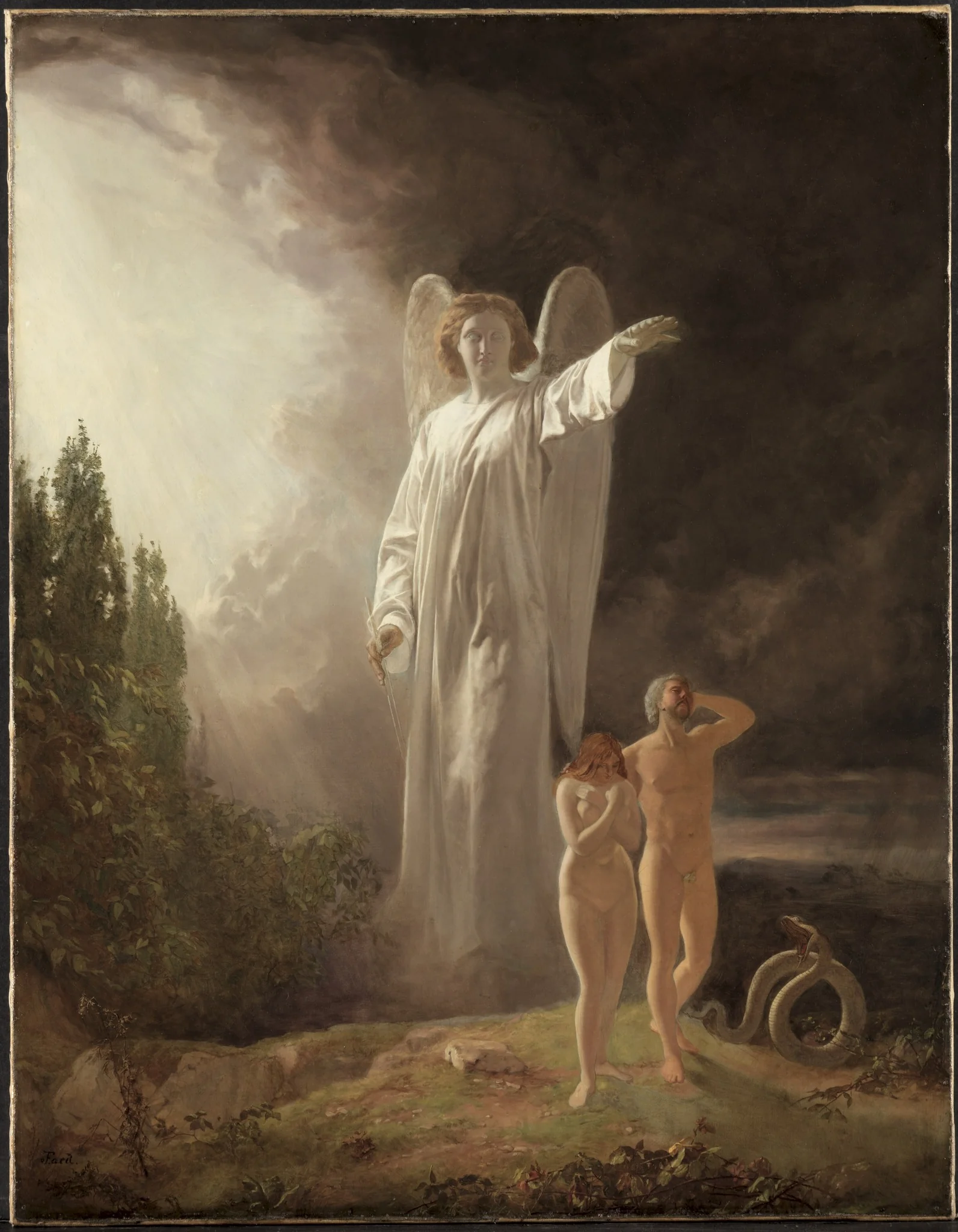
The Scottish painter John Faed is a small case of that geographic reach. His Expulsion of Adam and Eve keeps the Brotherhood's appetite for biblical narrative and minutely observed flesh and foliage, but it was made away from London, in a different artistic culture, by a man working a parallel track. The picture pushes its first couple toward us in clear, sculpted light, the bodies modelled with a hardness that belongs to the early Pre-Raphaelite instinct rather than to Rossetti's later haze. The serious religious subject, long out of fashion in the metropolitan avant-garde by then, survives here as a regional inheritance. That is the relay again. An idea generated in one room keeps living wherever it gets carried, often after the room itself has gone quiet.
Works discussed in this article
Across the water and into another medium
The longest leg of the journey was geographic and institutional, and it happened long after every Brother was dead. For most of the twentieth century the Pre-Raphaelites were a British taste, slightly embarrassing to a modernist establishment that prized abstraction over storytelling. The rehabilitation came slowly, then formally. In 2013 the National Gallery of Art in Washington mounted Pre-Raphaelites: Victorian Art and Design, 1848-1900, organised with Tate Britain and billed as the first major survey of the movement ever shown in the United States, per the exhibition record. An art conceived as a local English quarrel had to wait a century and a half to be seen whole on the other side of the Atlantic. The transit had a literal ocean in it.
The movement also travelled across media, which is where its afterlife gets genuinely strange. The Getty Museum's exhibition The Pre-Raphaelite Lens set Pre-Raphaelite painting beside early British photography of the same years, arguing that the painters and the first art photographers shared a way of looking, a hunger for sharp detail and staged narrative, as the Getty's account lays out. The brotherhood that defined itself against one old technology, academic oil painting after Raphael, turns out to rhyme with the newest technology of its century. The truth-to-nature creed, transposed onto a glass plate, looks less like a relic and more like a prophecy of the camera's own claim to honesty.
So what was Pre-Raphaelitism, finally? Asking for one definition is the wrong question, and the archive is what convinced me of it. A movement that produced both the forensic daylight of an early Millais and the locked-room reverie of a late Rossetti, that crossed from London to Scotland to Washington to a photographer's studio, that began as a secret and ended as a brand, cannot be pinned to a list of traits. It can only be tracked. The honest way to read these painters is to stop looking for the thing they all shared and start watching what each new pair of hands did to the inheritance. The banner stayed the same. Everyone underneath it kept changing what it meant, and the next leg of that relay is already hanging, unnoticed, in some regional museum, waiting for a visitor to pick it up and carry it forward again.
Sources & further reading
- Pre-Raphaelite (art term) — Tate
- Pre-Raphaelite Brotherhood — Wikipedia
- A beginner's guide to the Pre-Raphaelites — Smarthistory
- The Pre-Raphaelites (Heilbrunn Timeline of Art History) — The Metropolitan Museum of Art
- Pre-Raphaelites: Victorian Art and Design, 1848-1900 — National Gallery of Art
- The Pre-Raphaelite Lens: British Photography and Painting, 1848-1875 — The J. Paul Getty Museum
- The Germ (facsimile reprint) — Internet Archive