The National Museum of Art of Romania in Bucharest sits inside a building that was never meant to be a museum, and that fact tells you most of what you need to know about it. Nothing here arrived in its final form. The palace on Revolution Square began as a private mansion. The painters whose canvases fill its modern galleries began as students sent abroad. The collection itself was once scattered, then wounded, then put back together. This is a place of arrivals that turned into something else on the way.
Take that motion as the subject and a thesis follows, one a little against the grain: the museum is not best read as a fixed treasury of national genius. It is better read as a ledger of transit, a record of how forms, people, and the structure itself changed shape on the road to becoming Romanian. The French academy enters and comes out as a winter field near Bucharest. A boyar's town house enters and comes out as a national institution. Read the museum this way and its quieter holdings, the still lifes and park views and small soldier portraits, stop being minor. They become the evidence.
A building that kept changing its mind
The museum dates its founding to 1948, when the postwar government turned the former Royal Palace into a public collection holding roughly 70,000 works. Its own history records that lineage. The palace gives the place its grandeur and its awkwardness in equal measure. It is long, neoclassical, and built for a court rather than for hanging pictures, which means the institution has spent its life adapting rooms designed for receptions into rooms designed for looking.
That adaptation runs deeper than the monarchy. The structure grew out of the Golescu Mansion, raised between 1812 and 1815 for the boyar Dinicu Golescu, and it has sheltered the national art collection since 1950, as the palace's building history confirms. A private house became a princely residence, the residence became a royal palace, and the palace became a museum. Each change kept the bones and replaced the purpose. By the time the paintings arrived, the walls had already rehearsed the museum's central habit. Keep the shell. Change what it is for.
It is worth pausing on how unusual that continuity is. Most national museums are purpose-built declarations, halls designed from the foundation up to say that a nation has arrived and intends to display its arrival. This one inherited its dignity from a family residence and a throne room. The ceilings were sized for chandeliers and protocol, not for the even north light a curator wants. So the hanging has always been a negotiation with architecture that has its own opinions. A picture in these rooms is never quite the autonomous object the modernists wanted it to be. It is a guest in a house that remembers other uses, and that tension between the courtly container and the democratic collection inside it is the first thing a careful visitor feels.
The road to Paris and back
The collection's deepest pattern is a journey that ambitious young Romanians made all through the nineteenth century: the journey to Paris and home again. The clearest case is Nicolae Grigorescu, whom the standard accounts call one of the founders of modern Romanian painting and who won a state scholarship in 1861 to study at the École des Beaux-Arts, according to his biography. He set out toward the French academy and drifted to Barbizon, painting peasants and oxcarts and the low, flat light of the Romanian countryside. The training was foreign. The result was not.
He was neither alone nor first. Theodor Aman had already made the same crossing, and in 1864 he persuaded the ruler Alexandru Ioan Cuza to found the National School of Fine Arts in Bucharest, becoming its first director. The École that drew them was the French national school whose lineage reaches back to the Académie Royale de Peinture et de Sculpture, founded in 1648, an institution built to standardize taste across a kingdom. What the Romanians did with that standard is the part worth watching. They took the academy's discipline, its drawing, its sense of finish, and aimed it at subjects the academy would have filed as provincial: a frozen lane, a vase on a side table, a conscript in a grey coat.
The structure of that schooling matters, because it was designed to produce a very particular kind of picture. A student at the École learned to draw from casts before he touched paint, to build a figure from a memorized vocabulary of anatomy, to finish a surface until the labor disappeared. The reward at the top was the history painting, the grand machine staged for a salon jury. A Romanian who absorbed that system and then turned it on a snowbound village road was committing a quiet act of redirection. He kept the rigor and dropped the hierarchy of subjects. The thing the academy treated as a warm-up exercise, the modest study of a real place in real weather, became the finished statement. That inversion is the engine of nearly everything strong in the modern rooms.
Close looking: a book, some flowers, and the refusal of depth
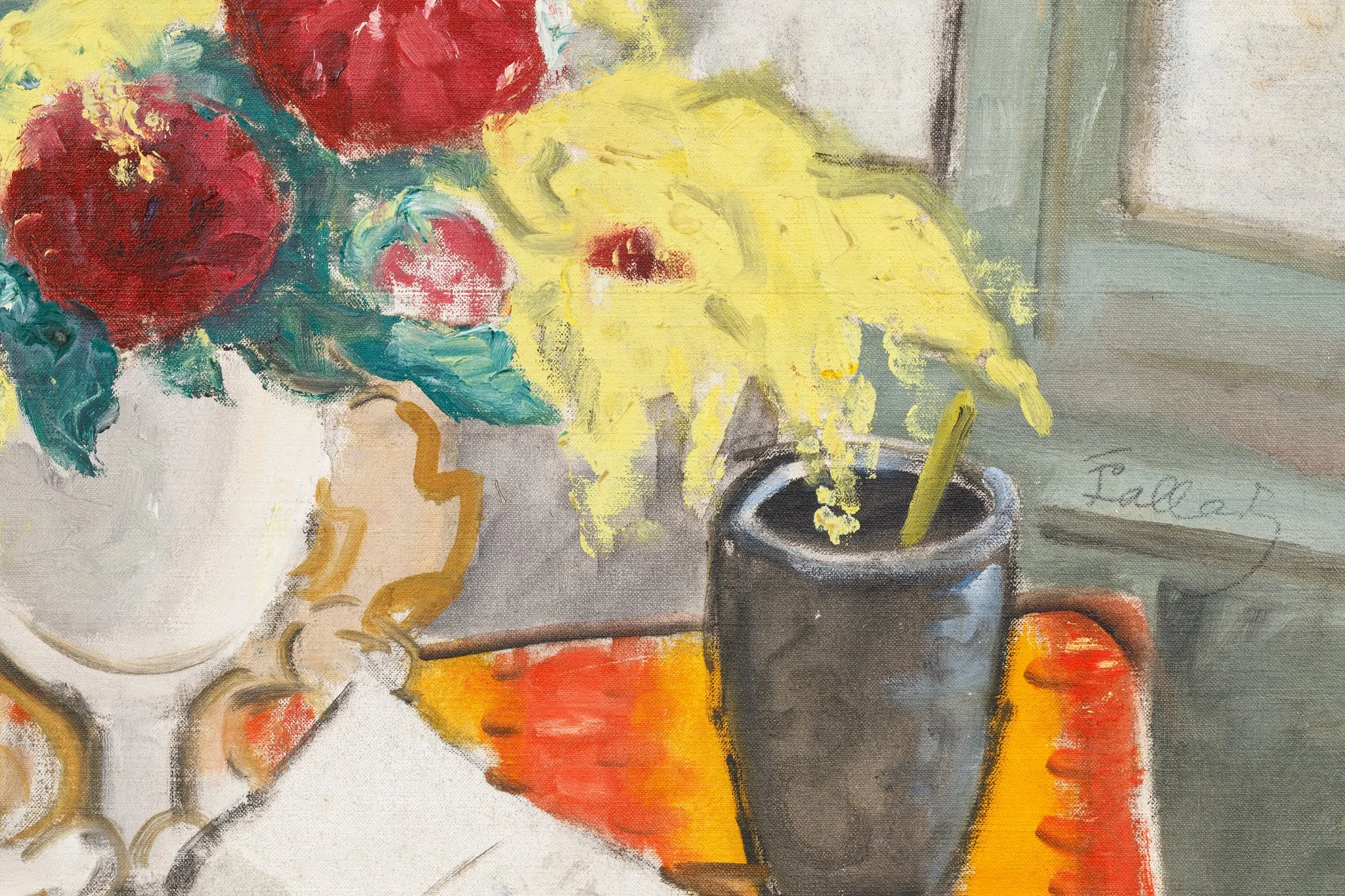
Stand in front of Theodor Pallady's Natură moartă cu carte și flori and you can read the whole argument of the modern Romanian rooms in one frame. A closed book lies flat on the table. Beside it a slim arrangement of flowers stands in a vessel, drawn rather than rendered, its blooms registered as a few decisive marks instead of botanical fact. The palette is held back, ochres and chalky greys and a muted green, nothing that raises its voice. What grabs you is the table. It tips up toward the picture plane so that the surface reads less as a place objects rest on and more as a field they are pinned to.
This is the French inheritance turned to a Romanian temperament. Pallady, who kept company with Matisse in his Paris years, trusts contour the way an academician was taught to trust modeling. The book's edges are firmer than its volume. The flowers sit a hair too forward, the way a bottle does in a Cézanne. He is not staging a corner of a room for our admiration. He is composing a flat thing that happens to be made of a book and some flowers, and the austerity is the point. A painter who wanted to dazzle would have given you reflections on the vase. Pallady gives you the line where the table meets the wall and asks you to find that enough.
Spend another minute with the surface and the restraint starts to look like a wager. There is no anecdote to soften the picture, no open page with legible print, no petal browning at the edge to cue a meditation on time. Pallady strips away the props that a lesser still life uses to feel meaningful and bets that the placement of two objects on a tilted plane can carry the weight on its own. The flowers are barely a bouquet, more a notation of one. The book refuses to be read. What is left is design: the interval between the two masses, the way the warm tabletop pushes the cooler wall back, the single firm contour that keeps the whole thing from sliding. It is a small painting that has decided exactly what it will and will not do, and that decisiveness is rarer than virtuosity.
What our archive shows
This is where our own holdings earn their keep. Artifact World Gallery keeps 2,727 works tied to this single venue, made by 544 different artists, with dates running from roughly 1250 to 1993. Set that figure against the museum's own count of about 70,000 objects and the gap is not a failure of coverage. It is a portrait of taste. A digitized sample skews toward what travels well online: easel paintings, modern names, the kind of intimate canvas that survives compression into a thumbnail. Seven centuries fold into a few hundred painters, and the densest cluster sits exactly where the Paris-and-back generation worked.
That skew is itself a finding worth stating plainly. A holding that runs from about 1250 to 1993 but concentrates its mass in the late nineteenth and twentieth centuries is telling you where the appetite for reproduction lives. The medieval icons and the decorative arts, the objects that need their gold ground and their scale to register, thin out in a thumbnail and so they thin out in the sample. The modern canvas wins because it was already built to be portable, a self-contained rectangle that a single artist signed. So the 2,727 works are less a miniature of the museum than a map of which chapter the internet finds easy to carry, and that chapter happens to be the one where the academy met the Romanian winter.
Winter does a surprising amount of the talking. Hrandt Avakian's Peisaj - iarna and Adam Bălțatu's Iarna, Peisaj carry nearly the same title and the same instinct, the plein-air impulse imported from France pointed at a Romanian freeze. Snow is a gift to a painter trained to value tone, because it strips a scene to a few greys and a hard horizon. The lesson learned under southern light gets re-tuned for a country where the light is thin for half the year. The brushwork loosens, the subject narrows, the ambition stays.
Look closely at Avakian's winter landscape and you see how much discipline hides inside the apparent simplicity. Snow is the hardest white a painter handles, because it is never actually white. It takes the blue of the sky in its hollows, the grey of cloud across its open stretches, a faint warm tone where a low sun catches a ridge. A trained eye reads those shifts and lays them down as a tonal scale rather than a single flat field, and that is exactly the academic skill of value relationships put to a humble, local use. The horizon sits low and firm, the bare trees give the one dark accent that makes the pale ground sing, and the whole picture is built on the smallest possible number of decisions. It is economy mistaken for ease.
Then there is the city itself. Micaela Eleutheriade's Vedere din Cișmigiu looks at Bucharest's central park, the Cișmigiu Gardens, and treats it as a motif worthy of the same care a French painter would spend on the Tuileries. Eleutheriade gives the park its paths and trees without fuss, a domestic patch of green made permanent. Beside her hangs work of a very different register. Max Chotiau's Soldat is a single conscript, the human cost of a century of borders that kept moving, and Carl Leopold Voss's Buchet de flori is the foreign-trained flower piece against which Pallady's austerity reads as a deliberate rebellion.
Works discussed in this article
1989 and the art of reconstitution
The hardest passage of transit this museum ever made was not geographic. It was the gunfire of December 1989. The palace stood at the center of the revolution that ended the Ceaușescu regime, on the square where the crowds gathered, and the building took serious damage. Paintings were hit. Galleries closed. The collection that had been assembled, nationalized, and rehung across four decades was suddenly a salvage operation.
Recovery was slow and deliberate. The medieval Romanian art collection, among the institution's treasures, reopened only in the spring of 2002, more than twelve years after the fighting, as the museum's record notes. A wounded museum that takes a decade to bring one wing back is not a museum that failed. It is a museum doing the unglamorous work its whole history prepared it for, which is to keep the shell and rebuild the purpose. The damage became part of the object. You cannot now look at the collection without knowing it was nearly lost.
There is a hard lesson folded into that twelve-year wait, and it is worth saying without euphemism. Conservation at this scale is not a rescue scene with a clear ending. It is years of triage, of stabilizing what can be stabilized and storing what cannot yet be shown, of deciding in what order a battered nation gets its own past back. The medieval gallery reopening in 2002 was not a return to normal. It was a verdict, the institution declaring that the oldest and most fragile part of its holdings had finally been made safe enough to face the public again. That a museum born from a requisitioned palace would spend the turn of the millennium painstakingly putting its earliest works back on the wall is the whole argument of this essay compressed into a single act of repair.
The traveler who never fully came home: Brâncuși
No figure tests the lens of transit harder than Constantin Brâncuși, the Romanian-born sculptor whose work the modern collection represents at home even as the rest of the world claims him. Brâncuși left for Paris and stayed, and the major versions of his signature forms live abroad. The Metropolitan Museum of Art owns a version of Bird in Space, and the National Gallery of Art in Washington holds another. The sculptor who carried a Romanian sense of the carved block into the twentieth century did his most decisive traveling in the opposite direction from Grigorescu. He went out and the work did not come back.
What he carried with him is visible in his early masterwork The Kiss, where two figures are reduced to a single roughly squared mass with the marks of direct carving left in. The block stays a block. Smarthistory's scholarly essay on the sculpture reads that retained materiality as the heart of his method, and it is also the most Romanian thing about him, an instinct for the honest stone that connects a Paris modernist to the carved crosses and gateposts of the countryside he came from. The museum's claim on Brâncuși is partly aspirational, a national institution insisting on a son the art market scattered. That insistence is its own kind of evidence for the thesis. Identity here is something asserted across distance, not something the building simply contains.
Set The Kiss beside Bird in Space and you can watch a single conviction travel a long way without breaking. The early carving keeps the figures lodged in their stone, the kiss pressed flat into the block so the material never lets you forget it. The later bird is polished to a gleam that seems to deny weight entirely, a thin upward sweep of bronze that wants to read as flight rather than metal. The two look like opposites, yet they answer the same question. What is the fewest forms a thing can be reduced to and still be itself? The version of Bird in Space that the Met and the National Gallery hold is the point at which that reduction left Romania for good, refined in a Paris studio and bought by foreign collectors. Bucharest keeps the earlier, rougher conviction and the claim of origin. The world keeps the polished result. The argument over who owns Brâncuși is, in the end, an argument about where a Romanian idea stops being Romanian, and the museum's answer is that it never does.
Walk the modern rooms with all of this in mind and the through-line is legible. The same French training that produced polished salon machines in Paris produced, in these hands, a snowbound lane, a closed book, a park in Bucharest, a soldier who will not meet your eye. The discipline crossed a border and the subjects stayed local. That is the conversion the museum exists to document, and it is why the small pictures matter as much as the famous ones.
Browse the gallery's holdings for this venue and you can follow that conversion painting by painting: a generation that went looking for a foreign rulebook and brought home a way of seeing its own winters. Start with Pallady's tilted table, move to the snow fields, and watch where the road bent.
Sources & further reading
- National Museum of Art of Romania — Wikipedia
- Royal Palace of Bucharest — Wikipedia
- Nicolae Grigorescu — Wikipedia
- Constantin Brâncuși, The Kiss — Smarthistory
- Theodor Aman — Wikipedia
- École des Beaux-Arts (art term) — Tate
- Pictorul Nicolae Grigorescu (Alexandru Vlahuță) — Internet Archive
- Bird in Space (Constantin Brâncuși) — The Metropolitan Museum of Art
- Bird in Space (Constantin Brâncuși) — National Gallery of Art