The Metropolitan Museum of Art's painting collection is usually praised for its breadth, as if breadth were the point. Walk its European and American galleries in roughly the order the pictures were made, though, and a different story comes forward. The collection records a slow change in what painters thought a painting was for. The earliest works try to be a clear window onto a world that already exists. The latest ones behave like built objects that announce their own making. Composition stops describing a scene and starts arguing one. Light stops being illumination and becomes structure. Paint stops hiding and starts confessing that it is paint.
That change is the thesis of this essay, and the Met is an unusually honest place to test it, because the museum was assembled backward. It did not inherit a royal collection and then defend it. It bought its way into history, decade by decade, with the result that the galleries hold both the conservative taste of its founders and the very pictures that broke that taste. Artifact World Gallery holds 10,888 works tied to the Met, made by 2,532 artists and spanning from roughly the year 1000 to 2000, which is wide enough to watch the formal break happen in slow motion rather than as a single Parisian thunderclap. Read the holdings as a sequence and the museum turns into an argument about form, told mostly by accident.
A museum assembled backward
The institution was incorporated on April 13, 1870, and opened first not in a palace but in rented rooms, the Dodworth Building at 681 Fifth Avenue, according to the museum's own history (metmuseum.org). Its first acquisition was a Roman sarcophagus, taken in that November. Within a year the trustees bought 174 European paintings in a single stroke, a purchase that brought in Anthony van Dyck, Nicolas Poussin, and Giovanni Battista Tiepolo before the museum had a permanent wall to hang them on. The taste on display in that founding purchase is telling. It favored finish, narrative clarity, and the grand manner. The men who built the place wanted Old Masters who behaved.
The building caught up with the ambition only later. The first portion of the current structure on the eastern edge of Central Park went up in 1880, and the collection is now split across seventeen separate curatorial departments, a scale that makes coherent looking difficult and makes thematic looking necessary. The Beaux-Arts facade and the Great Hall that most visitors think of as the Met, designed by the founding trustee and architect Richard Morris Hunt, did not open to the public until December 1902. Hunt's front is a classical argument in limestone, and it matters to the pictures behind it. A museum that announces itself with paired columns and a triple arch is telling you, before you reach a single canvas, that order and the antique are the standard against which everything inside will be measured. The formal break we are tracking is partly a break against that very building.
Composition as argument
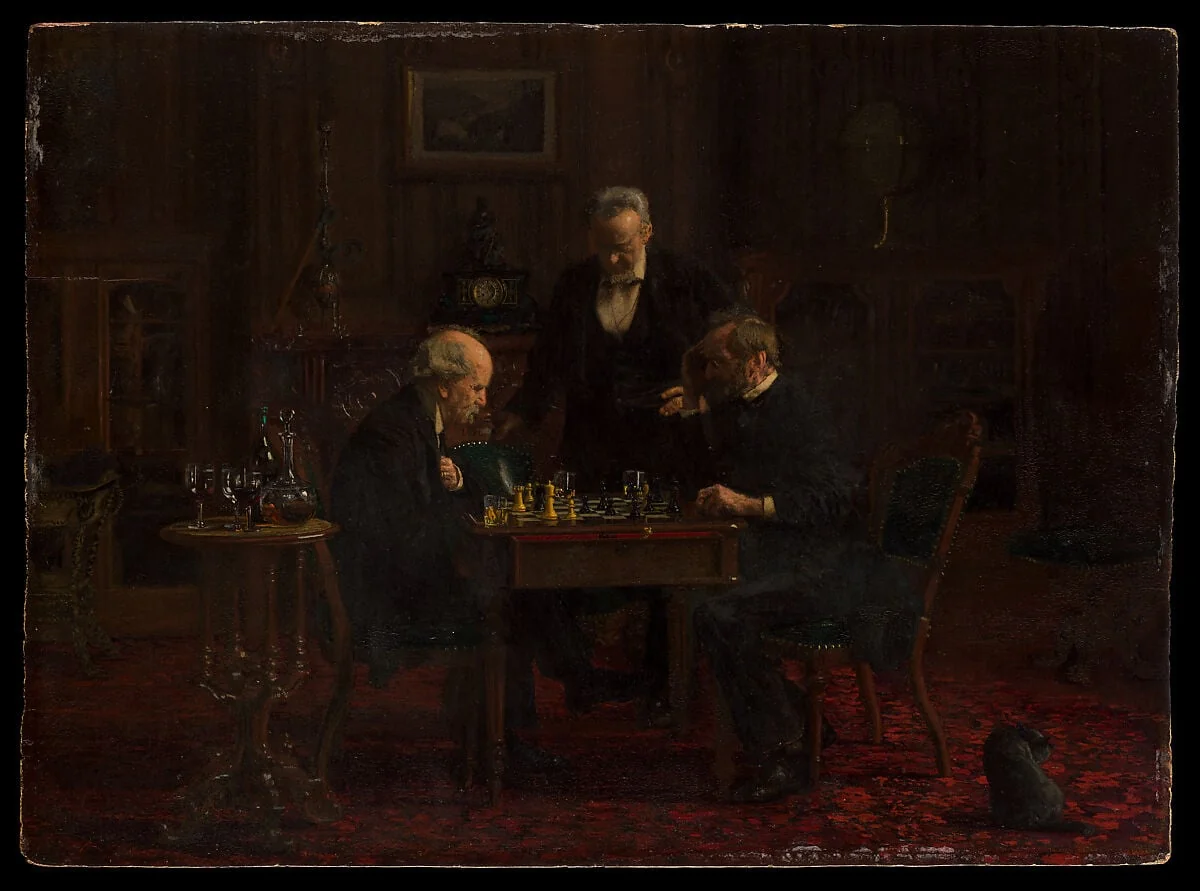
Start with composition, because that is where the break is easiest to see and hardest to fake. A conventional picture arranges its parts to lead the eye comfortably to a subject. A modern one arranges its parts so that the arrangement itself carries the meaning. Thomas Eakins sits exactly on that hinge, and his The Chess Players is a small panel that thinks like a large one.
Look at what is actually in it. Three men gather at a small table in a dim room. Two are seated and bent over the board, their faces lit from a low warm source, while a third, the painter's father, stands behind and leans in with one hand near the table edge. The chessboard tilts up toward us a few degrees more than strict eye level would allow, so that the pieces read as a legible diagram rather than a foreshortened blur. The brass and the polished wood throw small hard highlights. A white cuff and a pale collar catch the light and become the brightest notes in a field of mahogany browns and bottle-deep shadow. Everything not essential has been pushed into darkness. The rug, the wall, the far corners dissolve, and what remains is a triangle of attention with the board at its base and the standing father at its apex.
This is the work of a man who studied perspective the way an engineer studies load. Eakins did not let the scene assemble itself. He built the depth, then tilted the board to defeat it slightly, because a perfectly receding board would have hidden the game and the game is the subject. The composition is the argument. It says that thought is physical, that two old men over a chessboard are a structure under tension, and it says all that before you read a single facial expression. Of the nineteen Eakins paintings in this corpus, this is the one where the calculation is most visible without becoming cold.
Compositional argument runs the other direction too, outward into landscape. Thomas Cole's View from Mount Holyoke, Northampton, Massachusetts, after a Thunderstorm, the picture everyone calls the Oxbow, splits its canvas down a diagonal that is itself the meaning. On the left, storm-wracked wilderness, blasted trees and dark cloud. On the right, the sunlit cultivated valley with the Connecticut River curling into its famous loop. Cole puts a tiny self-portrait at the bottom, an easel and a painter turning back to face us from the divide. The composition is a thesis about America between wild and tamed, and it is delivered by geometry, not by anecdote. This is the founding grammar of the Hudson River School, and the Met holds eleven Cole paintings that let you watch a national landscape style learn to argue with its own layout.
Compare both to a quieter American genre scene, Francis William Edmonds's The New Bonnet. Here the composition still serves the story. A domestic interior, a woman showing off a hat, an older man's skeptical glance, props arranged so the narrative reads left to right like a sentence. Nothing tilts to make a point. Set it beside the Eakins and you can feel the difference between a picture that illustrates a moment and a picture that engineers one. Both hang under the same roof, which is the gift of a collection assembled backward.
Light as structure
The second strand of the break is light. For centuries light in painting was a service. It revealed form, modeled flesh, told you the time of day. Then certain painters discovered that light could be the form, that you could build a picture out of where the brightness goes and let the rest fall away. Georges de La Tour, working in Lorraine in the early seventeenth century, is the museum's purest early example. His The Penitent Magdalen gives you a single candle and very little else.
What is in that canvas is almost shocking in its economy. A young woman sits in profile, one hand resting on a skull in her lap, her face turned toward a flame we partly see through her fingers and partly read only by its effect. The candle does not just light the scene. It organizes it. Her forehead and the curve of her cheek glow; the far side of the room is pure black; a mirror picks up a second, doubled flame and quietly extends the meditation on vanity. La Tour models the whole figure with a single warm gradient running from incandescent to nothing. Remove the candle and there is no picture, only darkness. That is light as structure, two centuries before the Impressionists are usually credited with the idea.
Move forward to Edgar Degas and the same principle turns cool and modern. The Dancing Class floods a rehearsal room with flat grey daylight from high windows, and Degas uses that even light to do something a spotlight never could. He scatters the dancers across an off-center floor, crops figures at the frame, and leaves a great diagonal of bare boards in the lower foreground where a more conventional painter would have placed his subject. The light is democratic, falling equally on the principal dancer and on a girl scratching her back in the corner. Composition and light work together here to make the room feel observed rather than staged, as if we have walked in mid-lesson. The Met's nineteenth-century French holdings let you place this next to its sources and see how radical the ordinariness was.
Henry Lerolle's The Organ Rehearsal is the instructive near-miss. It is a large, ambitious church interior with figures gathered at an organ loft, bathed in a soft tonal light that Lerolle handles with real skill. Yet the picture still wants light mainly to be atmosphere, a mood poured over a tableau, rather than the load-bearing wall of the composition. Hang it in your mind between La Tour and Degas and you see the spectrum the Met preserves: light as revelation, light as ambience, light as the structure that holds the picture upright.
The handling of paint
The third and deepest strand is the handling of paint itself, the moment the surface stops pretending to be glass and starts behaving like worked matter. The Met lets you trace this further back than most museums, because its Venetian holdings are strong. Titian is the origin point. In his late work the brushwork loosens until, up close, a sleeve or a sky reads as a storm of separate strokes that only resolve into form at a distance. He let the viewer's eye do the final mixing, and in doing so he made the act of painting visible inside the finished painting. The four Titians in this corpus, alongside the four by Paolo Veronese and the two by Lorenzo Lotto, carry the Venetian colorito tradition that argued, against Florentine draftsmanship, that color and touch were the soul of a picture rather than its decoration.
That argument lay mostly dormant for two centuries of polished academic finish, the very finish the Met's founders prized when they bought their first 174 pictures. Then Gustave Courbet picked it up and weaponized it. Courbet troweled paint on with a palette knife, building rock faces and snow and animal fur out of slabs of pigment you can read as geology before you read them as image. With twenty-seven works in this corpus he is one of the better-represented modern hands here, and his Realism was as much a revolution of the wrist as of the subject. A Courbet cliff insists that you notice it was made. The eye cannot pretend the surface is a window when the window has visible trowel marks.
Line up the three strands and the break stops looking like a single event and starts looking like a long argument the Met happens to hold both halves of. Courbet's knife, Degas's cropped grey room, La Tour's candle, Eakins's tilted board: each refuses the idea that a painting's job is to disappear behind its subject. Each insists, in a different register, that the made-ness of the thing is part of what it means. That is the formal break, and you can see it without leaving a single building.
Works discussed in this article
What the founders were buying against
It helps to remember what taste the founders carried in. The dominant standard of their education was the classicising one. Tate describes Neoclassicism as a particularly pure form of classicism that emerged from about 1750 (tate.org.uk), and that taste, filtered through the École des Beaux-Arts, is precisely what Hunt's columned facade announces. The men who bought Tiepolo and commissioned a temple front were not looking for trowel marks or cropped dancers. They wanted the antique, made legible and made grand. The pictures that broke their standard entered the collection later, and the friction between the architecture and the radical canvases inside is one of the museum's most productive accidents.
The Met also documents the deep history that makes the break legible as a break. Petrus Christus's A Goldsmith in His Shop, dated 1449 and painted in oil on oak panel, hangs in these galleries and stands near the start of the whole project of optical illusion in Northern oil painting, as Smarthistory lays out in its study of the work (smarthistory.org). The convex mirror in that panel, reflecting two figures from the street outside, is a virtuoso claim that paint can hold the entire visible world. Four centuries later, Courbet's knife and Degas's crop are answering that claim, deciding the world is better served when the paint admits it is paint. You can stand in front of the early Netherlandish room and the nineteenth-century French room in one afternoon and watch the question turn over.
The collection also carries its own internal critique. The Met's scholarship arm, the Heilbrunn Timeline of Art History, has grown since 2000 into more than 1,000 essays organized around some 8,000 works, 300 chronologies, and 3,700 keywords drawn from the holdings (the museum's Timeline), a research apparatus that lets the public read the same formal arguments this essay traces. And the institution has been challenged on whose hands get to make those arguments. The Guerrilla Girls' 1989 poster about the ratio of women artists to female nudes in the museum's modern galleries put the question of representation directly onto the Met's walls, and that poster is now itself a collected, studied object elsewhere. The break in form, it turns out, was never separable from the question of who was allowed to break it.
How to look, and where
If you want to see the argument rather than the inventory, plan a path rather than a tour. Begin in the early Netherlandish rooms with the Christus and let the convex mirror set the standard of total illusion. Cross to the Venetians and watch Titian loosen the wrist. Drop into the seventeenth century for La Tour's candle, the first time light alone carries a picture. Then take the nineteenth century in two countries at once: Cole and Eakins for composition that argues, Degas and Courbet for light and paint that refuse to disappear. The seventeen departments make a complete walk impossible in a day, so choose the through-line and ignore the rest.
The reward of reading a vast museum this way is that scale stops being intimidating and starts being evidence. Ten thousand works by twenty-five hundred hands is not a pile. Sequenced, it is a record of painting changing its mind about its own job, from window to wall, from illustration to construction. The next time someone tells you the modern break in art was a sudden Parisian rupture, send them to the chessboard that tilts a few degrees too far, and to the single candle that builds a woman out of the dark. The break was long, it was argued in paint, and the Met keeps both sides of the argument hanging in the same rooms.
Sources & further reading
- History of the Metropolitan Museum of Art — The Met
- Petrus Christus, A Goldsmith in His Shop — Smarthistory
- Neoclassicism (art term) — Tate
- About the Heilbrunn Timeline of Art History — The Met
- Metropolitan Museum of Art — Wikipedia
- A History of the Metropolitan Museum of Art (Winifred E. Howe, 1913) — Internet Archive / The Met
- Guerrilla Girls, Do Women Have to Be Naked to Get into the Met. Museum? — National Gallery of Art