Every painting of a person reading tries to draw something that has no shape. Attention is invisible. A face bent over a page tells you almost nothing about what the page actually says, and yet painters have come back to the motif for the better part of seven centuries, because a reader lets them picture an interior without having to invent an allegory for it. The question under all these pictures is single and stubborn. What is happening inside a person who reads? The answers are not single at all.
Here is the claim this essay will defend, work by work: the painted reader is never a neutral report on a quiet afternoon. The book is a lever. Depending on the century and the person paying for the picture, the same lowered eyes were made to carry devotion, desire, self-possession, idleness, or open moral danger, and the history of reading-pictures is really a history of what a culture believed reading did to the one doing it. Across the holdings at Artifact World Gallery the subject surfaces in 388 paintings, gathered from 74 venues, made by 259 different hands, the earliest dated near 1300 and the latest to 2013. That span is the argument in miniature. The gesture barely moves across all those years while its meaning keeps turning over underneath it.
The book before the novel
The first widespread image of a layperson reading is a person at prayer. From roughly 1200 onward in Western Europe, ordinary people who were neither monks nor clerics began to own personal devotional books, and the format that emerged, the book of hours, became the most copied book of the late Middle Ages (Smarthistory). These were small manuscripts built for private use and organized around prayers assigned to set hours of the day, which is where the name comes from (J. Paul Getty Museum). The object was intimate, held close, often no larger than a hand. So the earliest painted readers tend to be shown the way you would actually hold such a book: cradled, tilted toward the body, the head inclined.
You can watch the convention harden in the Northern devotional panels of the fifteenth century. In the work of Hans Memling, a Virgin or a kneeling donor will hold a small clasped volume open against a dark sleeve, the page catching a cool light, the figure's eyes already settling toward it. The book here is not a prop to indicate that the sitter is clever. It is the instrument of contact with the divine, and the reader's downcast gaze is meant to read as humility rather than absorption. This is the genre's quiet starting position: reading as a way of leaving the visible world for an hour, sanctioned and supervised by the church that produced the books in the first place.
Notice too what the medieval painter leaves out. There is no caption, no glimpse of the words on the page, nothing that lets you eavesdrop on the prayer itself. The book is turned just far enough from us that we register the act without sharing it. That reticence becomes the genre's founding rule. A reader is shown from the outside, and the painter trusts the bent neck and the steady hands to carry everything the words cannot be allowed to say. Every later variation, sacred or scandalous, works inside that constraint, which is why the motif could keep meaning new things without ever changing its basic shape.
The letter and the lover
Then the Dutch seventeenth century did something the medieval picture could not. It made reading private in a worldly sense, and it made the contents of the page a withheld secret that the viewer is invited to guess. The letter, more than the book, drove this. A letter has a specific sender. It carries news the woman holding it knows and you do not, and the whole drama of the picture becomes the gap between her composed surface and the unseen text in her hands.
Vermeer built a career on that gap, and one of his early letter pictures recently confessed how deliberate the game was. For decades his Girl Reading a Letter at an Open Window, in Dresden, showed a plain wall behind the absorbed young woman. A restoration completed in 2021 stripped away a later overpaint and found a large Cupid that Vermeer himself had painted on that wall and that someone had concealed after his death. Scholars take the recovered figure to mean what it most obviously means, that she is reading a love letter (Wikipedia). For three hundred years viewers had been guessing at the contents of a page Vermeer had already, in effect, captioned.
The seduction in these scenes is partly chromatic. In a related Vermeer, a woman stands reading a letter in a blue jacket so saturated it organizes the whole room, and the blue is not cheap. He ground lapis lazuli, the costly semiprecious stone, to reach it (Rijksmuseum). A reading woman, in this tradition, was worth the most expensive pigment on the bench.
Vermeer's contemporary Jacob Ochtervelt worked the same theme with more social friction. His The Love Letter stages the moment of delivery inside a well-appointed interior, where the arrival of a folded paper rearranges the room's small hierarchy of mistress and servant. Ochtervelt is interested in the seam between the public household and the private message, the instant when a piece of writing crosses from a messenger's hand into a woman's keeping and becomes hers alone. The book had been a window onto God. The letter is a door that can be quietly shut.
Fragonard, and the pleasure of being unobserved
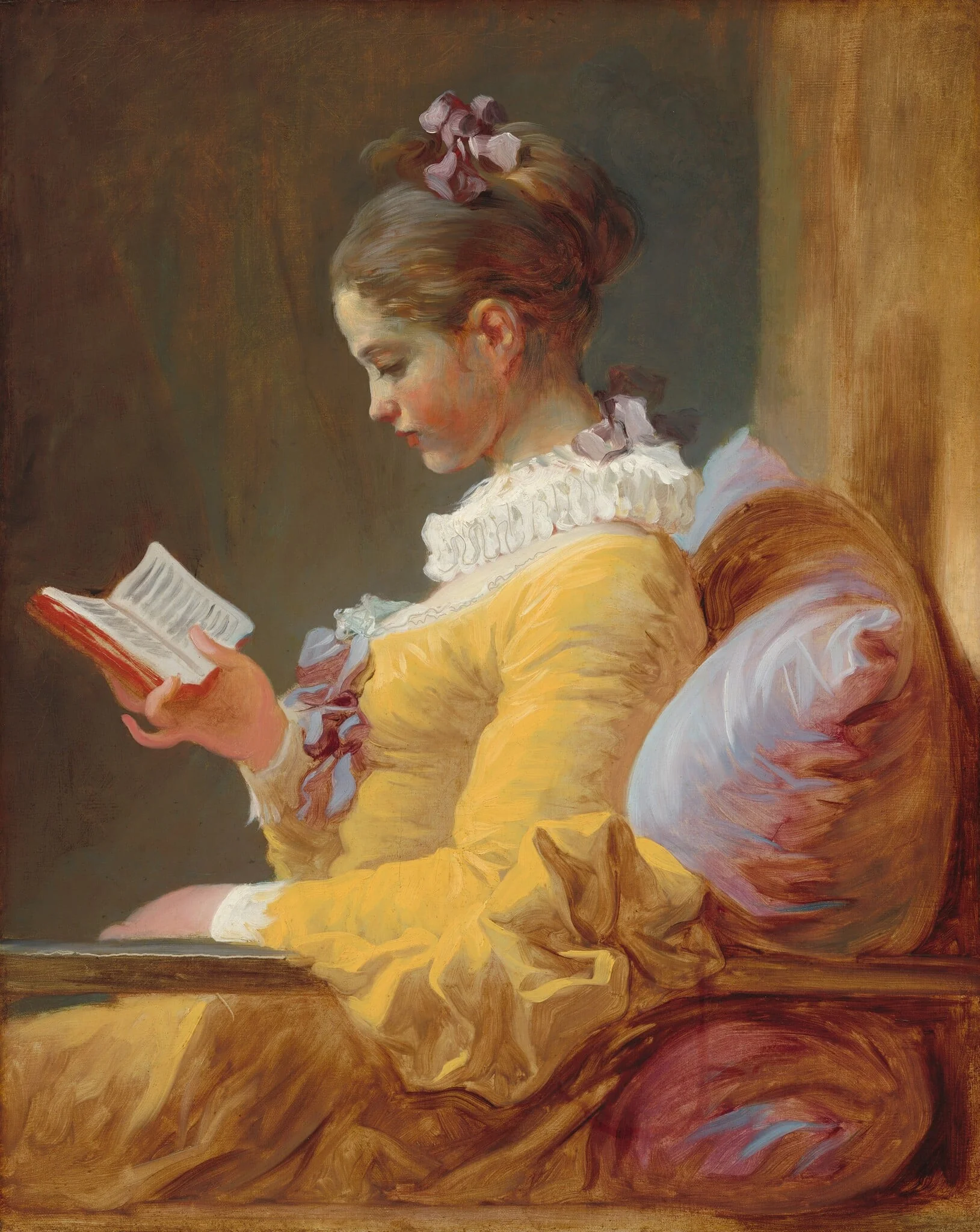
By the eighteenth century the reader has stopped praying and stopped waiting for word from a lover. She is simply, gloriously, alone with a book, and the picture's subject becomes absorption itself. No work in the corpus states this more confidently than Jean Honoré Fragonard's Young Girl Reading, and it rewards slow looking.
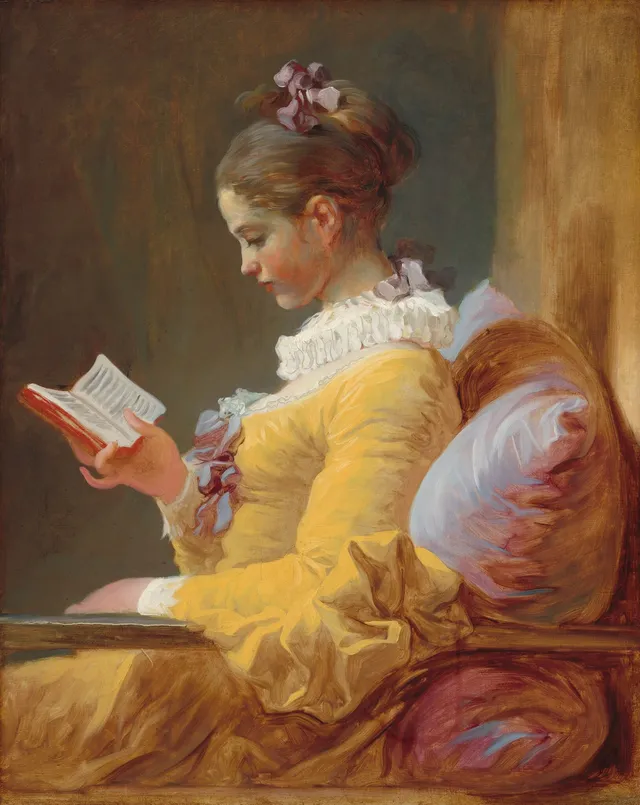
Look at how she sits. She is shown in clean profile, facing right, propped against a fat lilac cushion that Fragonard lays in with a few loaded sweeps of the brush. Her dress is a warm lemon-saffron, and the soft ruff at her throat is built from quick commas of thick paint that you can almost feel were dragged while still wet. The small book is held lightly in her right hand, fingertips only, at a comfortable reading distance, with no strain and no ceremony. Her eyes are down, her mouth closed and at ease. Crucially, she does not look out at us. The whole composition is arranged so that she has no idea she is being watched, and Fragonard makes a virtue of the rough, almost unfinished handling: the more loosely he paints her, the more she seems caught mid-thought rather than posed. This is reading as a private good, a pocket of attention that belongs to her and not to the room, and the painter's wager is that the unguarded face is more beautiful than any performed one.
It is worth pausing on how radical that decision is inside the long history of the motif. The medieval donor read under God's eye and the church's. The Dutch letter-reader was watched by us, the viewers leaning in to decode her secret. Fragonard cuts both audiences out. No deity, no eavesdropper, no message to be guessed at, only a girl and the steady pleasure of a book. The picture asks nothing of her and grants her, for the length of a page, complete privacy. That is a genuinely modern idea of the self, arrived at through nothing more than a turned head and a few yellow brushstrokes.
The nineteenth century inherited this image of the self-contained reader and pushed it toward something softer and more atmospheric. Jean Baptiste Camille Corot painted readers again and again, and his Femme Lisant sets a single figure with a book into the kind of hushed, silvered landscape he is known for. Corot is less interested than Fragonard in the texture of the page and more in the mood the reading produces, a stillness that spreads from the figure out into the trees. The reader becomes a way of tuning the entire picture to a lower, more inward key.
The dangerous reader
Absorption can be praised, and it can be feared. The same nineteenth century that loved the gentle reader also grew anxious about her, specifically about what cheap printed novels were doing to women with time and privacy. The anxiety was not subtle, and at least one painter made it lurid. Antoine Wiertz's The Reader of Novels, painted around 1853, shows a devil at the edge of the scene literally handing the reclining woman her books, a blunt visual argument that novel-reading seduces and corrupts (Wikipedia). The book that had once joined a soul to God is now contraband, smuggled in by the worst possible supplier.
What makes the panic worth taking seriously is that it was a fight over autonomy, not just over taste. A woman reading alone is a woman whose attention no one else controls, and that is exactly the freedom a certain kind of moralist wanted to police. The figure of the woman reader became contested cultural property in the Victorian and Edwardian decades, a subject historians have since traced in detail, Kate Flint's study of the woman reader between 1837 and 1914 chief among them (Internet Archive). The painters who kept showing absorbed women were, whether they meant to or not, taking a side in that argument simply by making private attention look like the most natural thing in the world.
- Devotion. The book as a channel to God, hugged close, eyes lowered in humility.
- Desire. The letter as a withheld secret, the gap between a composed face and an unseen message.
- Self-possession. The reader alone and unobserved, attention belonging only to her.
- Danger. The same privacy reframed as a threat, the unsupervised mind as something to be feared.
Reading as a room of one's own
Cross the Atlantic and the threat drains out of the picture, replaced by comfort. American genre painting of the later nineteenth century treats reading as the very emblem of a settled domestic life, and the corpus carries good examples. Frank Millet's A Cosey Corner says it in the title. The reader is tucked into a warm interior nook, the book one more soft furnishing in a room organized for ease. Eastman Johnson, the great American chronicler of the home, works the same register, where a person with a book signals a household at peace with itself. The book here is neither sacred nor scandalous. It is upholstery for the mind, and the message it sends is reassurance rather than warning.
It helps to remember what category these pictures belong to. Tate defines genre painting as the depiction of scenes of everyday life, a type established as one of the recognized branches of painting back in the seventeenth century (Tate). Most reading-pictures live in that everyday register, which is precisely why the motif could absorb so many different meanings. Everyday life is where a society quietly decides what an ordinary act is supposed to signify, and reading was an ordinary act loaded with more freight than almost any other. A battle scene announces its own importance. A woman with a book does not, and that modesty is exactly what let painters fold so much into it.
The anonymous works in the corpus make the same point from the margins. A panel catalogued only as Domestic Scene folds a reader into the texture of household routine, the book treated as unremarkable as a broom or a bowl. An allegorical figure like The Nymph of Fontainebleau pulls in the opposite direction, lending the act of reading a mythic, idealized charge. Between the broom and the nymph sits the whole range of what a painted page could be asked to mean.
Why the gesture keeps coming back
Set the answers next to each other and the pattern is clear. The medieval reader prays. The Dutch reader keeps a secret. Fragonard's reader belongs to no one. Wiertz's reader is being corrupted on purpose, and Millet's is simply at home. One pose, lowered eyes over a page, asked to mean five incompatible things across the centuries. That is what makes reading such a durable subject. It is the one everyday gesture that points directly at the part of a person a painter can never actually show, the moving interior, and so each era could pour its own hopes and suspicions about the inner life straight into it.
Which is also why the motif has outlived every social condition that produced it. The book of hours is gone, the scandal of the novel is a historical curiosity, the cosey corner is a piece of antique furniture. The image survives because the underlying problem it solves has not changed. We still cannot see another person think. A painter who wants to show that someone is fully, privately alive with their own mind still reaches, after seven hundred years, for the oldest trick available: a head bent toward a page, and the rest of the room left to wait.
Spend an afternoon with the reading-pictures spanning roughly 1300 to 2013, and the corpus stops looking like a parade of quiet women with books and starts looking like a long, unsettled conversation about how much freedom a private mind should be allowed. The painters never agreed. They only kept asking, in saffron and lapis and silvered grey, the same single question.
Works discussed in this article
The Dutch seventeenth century, the moment that turned the reader from a worshipper into a keeper of secrets, repays study on its own terms. Its painters discovered that a single sheet of folded paper could hold more suspense than a battlefield, and they built whole rooms of light around the woman who held it. Everything the later centuries did with the motif, the solitude, the danger, the domestic calm, was already latent in those quiet interiors, waiting for a new audience to need it. That is the strange economy of a great subject. The painters spend it for centuries and never use it up.
Sources & further reading
- Girl Reading a Letter at an Open Window — Wikipedia
- 10 things about Vermeer's Woman Reading a Letter — Rijksmuseum
- Women reading in art — Wikipedia
- The Art of Devotion in the Middle Ages — The J. Paul Getty Museum
- The Woman Reader, 1837-1914 (Kate Flint) — Internet Archive
- Medieval prayer books — Smarthistory
- Woman Reading a Letter (Vermeer) — Wikipedia
- Genre painting (art term) — Tate