Artist
Antoine Pierre Mongin
France
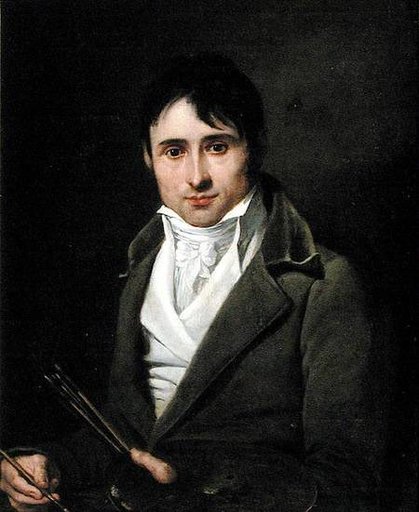
Antoine Pierre Mongin is a France French Romanticism artist. 2 works are cataloged here, principally at Cleveland Museum of Art.
Pierre-Antoine Mongin (1761 – 19 May 1827) was a French painter and engraver. Mongin was the designer for the 1807 Zuber & Cie scenic wallpaper l'Hindoustan. In 2013, a part of his design for l'Hindoustan appeared on a postage stamp for the French Post. His work is included in the permanent collections of the Art Institute of Chicago, the Cooper-Hewitt, Smithsonian Design Museum, and the Metropolitan Museum of Art.
Overview
Pierre-Antoine Mongin (1761-19 May 1827) was a French painter and engraver whose career spanned one of the most turbulent and transformative periods in French art history, from the final years of the Ancien Régime through the Napoleonic era and into the Restoration. Born in Paris and based for much of his life in that city, Mongin distinguished himself as a versatile practitioner who moved fluidly between history painting, landscape, genre scenes, and the decorative arts. He is best known today for his extensive work in scenic wallpaper design, particularly his panoramic creations for the Mulhouse manufacturer Jean Zuber, which remain in major museum collections. His work is held by institutions including the Art Institute of Chicago, the Cooper-Hewitt Smithsonian Design Museum, the Metropolitan Museum of Art, the Cleveland Museum of Art, the Morgan Library and Museum, and the Musée du Louvre, among others.
Biography & dates
Mongin was born in Paris in February 1761 and died in Versailles on 19 May 1827. He entered the Académie royale de peinture et de sculpture in 1782 and studied there until 1785 under three prominent masters: Noël Hallé, Gabriel-François Doyen, and François-André Vincent. After completing his formal training, he continued to work with Hallé before establishing his own studio at 29 rue de Sèvres in Paris. He exhibited regularly at the Salon from 1791 to 1824, a remarkably consistent presence that attests to his professional standing across the Revolutionary, Napoleonic, and Restoration periods. His studio became a training ground for younger artists, and he developed working relationships with lithographers and manufacturers that extended his practice beyond traditional easel painting.
Style & movement
Mongin worked simultaneously as a landscape painter, genre painter, and history painter, with a particular concentration on Napoleonic military scenes. He practiced both gouache and oil painting, and was also an accomplished engraver. His technical range extended to lithography, and he supplied drawings to the press of the lithographer Godefroy Engelmann. Around 1804, he began designing panoramic wallpapers, initially for the manufacturer Dufour with Les Jardins anglais, which drew inspiration from the fabricated structures then fashionable in English landscape gardens. This decorative work led to his major collaboration with Jean Zuber, for whom he created vast panoramic views in diverse themes. His ability to adapt his skills across media, from intimate drawings to large-scale decorative schemes, characterizes his professional approach.
Major works
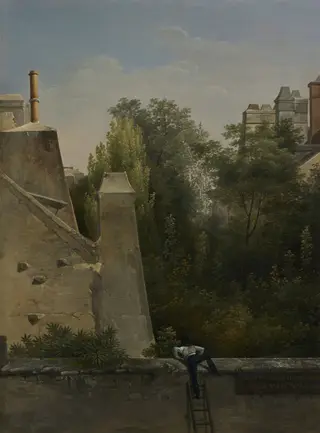
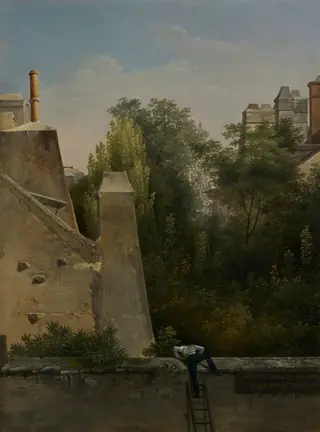
Mongin's most significant surviving works span multiple media and institutions. For Zuber, he designed L'Hindoustan (1807), La Grande Helvétie (1814), La Petite Helvétie (1818), Les Jardins français (1821), and Les Lointains (1825). A portion of his L'Hindoustan design appeared on a French postage stamp in 2013. In traditional painting, his works include Le Curieux (1823), oil on canvas, at the Cleveland Museum of Art; The Corner of a Park at the Morgan Library and Museum; and La Diseuse de Bonne Aventure (1812), oil on canvas, at the Musée de l'Échevinage in Saintes, with figures by Marie-Guillemine Benoist and landscape and architecture by Mongin. The Musée des Arts décoratifs in Marseille and the Musée des Arts décoratifs in Paris both hold versions of La Grande Helvétie. The Musée du Louvre's Département des Arts graphiques holds eight drawings. The Musée national des Arts et Traditions populaires holds Le Repos du joueur de vielle, a popular subject depicting a Parisian street musician that attracted notice at the Salon of 1814. The Musée national des châteaux de Versailles et de Trianon holds two Napoleonic military paintings: Passage de l'armée de réserve dans le défilé d'Albaredo (21 May 1800) and Bivouac de Napoléon près du château d'Ebersbarg (4 May 1809). The Staatliches Museum Schwerin in Germany holds several gouaches. Other works include Othon de Grandson at the Musée Rolin in Autun, and Bénédiction des troupeaux partant pour les Alpes at the Musée des Beaux-Arts inark in Marseille.
Influences & students
Mongin's formative training came from three established painters at the Académie royale de peinture et de sculpture. Noël Hallé, from a distinguished family of artists, provided ongoing mentorship beyond the formal curriculum. Gabriel-François Doyen was a prominent history painter, while François-André Vincent was a leading Neoclassical artist who had trained in Rome. These combined influences gave Mongin grounding in both the academic tradition and the emerging Neoclassical movement. In turn, Mongin's studio at 29 rue de Sèvres attracted pupils including Hippolyte Lecomte, who became known for his military and historical paintings, and Alexis-Victor Joly, who continued in the landscape tradition.
Legacy
Mongin's legacy rests on his unusual combination of academic painting and commercial decorative design. His panoramic wallpapers for Zuber represent a high point in the early nineteenth-century French wallpaper industry, and these works have been collected and exhibited by major museums as significant examples of decorative art. The 2013 French postage stamp featuring his L'Hindoustan design brought renewed public attention to his work. His paintings of Napoleonic subjects at Versailles preserve a documentary aspect of French imperial history, while his genre scenes offer valuable visual evidence of contemporary Parisian life. The dispersal of his work across American and European collections, from Chicago and New York to Schwerin and Marseille, indicates the breadth of his reputation, though scholarly attention has been relatively limited compared to his more famous contemporaries.
Works by Antoine Pierre Mongin
Collections represented

Artists in a similar vein