Artist
Master of the Burg Weiler Altarpiece
German
Master of the Burg Weiler Altarpiece is a German Northern Renaissance painter. 1 work is cataloged here, principally at Metropolitan Museum of Art.
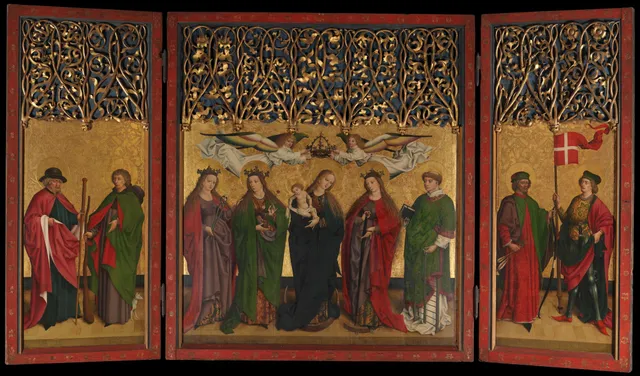
The Master of the Burg Weiler Altarpiece is a modern scholarly notname for a German painter whose real identity and dates remain unknown. Art historians designate him after the triptych commissioned for the chapel adjoining Burg Weiler, a seat of the Freiherren von und zu Weiler near Heilbronn. Dated to about 1470, the work is executed in oil on wood with a gold ground and survives in imposing scale: the central panel measures roughly 174 by 152 centimetres, with matching wings.
When open, the interior presents the Virgin and Child standing on a crescent moon, flanked by Saints Apollonia, Barbara, Catherine of Alexandria, Lawrence, Jodokus, Wendelin, Sebastian and Maurice; angels lower a crown onto the Virgin's head. Closed, the outer wings reveal Saint Theodulus and martyrs of the Theban Legion. For decades the altarpiece was attributed to a Middle Rhenish painter in the circle of the Master of the Housebook.
More recent scholarship, however, reassigned it to the northern reaches of Swabia, bordering Franconia, with speculation that the painter maintained a workshop in Heilbronn. Beyond this single altarpiece, no additional works are universally accepted as his, and no documents name the hand. The triptych entered The Cloisters collection of the Metropolitan Museum of Art in 1953, where it serves as the sole fixed point around which any biography of this anonymous master must be constructed.
Works by Master of the Burg Weiler Altarpiece
Collections represented

Artists in a similar vein