Artist
Floris Claesz van Dijck

Dutch Republic
Floris Claesz van Dijck is a Dutch Republic Dutch Golden Age artist. 2 works are cataloged here, principally at Rijksmuseum.
Floris van Dyck, also called Floris van Dijck or Floris Claesz. van Dyck (c.1575 – before 26 April 1651) was a Dutch Golden Age still life painter.
Overview
Floris van Dyck, also known as Floris van Dijck or Floris Claesz. van Dyck (c. 1575, before 26 April 1651), was a Dutch Golden Age painter who specialized in still lifes. Born in Delft, he spent most of his working life in Haarlem, where he became a central figure in the development of the banketje, or banquet still life. Though his known oeuvre is small, van Dyck is credited with helping establish still life as an independent genre in the Netherlands and exerting a formative influence on the next generation of Haarlem painters.
Biography & dates
Van Dyck was born around 1575 in Delft. His cousin was Pieter Cornelisz. van Rijck, and through this family connection he was linked to the brewing trade; his uncle Cornelis van Rijck operated the "De Olyphant" brewery in Haarlem. Around 1600, van Dyck was documented in Rome, where he befriended the painter Joseph van Arpino and witnessed his miraculous cure by means of Olio del gran Duco, an oil provided by the Pope's personal physician. This cure enabled Arpino to complete an altarpiece for the Archbasilica of St. John Lateran. Van Dyck returned to the Netherlands by 1606 and settled in Haarlem, where he had already been engaged in 1604. He joined the Haarlem Guild of St. Luke in 1610 and eventually became dean in 1637. On 11 September 1625, he married for the second time to Cornelia Jansdr. Vlasman; the wealthy Gijsbert Claesz van Campen served as sole witness. According to some accounts, this second marriage brought significant wealth, and he may have painted less in his final decades. He died in Haarlem shortly before 26 April 1651.
Style & movement
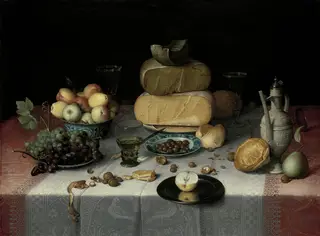
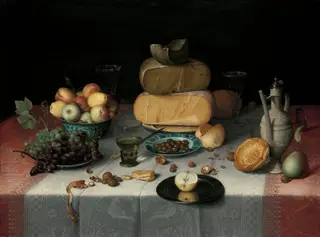
Van Dyck worked within the Dutch Golden Age still life tradition and is closely associated with the emergence of the banketje, a type of banquet still life depicting tables laden with food and tableware. Working alongside Nicolaes Gillis, he helped establish this subject as an independent genre in Haarlem. Some scholars have suggested the more precise term Schautafel for the specific type of carefully arranged table scene that van Dyck and Gillis pioneered. His paintings are characterized by their naturalistic rendering of plants, flowers, cheeses, fruits, and nuts. He signed his works with the monogram "FVD," sometimes accompanied by an "H" for Harlemensis, followed by "Fecit." The later development known as the monochrome banketje, with its more restrained palette, built upon the foundations laid by van Dyck and Gillis.
Major works
Van Dyck's known oeuvre is exceptionally small: only thirteen paintings and one work in watercolor are securely attributed to him. Of these, only about ten still lifes are well documented. His works typically depict tables set with cheeses, fruit, nuts, and various tableware, the compositions that established the banketje format. Specific current locations of individual paintings are not detailed in the available sources, though his work is represented in the Rijksmuseum collection.
Influences & students
Van Dyck was influenced by the Flemish painters Osias Beert and Clara Peeters, whose work informed his approach to the still life genre. Together with Nicolaes Gillis, he is considered the inventor of the banketje in Haarlem, though van Dyck is accorded the stronger stylistic influence of the two. His paintings and those of Gillis had significant impact on the following generation of painters, including Floris van Schooten, Pieter Claesz, and Roelof Koets. These artists helped develop the monochrome banketje that became a hallmark of Haarlem still life painting. Van Dyck also served as a source for Karel van Mander's Schilder-boeck, providing information about modern Italian painters based on his own experiences in Rome.
Legacy
Despite his small surviving body of work, van Dyck holds an important place in art history as a pioneer of Dutch still life painting. His establishment of the banketje as an independent subject in Haarlem prepared the way for the later development of the monochrome banquet piece. The fact that he could reduce his output in later life, apparently supported by his second wife's wealth, suggests he achieved considerable material success. His reputation rests less on quantity than on his role as what scholars describe as the strongest formative force in early Haarlem still life, bridging Flemish influences and the emerging Dutch tradition.
Works by Floris Claesz van Dijck
Collections represented

Artists in a similar vein