Artwork
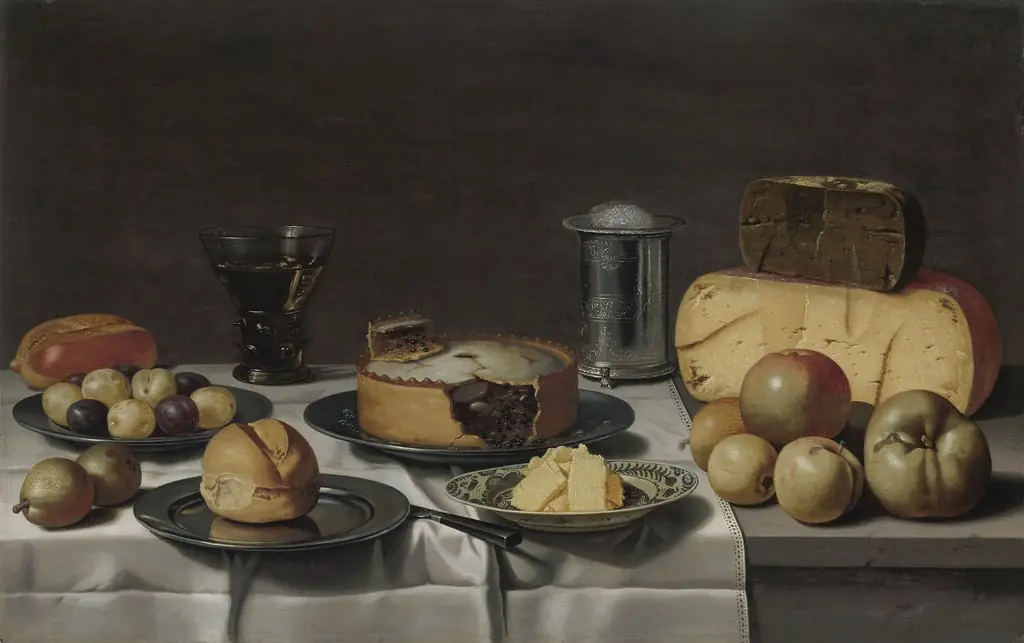
Still Life with Cheese
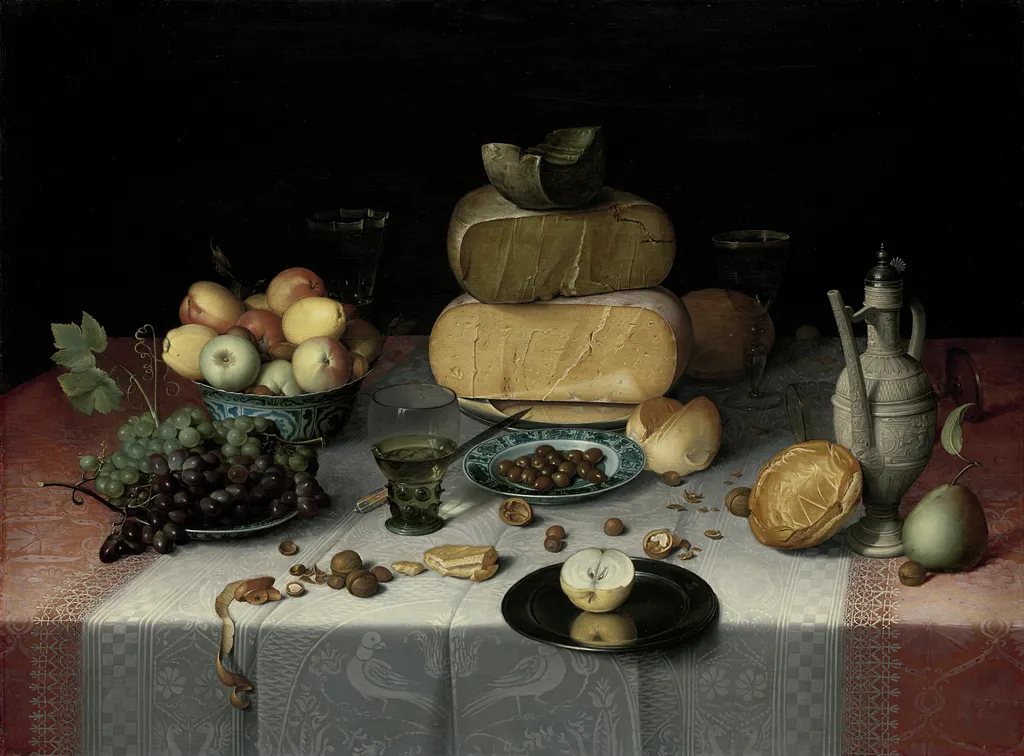
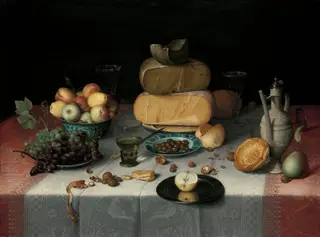
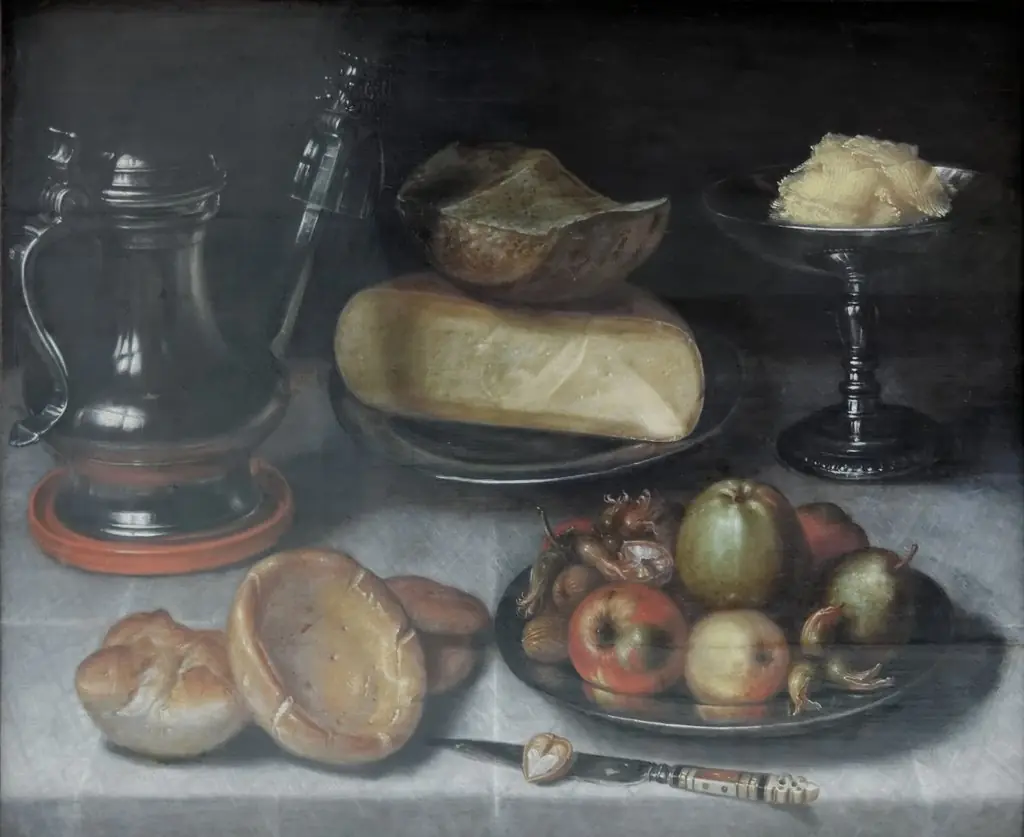
Still Life with Cheese is an oil painting by the Dutch Golden Age artist Floris Claesz van Dijck. It dates from 1615 and is held in the collection of the Rijksmuseum.
About this work
Subject & Meaning
Floris van Dyck's Still Life with Cheese depicts a lavish table arrangement characteristic of the early Dutch "ontbijtje" or breakfast piece.
Floris van Dyck's Still Life with Cheese depicts a lavish table arrangement characteristic of the early Dutch "ontbijtje" or breakfast piece. The composition centers on stacked wheels of cheese presented on a precious metal plate, surrounded by imported luxury goods including Chinese Wanli porcelain, Venetian glass, and Siegburger stoneware. These items sit alongside fresh produce such as grapes, apples, olives, nuts, and bread, all resting on intricate damask tablecloths.
The painting serves as a testament to the wealth of the Dutch Golden Age merchant class, documenting their access to global trade networks and exotic commodities. Beyond mere display of affluence, specific details carry vanitas symbolism; notably, a browning apple peel left on the table edge suggests the passage of time and the transience of earthly pleasures. The work thus balances a celebration of material abundance with a subtle moral reminder of life's impermanence.
History & Provenance
Still Life with Cheese was created by Floris van Dyck around 1615, as consistently dated in contemporary scholarship. The painting is neither signed nor explicitly documented in period records regarding its commission, suggesting it was likely produced for the open market rather than a specific patron. The work emerged during the Dutch Golden Age, a period marked by affluent bourgeois demand for still lifes, particularly the ontbijtjes (breakfast pieces) genre to which this painting belongs.
The earliest traceable ownership places the work in the collection of the Rijksmuseum, Amsterdam, where it has been housed since 1982. No intermediate private owners or auction records are documented in the available sources, leaving a gap in its provenance prior to its acquisition by the museum.
Still Life with Cheese by Floris van Dyck has been part of the Rijksmuseum’s collection since 1982 []. The work is catalogued under accession details maintained by the museum, though its specific inventory number is not publicly detailed in the available sources [][].
The painting has been featured in key exhibitions dedicated to Dutch still-life art. Notably, it was included in the 1999 Rijksmuseum exhibition Still-Life Paintings from the Netherlands 1550–1720, co-curated by Alan Chong and Wouter Kloek, as documented in the accompanying catalogue [].
Context
The painting is considered a key example of early Dutch meal still lifes, often termed Haarlemer Schautafeln, and exemplifies the specialization of artists in the Dutch Golden Age when a burgeoning market for domestic decoration arose among the Protestant bourgeoisie (3). It is identified as a typical ontbijtje, a breakfast piece, and forms part of Floris van Dyck’s small oeuvre of cheese still lifes produced between 1610 and 1622, which stylistically vary only slightly (4). Critical discussion praises Van Dyck’s meticulous rendering of light and texture, notably the transparent wine glass and the reflected apple on the silver tray, highlighting his technical virtuosity (4).
The work is referenced in scholarly surveys such as Chong and Kloek’s Still-Life Paintings from the Netherlands 1550‑1720 (1999) and Pieters et al.’s Het Nederlandse Kunst Boek (2016) (4). Since entering the Rijksmuseum collection in 1982, it has occupied a canonical place in the narrative of seventeenth‑century Dutch still‑life painting (4).
Legacy
Floris van Dyck's Still Life with Cheese stands as a defining example of the early Dutch breakfast piece, or ontbijtje, a genre he helped establish. The work exemplifies the specialization within Dutch Golden Age still life, where artists perfected specific sub-genres to meet the demands of a wealthy bourgeois market seeking to document their domestic luxury. While van Dyck produced a limited body of work, with only about eight known breakfast scenes dated between 1610 and 1622, this painting remains a benchmark for the artist's technical mastery in rendering light, texture, and the illusion of depth.
Although the artist's career in this specific genre effectively ended after 1625, the painting's enduring presence in the Rijksmuseum collection since 1982 cements its status as a representative masterpiece of the Haarlem school's contribution to art history.
Overview
Created in 1615 by Floris van Dyck, Still Life with Cheese is an oil painting characteristic of the Dutch Golden Age. This work presents a carefully arranged display of foodstuffs and objects, including bread, cheese, grapes, and Chinese ceramics. It is currently held in the collection of the Rijksmuseum, serving as an example of early 17th-century Dutch still life painting.
Technique & Style
Van Dyck employed oil paint to achieve a high degree of realism and detail in this composition. The artist meticulously rendered textures, from the rough surface of the bread to the crumbly quality of the cheese, and the smooth skin of fresh grapes and apples. A dark background enhances the visual prominence of the objects, allowing their forms and colors to emerge with striking clarity and precision.
Own this work as a print
Artist & collection

Artist
Floris van Dyck, also called Floris van Dijck or Floris Claesz. van Dyck (c.1575 – before 26 April 1651) was a Dutch Golden Age still life painter.