Artist
John Ferneley

United Kingdom of Great Britain and Ireland
John Ferneley is an United Kingdom of Great Britain and Ireland Romanticism artist. 2 works are cataloged here, principally at National Gallery of Art.
Overview
John E. Ferneley, born on 18 May 1782 in Thrussington, Leicestershire and dying on 3 June 1860 in Melton Mowbray, Leicestershire, was an English painter celebrated for his sporting horses and hunting scenes. Although his renditions of horses were stylized, he is widely regarded as one of the great British equine artists, second perhaps only to George Stubbs. The 19th century art critic Walter Shaw Sparrow even dubbed him the Gainsborough of English horse painters. His work captured the height of fashionable fox hunting in Leicestershire, earning him a wealthy and aristocratic clientele.
Biography & dates
Born the son of a master wheelwright, Ferneley was initially apprenticed to his father until 1801. His artistic talent caught the attention of John Manners, 5th Duke of Rutland, who noticed his paintings on the foreboards of locally repaired wagons. Encouraged by the Duke, Ferneley moved to London around 1801 or 1803 to study under the sporting artist Benjamin Marshall. During this apprenticeship, he joined the Royal Academy School, though he may not be listed in their official register, and exhibited his first painting there in 1806. He traveled extensively in Ireland from 1806 to 1809, returning to England to marry Sarah Kettle in 1809. Between 1810 and 1812, he made two more visits to Ireland for wealthy patrons. He eventually settled in Melton Mowbray by 1814 or 1817, building a studio and later a house named Elgin Lodge on the Scalford Road. He and Sarah had six or seven children before her death in 1836. He married Ann Allan in 1844, with whom he had another son. Ferneley continued working until his final days, completing his last commission at age 79, and died in Melton Mowbray.
Style & movement
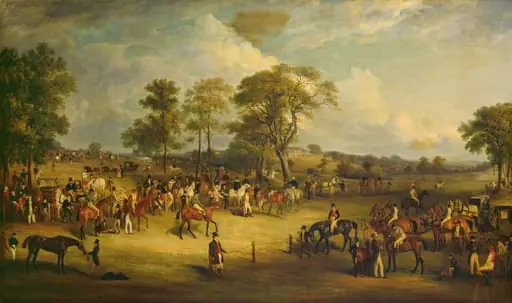
Ferneley specialized in posed equestrian portraits, large group portraits of entire hunts, and hunting scenes, particularly hunts in full cry. He also painted coaches, carriages in Hyde Park, prize cattle, sheep, dogs, game, and sporting meetings. A notable specialty was the scurry, a panoramic painting showing a sequence of events. His compositions often featured animals with their tack, grooms, and a landscape with distant activity, frequently incorporating a signature blasted tree. Ferneley signed his works very delicately with a pin head in the wet paint, often hiding the signature on a fence, stable door, or in an unexpected corner, and many paintings remain unsigned. This delicate technique easily differentiates his work from that of his son, John Jr., who normally signed heavily in black.
Major works
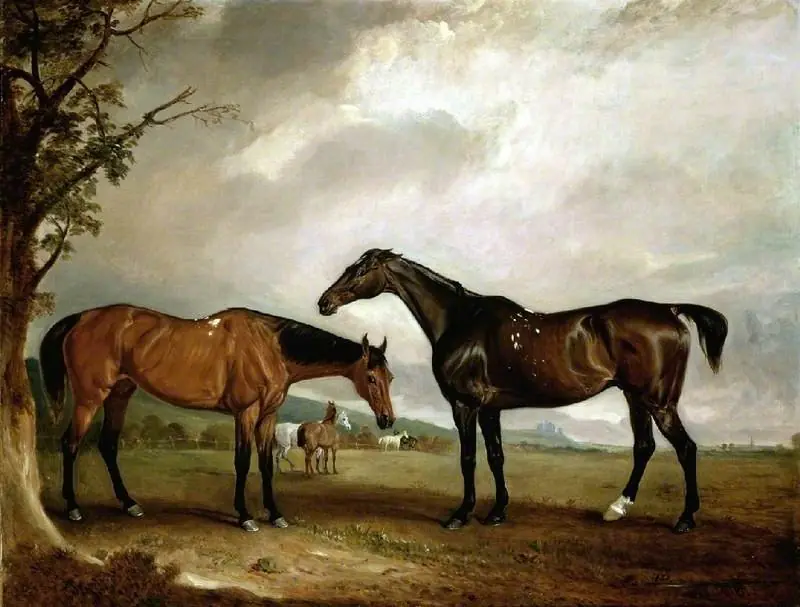
Ferneley routinely painted the famous Quorn, Belvoir, and Cottesmore hunts, with members contributing to his fee and drawing lots to determine the winner. Between 1828 and 1834, he was commissioned to paint many St. Leger and Derby winners, which were widely reproduced as prints and engravings. Key works in the Leicestershire museum collections include Mr Greene's Bay Mare, regarded as one of his finest equestrian paintings, and Carthorses with Grooms from 1856, which features his characteristic blasted tree. John, Henry and Francis Grant at Melton from 1823 is one of his most famous group portraits and fox hunting scenes, showing the three Scottish Grant brothers with hunters and hounds above the town. Other notable works include Mr Pare's Coachman and his Newfoundland Dog from 1823, a Portrait of the Artist and his Family in his Studio painted in the 1820s, and the Opening of the Leicester and Swannington Railway from 1832, which documented the industrial steam age arriving in the countryside. His works are held in the National Museum of Racing in Saratoga, the Tate Gallery in London, the Hull Art Gallery, the Worthing Art Gallery, and the Leicester Art Gallery.
Influences & students
Benjamin Marshall was Ferneley's primary teacher and artistic influence during his formative years in London. Sir Francis Grant also influenced him and became a close friend and collaborator. Grant, who was initially a pupil of Ferneley, studied painting with him in Melton Mowbray. The two artists collaborated on numerous paintings, with Ferneley painting the horses and Grant painting the human figures. Three of Ferneley's children, including his sons Claude Lorraine and John Ferneley Jr., and his daughter Sarah, followed him into the painting profession. Ferneley's detailed account books, kept between 1807 and 1860, have provided later historians with useful material for understanding his career and circle.
Legacy
Ferneley's work remains highly sought after and is considered an important record of the people, places, and pursuits of Leicestershire during a time of significant change. His paintings document the heyday of Melton Mowbray as a center for fox hunting, the agricultural interest in prize winning stock, and the arrival of the industrial steam age. John Ferneley College in Melton Mowbray is named in his honor. His account books, detailed from 1807 to 1860, have been published by Major Guy Paget, providing invaluable historical resources. The Leicestershire museum collections hold an important group of his oil paintings, drawings, watercolors, and prints, ensuring his artistic and historical legacy endures.
Works by John Ferneley
Collections represented


Artists in a similar vein
Artist
