Artist
Sengai
Japan
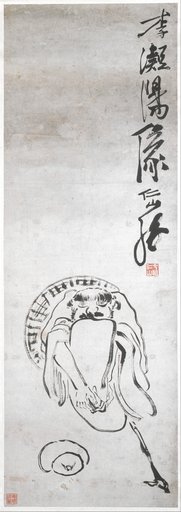
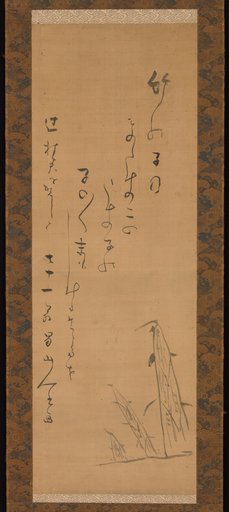
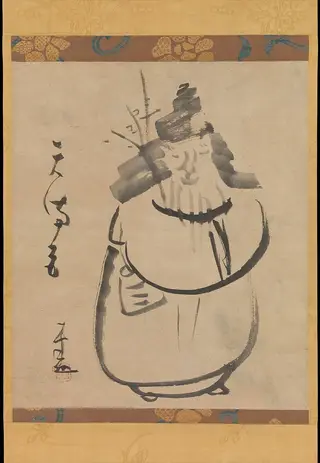
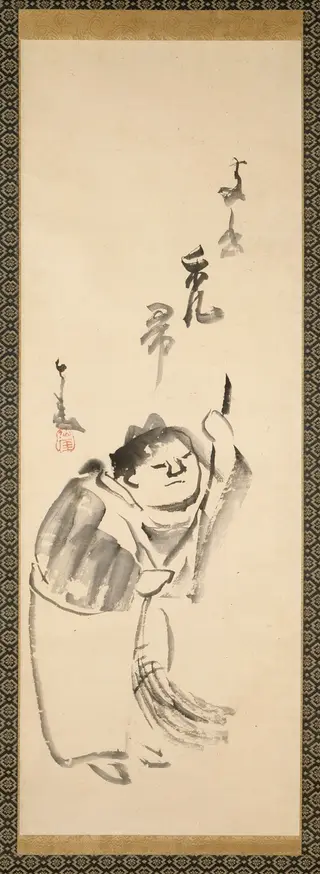
Sengai is a Japan Nihonga artist. 2 works are cataloged here, principally at Los Angeles County Museum of Art.
Sengai Gibon (仙厓 義梵; 1750–1837) was a Japanese monk of the Rinzai school (one of three main schools of Zen Buddhism in Japan, the others being the Sōtō school and the much smaller Ōbaku school). He was known for his controversial teachings and writings, as well as for his lighthearted sumi-e paintings. After spending half of his life in Nagata near Yokohama, he secluded himself in Shōfuku-ji in Fukuoka, the first Zen temple in Japan, where he spent the rest of his life. Though the Rinzai sect is particularly known for its hard-to-understand teachings, Sengai tried to make them accessible to the public.
Overview
Sengai Gibon (1750-1837) was a Japanese Zen Buddhist monk and painter of the Rinzai school, celebrated for making the sect's traditionally esoteric teachings accessible to a broad public through his lighthearted sumi-e ink paintings. Working primarily in western Japan during the late Edo period, he produced a large body of spontaneous brushwork that combined religious instruction with humor and visual directness. His reputation became so widespread that he was paired with his contemporary Hakuin Ekaku as the two great Zen painters of their era, summarized in the popular saying "Hakuin of Hara in the East, Sengai of Hakata in the West."
Biography & dates
Sengai was born in 1750 in Taniguchi, Mino Province (present-day Gifu Prefecture). He entered monastic life under Kūin, a priest at Seitai-ji near his birthplace. He subsequently received Zen training under Gessen Zenne at Tōki-an in what is now Yokohama, who certified him as a Zen master. Sengai then traveled to Hakata on Kyūshū, where he continued his Zen studies under the priest Bankoku at Shōfuku-ji, the first Zen temple established in Japan. He spent the first half of his life in Nagata near Yokohama before withdrawing to Shōfuku-ji in Fukuoka, where he remained until his death on 4 November 1837. In his later years he lived in seclusion at a subtemple called Kyohaku-in. Posthumously he was given the name Fumon-in Entsū Zenji.
Style & movement
Sengai worked in the sumi-e tradition of Zen ink painting, yet his approach was notably accessible and playful. Where Rinzai teachings were typically regarded as difficult and esoteric, Sengai deliberately rendered them in a style that ordinary people could grasp. His brushwork, while sometimes appearing at first glance heavy or even childlike, carried a distinctive energy and momentum. The inscriptions on his paintings were frequently humorous, and the compositions resembled the concise formulation of haiku. He explicitly rejected conventional categorization of his work, stating: "My play with brush and ink is not calligraphy nor painting; yet unknowing people mistakenly think: this is calligraphy, this is painting." His paintings served simultaneously as personal expression and as didactic tools for spreading understanding of Zen Buddhism among lay audiences.
Major works
Sengai's most famous painting depicts a circle, a square, and a triangle, left untitled and without inscription except for his signature. Commonly known as Marusankakushikaku (written as "○△□"), it was given the English title "The Universe" by Daisetz Taitaro Suzuki, who introduced Sengai to Western audiences and translated many of his inscriptions. The three shapes were commonly associated in Japan with "correct," "half-correct," and "incorrect." Among his other notable works are hanging scrolls depicting Hanshan and Shide, the celebrated pair of eccentric monks, which are held in the Eisei Bunko, the collection of the Hosokawa clan. In the twentieth century, the industrialist and collector Idemitsu Sazō amassed a significant collection of Sengai's works, which he made available to the public through the Idemitsu Museum of Arts.
Influences & students
Sengai's principal teachers were Kūin, under whom he took initial monastic vows at Seitai-ji; Gessen Zenne, who provided his Zen training at Tōki-an and certified him as a master; and Bankoku, under whom he continued his Zen studies at Shōfuku-ji in Hakata. The sources do not record named pupils or a formal circle of followers, though his popular approach to Zen teaching through visual art reached a wide lay audience. During his lifetime and after, he was closely associated with Hakuin Ekaku, the dominant Zen painter of eastern Japan, with the two figures representing the twin poles of Zen painting in their era.
Legacy
Sengai's posthumous reputation rests on his success in democratizing Zen teachings through visual art. The pairing with Hakuin Ekaku as "Hakuin of Hara in the East, Sengai of Hakata in the West" became a standard formulation in accounts of Japanese Zen painting. His work gained significant international attention through the efforts of Daisetz Taitaro Suzuki, whose 1971 publication "Sengai: The Zen Master" and translations of inscriptions introduced him to Western readers. The Idemitsu Museum of Arts in Tokyo houses the most important institutional collection of his work, assembled by Idemitsu Sazō. Additional collections of his images are held by Kyushu University. His paintings remain widely reproduced and studied as exemplars of popular Zen art that balanced spiritual content with immediate visual appeal.
Works by Sengai
Collections represented


Artists in a similar vein