Artwork
Five Children of the Budd Family
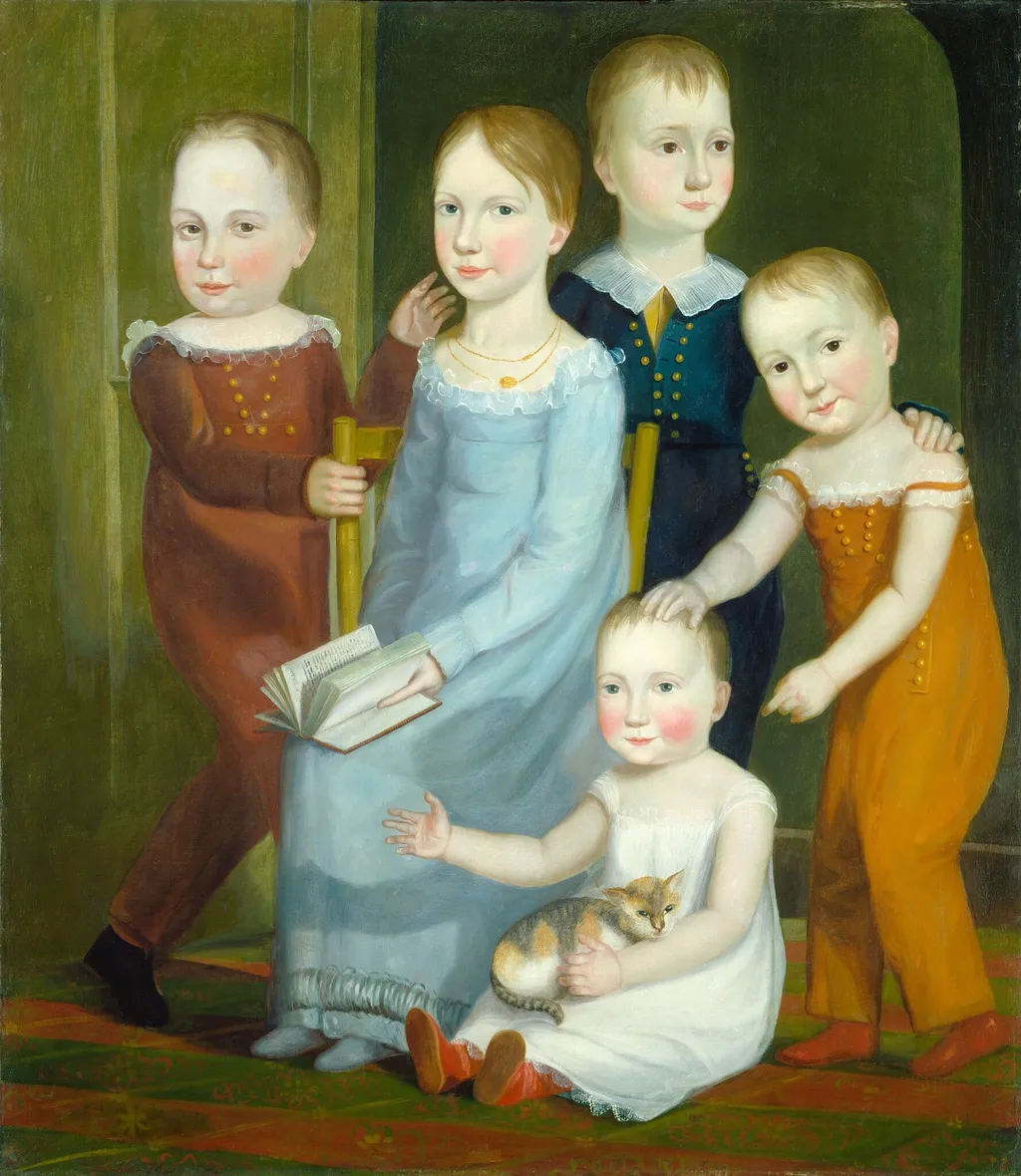
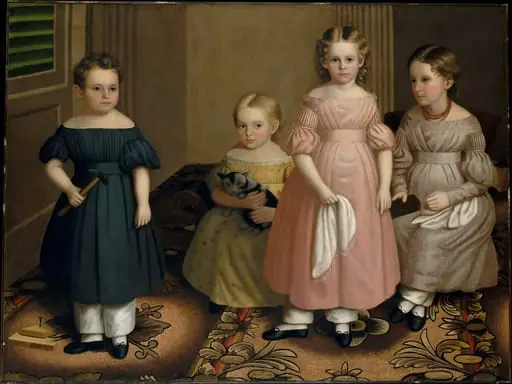
Five Children of the Budd Family is an oil painting. It dates from 1818 and is held in the collection of the National Gallery of Art.
- Inscription
- Inscribed:on book page: 140 / JUVENILE TALES
About this work
Technique & Style
The composition relies on a balanced arrangement of figures, with restrained gestures and expressions that convey a sense of decorum and familial unity.
Five Children of the Budd Family is an oil painting on canvas, executed in 1818. The support measures 121 cm in height and 106.4 cm in width, providing a substantial surface for the group portrait. The medium consists of oil paint applied to a tightly woven canvas, characteristic of early 19th-century American portraiture.
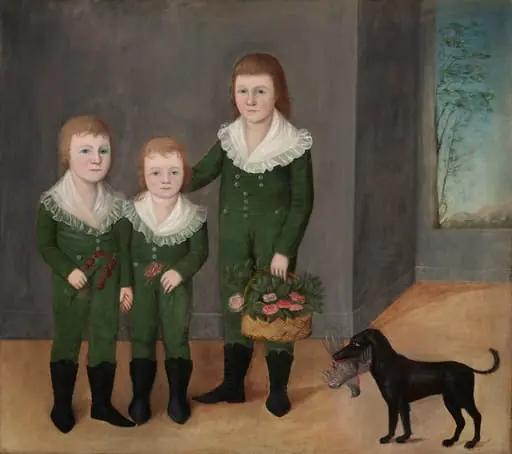
Stylistically, the work exhibits a precise, linear handling of form, with careful attention to individual facial features and costume details. The children are rendered with a smooth, almost enamel-like finish, minimizing visible brushwork. Color is modulated subtly, particularly in the flesh tones and drapery, reflecting the artist’s adherence to academic conventions of the period.
The composition relies on a balanced arrangement of figures, with restrained gestures and expressions that convey a sense of decorum and familial unity.
History & Provenance
Created in 1818, this oil-on-canvas portrait depicts five children of the Budd family. The work originated in Pennsylvania and descended through the Budd and Hull families before reaching Blanche Hull. According to dealer William S. Bowers, the painting was brought from Lancaster to Chambersburg, Pennsylvania, around 1880 by Mary Budd, the tenth child of Charles Budd.
The portrait remained in the family until the death of a Hull family member in 1914, after which it passed to Blanche Hull, the last of the second generation to hold it. Bowers purchased the work from Hull and sold it in 1954 to collectors Edgar William and Bernice Chrysler Garbisch. The piece was subsequently gifted to the National Gallery of Art in Washington, D.C., in 1959.
Five Children of the Budd Family is held in the collection of the National Gallery of Art in Washington, D.C. The work entered the museum's inventory in 1959 as a gift from Edgar William and Bernice Chrysler Garbisch. Prior to this donation, the painting was sold to the Garbisches in 1954 by the dealer William S. Bowers of Chambersburg, Pennsylvania. Bowers had acquired the portrait from Blanche Hull, through whose family the work had descended after passing from the Budd lineage.
A letter from Bowers indicates the painting was brought to Chambersburg from Lancaster around 1880 by Mary Budd, the daughter of Charles Budd.
The provided sources do not list any specific exhibitions where this work has been displayed.
Overview
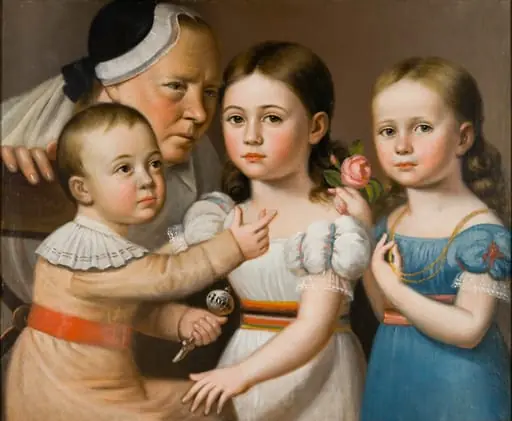
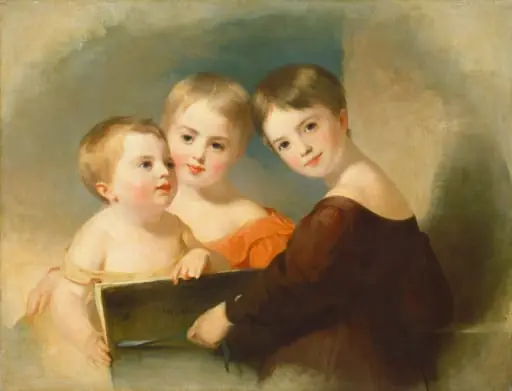
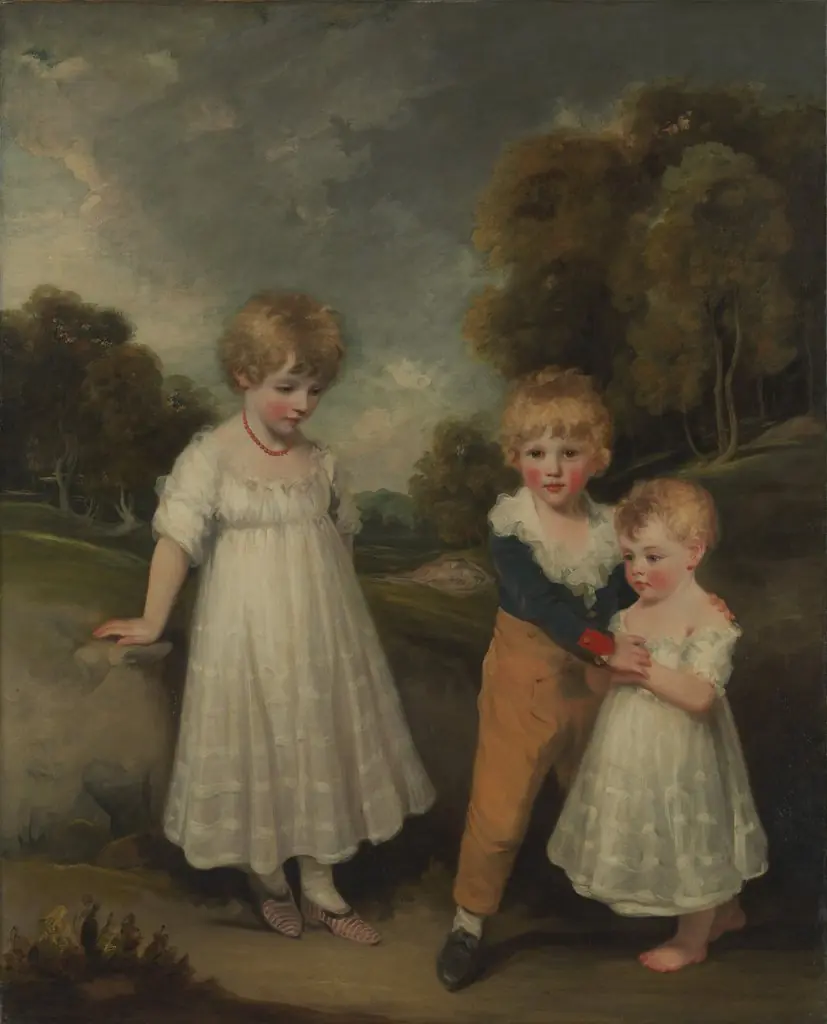
This oil on canvas painting, titled Five Children of the Budd Family, presents a formal group portrait. It depicts five young individuals standing together, their attire and demeanor suggesting a family of considerable means. The creation of such a work likely represented a significant undertaking for the Budd family, serving as a lasting record of their children.
Subject & Meaning
The children are depicted in elaborate clothing, a clear indicator of their family's social and economic status. Their carefully arranged poses suggest a deliberate effort by the artist to convey distinct personalities within the unified composition. This approach allowed for both a formal representation of the family unit and an intimation of each child's individual character.
Context
Group portraits of children from affluent families were a prevalent genre during the period, reflecting a desire to document lineage and prosperity. Artworks of this nature often served as prominent displays within family homes. Similar examples of portraiture can be found within the collections of institutions such as the National Gallery of Art in Washington.
Artist & collection