Artwork
Indian Tobacco Shop Sign [obverse, Indian facing left]
![Indian Tobacco Shop Sign [obverse, Indian facing left], oil, 1850](https://artifactworldgallery.com/img/indian-tobacco-shop-sign-obverse-indian-facing-left--b34258933f147a37-w1024.webp)
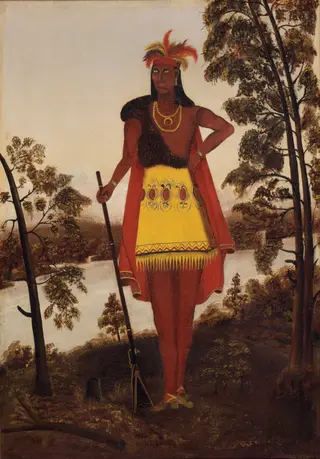
Indian Tobacco Shop Sign [obverse, Indian facing left] is an oil painting. It dates from 1850 and is held in the collection of the National Gallery of Art. The work is an oil painting on wood portraying a Native American figure turned toward the left.
About this work
If you're interested in learning more about this style of painting, you might want to explore the work of American 19th Century artists.
This painting depicts a Native American man facing left, wearing a red tunic with a decorative border and a feathered headdress. He holds a long object over his left shoulder, possibly a pipe or a spear, and has a black bag hanging from his right side. His face is dark brown, and he wears a necklace and a bracelet on his right wrist.
The man stands on a light-colored background, with his reflection visible below him. The overall style of the painting is simple and folk-art-like, with bold lines and bright colors.
If you're interested in learning more about this style of painting, you might want to explore the work of American 19th Century artists.
Subject & Meaning
The work is classified as an allegory depicting a figure associated with an Indian tobacco shop. The obverse side features a Native American figure facing left, serving as the central subject of the composition. Created in 1850, the painting functions as a commercial sign, utilizing the imagery of the indigenous figure to represent the tobacco trade. This iconography reflects the 19th-century American practice of using such figures as visual symbols for tobacco establishments.
Technique & Style
The work is an oil painting on a wooden panel. Its support is a vertically oriented panel measuring approximately 136.4 cm in height and 57.8 cm in width. The handling is consistent with 19th-century American oil techniques, characterized by smooth, even application and careful delineation of form.
Stylistically, the composition employs a frontal, emblematic arrangement, with the figure's leftward orientation creating a pronounced lateral emphasis within the narrow format. The palette is subdued, relying on earth tones to convey the allegorical subject, while the linear precision in the figure's profile and costume underscores a didactic clarity typical of genre-allegorical painting of the period.
History & Provenance
The work was created in 1850 by an unidentified American artist of the 19th century. It was recorded as originating from New York City, where it was sold in 1949 by The Old Print Shop to Edgar William and Bernice Chrysler Garbisch. The couple subsequently bequeathed the painting to the National Gallery of Art in Washington, D.C., in 1980, where it remains.
Measuring 136.4 cm in height and 57.8 cm in width, the oil on wood panel is catalogued with an accession year of 1980.
Overview
The work is an oil painting on wood portraying a Native American figure turned toward the left. He is dressed in a red tunic edged with decorative trim, wears a feathered headdress, and carries a long object across his left shoulder. A black satchel hangs from his right side, and he is accessorized with a necklace and a bracelet on his right wrist.
![Indian Tobacco Shop Sign [reverse, Indian facing right]](https://artifactworldgallery.com/img/indian-tobacco-shop-sign-reverse-indian-facing-right--37fe4a5c7c2044fe-w320.webp)
Artist & collection