Artwork
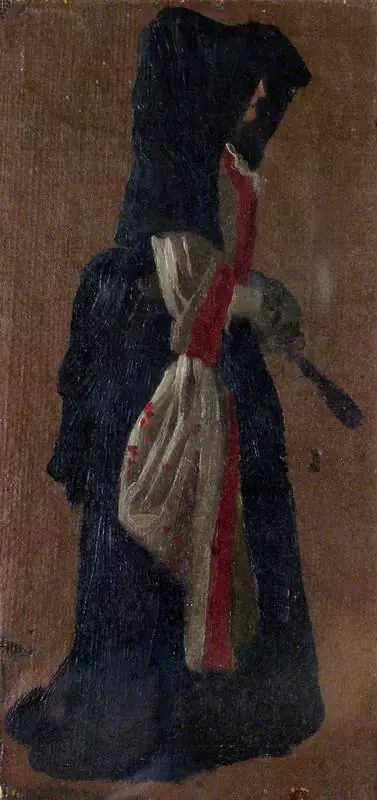
Indian Tobacco Shop Sign [reverse, Indian facing right]
![Indian Tobacco Shop Sign [reverse, Indian facing right], oil, 1850](https://artifactworldgallery.com/img/indian-tobacco-shop-sign-reverse-indian-facing-right--37fe4a5c7c2044fe-w1024.webp)
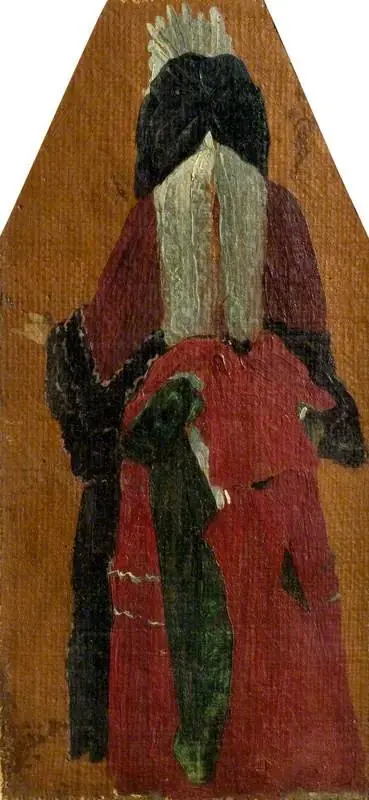
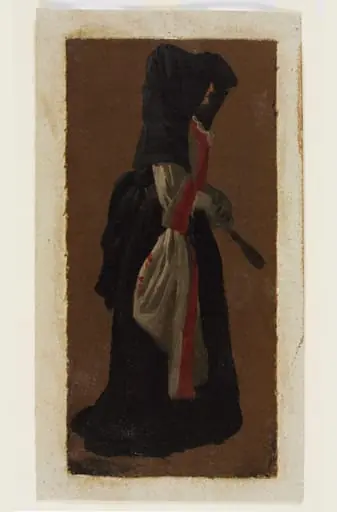
Indian Tobacco Shop Sign [reverse, Indian facing right] is an oil painting. It dates from 1850 and is held in the collection of the National Gallery of Art. The work is an oil painting on a wooden panel depicting a solitary figure rendered in vivid, flat colors.
About this work
Technique & Style
The composition adopts a frontal, symmetrical arrangement, framing a stylized tobacco leaf and a clay pipe against a plain ground.
The work is an oil painting on a wooden panel, with dimensions of 136.4 × 57.8 cm. The medium’s handling emphasizes linear clarity and flat, decorative color typical of mid-19th-century American folk art. The composition adopts a frontal, symmetrical arrangement, framing a stylized tobacco leaf and a clay pipe against a plain ground. The reverse side’s title motif, an Indian facing right, employs bold contour lines and restrained modeling to convey a genericized Indigenous silhouette, subordinating naturalism to graphic legibility.
No evidence of later restorations or significant paint loss is recorded in the cited sources.
History & Provenance
Created in 1850, this oil-on-wood sign was originally recorded as being from New York City. The work entered the documented ownership chain when The Old Print Shop in New York sold it in 1949 to Edgar William and Bernice Chrysler Garbisch. Following their ownership, the sign was bequeathed to the National Gallery of Art in Washington, D.C., in 1980. The piece is attributed to an American artist from the 19th century.
The work is held in the collection of the National Gallery of Art in Washington, D.C. Its provenance traces back to New York City, where it was sold by The Old Print Shop in 1949 to Edgar William and Bernice Chrysler Garbisch. The painting entered the museum's holdings in 1980 through a bequest from the Garbisches. The provided records do not list specific exhibition history or an accession number for this piece.
Legacy
The painting's enduring presence in a major national collection has made it a reference point for scholars examining 19th-century American still-life, particularly in discussions of commercial signage motifs. Its inclusion in the National Gallery's holdings since 1980 ensures continued study of its compositional treatment of ephemeral advertising wares. Legacy research frequently cites the work when analyzing how such signs functioned as cultural artifacts of trade practices in the antebellum period.
Overview
The work is an oil painting on a wooden panel depicting a solitary figure rendered in vivid, flat colors. The subject stands against an unadorned background, drawing immediate attention to the costume and accessories. The composition is straightforward, with the figure occupying the central space and the visual elements arranged for clear identification.
Subject & Meaning
The figure is dressed in a striking red garment patterned with black zigzags, crowned with a tall, leafy headdress, and holds a stick in one hand and a pipe in the other. The presence of the pipe suggests a commercial function, likely serving as a sign for a tobacco vendor, indicating the product offered to passersby.
Context
In the broader spectrum of 19th‑century visual culture, such sign paintings occupied a practical niche, bridging folk art and emerging market economies. They provided an accessible visual language for illiterate audiences, using bright hues and symbolic motifs to convey product information directly.
![Indian Tobacco Shop Sign [obverse, Indian facing left]](https://artifactworldgallery.com/img/indian-tobacco-shop-sign-obverse-indian-facing-left--b34258933f147a37-w320.webp)
Artist & collection