Artwork
The Artist's Mother Ane Hedvig Brøndum in the Red Room
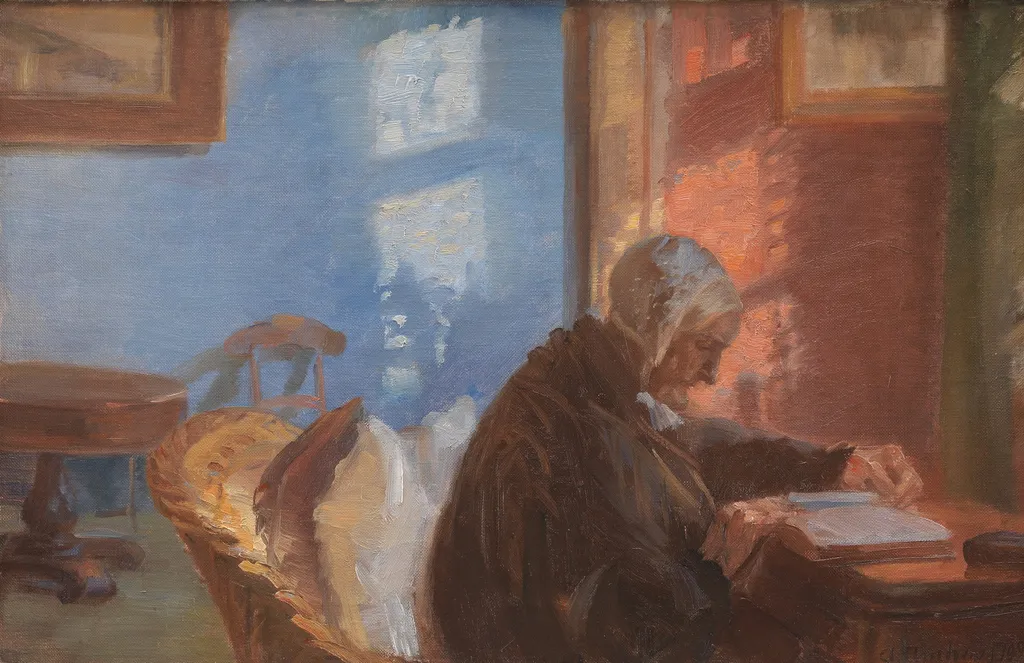
The Artist's Mother Ane Hedvig Brøndum in the Red Room is an oil painting by the Post-Impressionist artist Anna Ancher. It dates from 1909 and is held in the collection of the Statens Museum for Kunst.
About this work
This painting is called The Artist's Mother Ane Hedvig Brøndum in the Red Room. It's an oil paint work by Anna Ancher.
The painting was made in 1909. It is held at the National Gallery of Denmark, also known as Statens Museum for Kunst.
You can learn more about the artist behind this work by looking up the artist: Anna Ancher.
Subject & Meaning
The painting shows Ane Hedvig Brøndum, the artist’s mother, seated in a red‑painted interior and engrossed in a book.
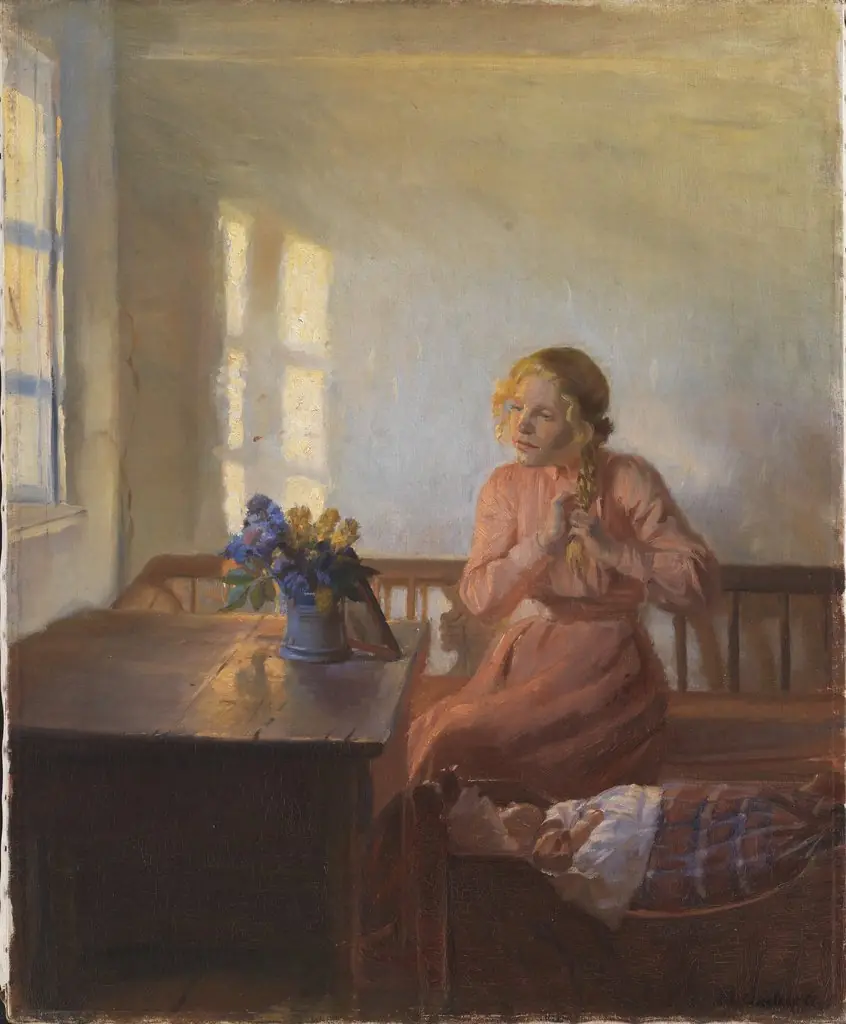
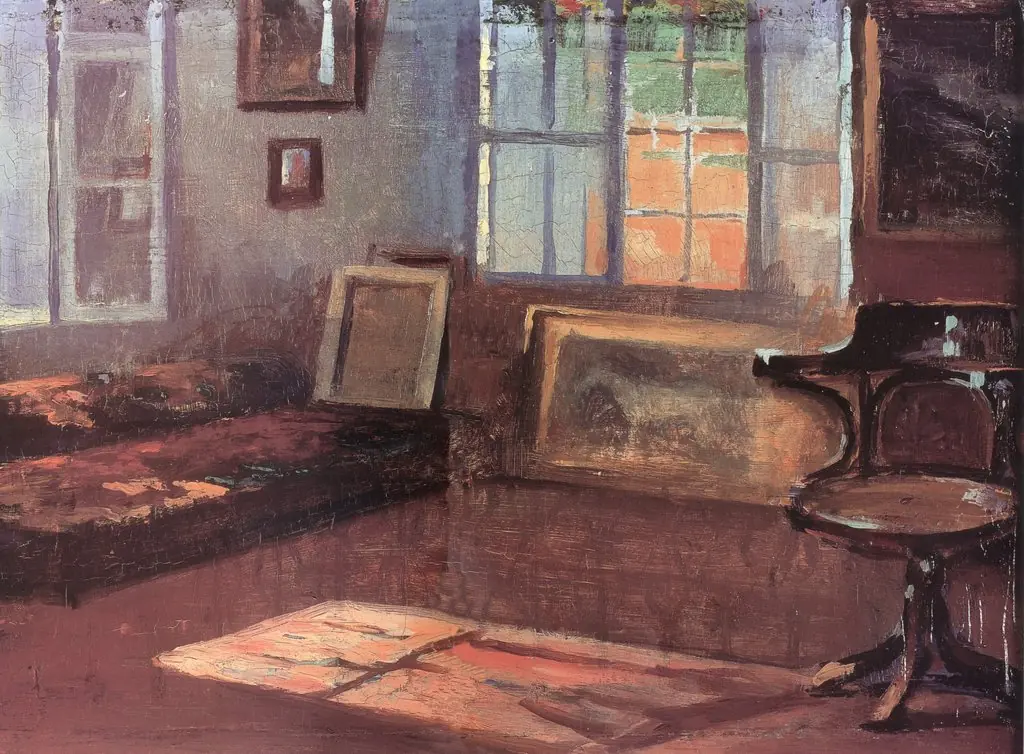
The painting shows Ane Hedvig Brøndum, the artist’s mother, seated in a red‑painted interior and engrossed in a book. She is placed in the “red room” of the family hotel, with a doorway opening onto a blue‑painted adjoining space, a composition that creates depth through contrasting warm foreground tones and cool background hues. Sunlight streams through a window, forming vertical shafts that illuminate the figure and cast faint shadows of curtains and plants, a visual reference to the careful observation of light found in the work of Johannes Vermeer.
The quiet, meditative pose reflects the subject’s devout lifestyle and her habit of retreating for prayer or reading, while the stark red foreground against the blue background underscores a symbolic contrast between earthly activity and spiritual stillness.
Technique & Style
Executed in 1909, this work is an oil painting on canvas measuring 38.8 by 56.8 cm. The composition features a saturated red foreground that contrasts sharply with the cool blue tones of an adjoining room visible through an open doorway, creating a strong sense of atmospheric depth. Ancher renders sunlight not as a uniform wash but as tangible, vertical columns that illuminate the interior walls, casting distinct shadows of unseen objects like curtains and potted plants. This precise handling of light reflects the artist's admiration for Johannes Vermeer while simultaneously applying French Impressionist color theories through a distinctively Nordic lens.
The figure of Ane Hedvig Brøndum is depicted in a meditative state, absorbed in reading without making eye contact with the viewer, a stylistic choice that emphasizes introspection and quietude typical of Ancher's portraiture.
History & Provenance
Created in 1909, the oil on canvas painting depicts Anna Ancher's mother, Ane Hedvig Brøndum, reading in the red room of the family hotel in Skagen. For much of the twentieth century, the work remained in private Danish ownership. It was sold at a private collection auction on April 22, 1991, and changed hands through subsequent sales.
On November 28, 2011, the painting was acquired at a Bruun Rasmussen auction in Copenhagen by the Statens Museum for Kunst. This acquisition was funded as a gift from the Ny Carlsbergfondet, securing the work for the national collection. Although the title sometimes varies in records, the piece is consistently dated to 1909 and entered the museum's holdings in 2011.
The painting is held by the Statens Museum for Kunst (National Gallery of Denmark) in Copenhagen. Although it remained in Danish private collections for much of the twentieth century and was sold at auction in 1991, the museum acquired the work on November 28, 2011. The acquisition occurred during a sale at Bruun Rasmussen in Copenhagen, where the piece was purchased through the Ny Carlsbergfondet and subsequently donated to the national collection.
Regarding its exhibition history, the work was selected in April 2016 as one of ten significant Danish artworks for the Europeana 280 project. It has also been featured in the exhibition titled Against All Odds: Historical Women and New Algorithms.
Context
Scholarship positions Anna Ancher as a unique interpreter of French Impressionist color theory, adapting it to a distinct Northern European sensibility. Critics note the painting's depiction of light as tangible vertical columns, a technique reflecting Ancher's admiration for Johannes Vermeer. The work is situated within the context of the Skagen Painters, a group that frequented the family hotel where the subject, Ane Hedvig Brøndum, resided.
Art historical analysis highlights the meditative quality of the portrait, where the subject is absorbed in reading rather than engaging the viewer, a recurring theme in Ancher's oeuvre. In 2016, the project Europeana 280 recognized the painting's significance by selecting it as one of the ten most important artistic works from Denmark.
Legacy
The painting's significance was formally recognized in April 2016 when it was selected as one of the ten most important artworks in Denmark by the Europeana 280 project. This digital initiative highlighted the work's status as a key piece of national cultural heritage. Its legacy is further cemented by its permanent residence at the Statens Museum for Kunst in Copenhagen, where it has been held since 2011 following a gift from the Ny Carlsbergfondet.
The acquisition by the museum ensured the portrait's preservation and public accessibility, moving it from private ownership to a major national collection. Additionally, the work has featured in exhibitions such as 'Against All Odds: Historical Women and New Algorithms', demonstrating its continued relevance in contemporary discourse on historical women and art history.
Overview
This painting, titled The Artist's Mother Ane Hedvig Brøndum in the Red Room, was created by Danish artist Anna Ancher in 1909. Executed in oil on canvas, the work depicts Ancher's mother, Ane Hedvig Brøndum, within a domestic interior characterized by its red tones. The artwork is part of the collection at the National Gallery of Denmark, located in Copenhagen, where it remains on display.
Own this work as a print
Artist & collection
Artist
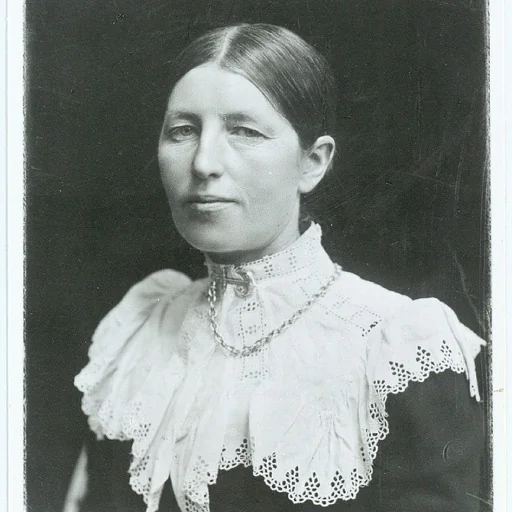
Anna Ancher (18 August 1859 – 15 April 1935) was a Danish artist associated with the Skagen Painters, an artist colony on the northern point of Jylland, Denmark. She is considered to be one of Denmark's greatest visual artists.