Artwork
Untitled
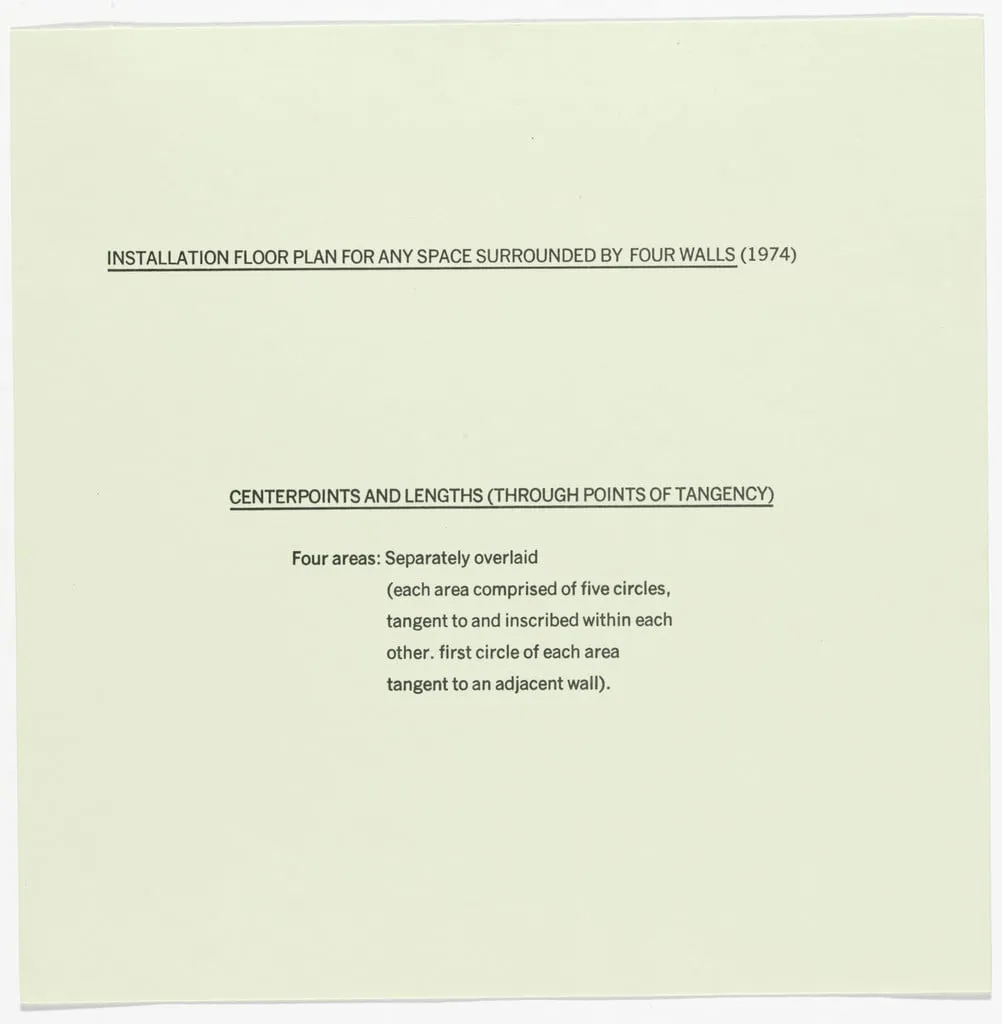
Untitled is a print by Barry Le Va. It dates from 1976 and is held in the collection of the Museum of Modern Art.
About this work
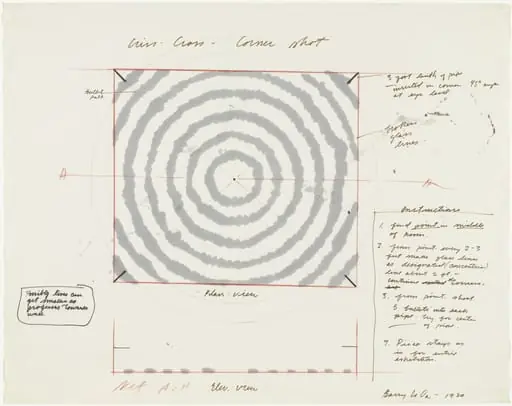
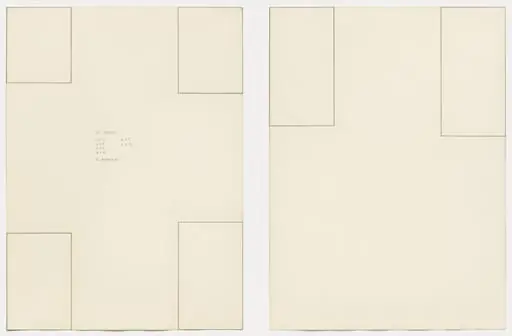
The plan is labeled as an "installation floor plan" from 1974, meaning it’s a set of directions for making something in a room.
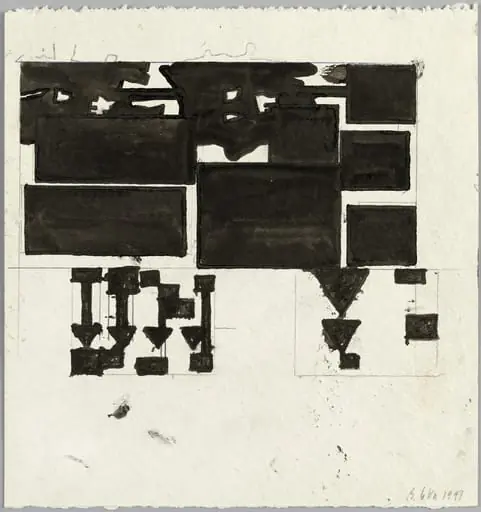
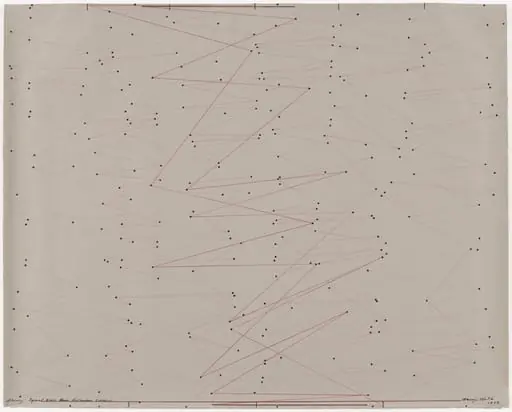
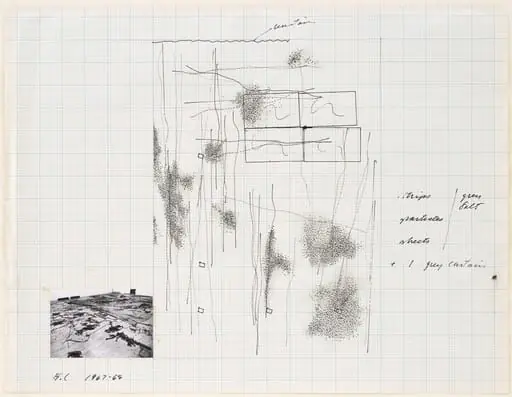
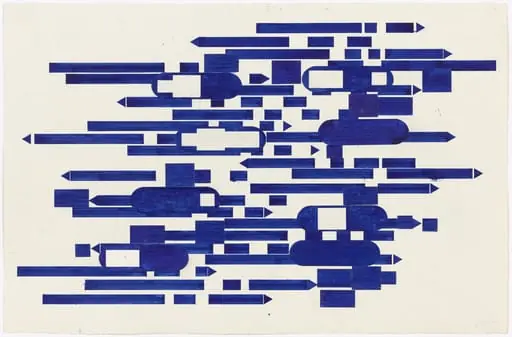
This image is a black-and-white floor plan on a light background. It shows text and geometric instructions for arranging circles in four wall corners. The words describe how to draw five circles in each corner, touching the walls and each other.
The plan is labeled as an "installation floor plan" from 1974, meaning it’s a set of directions for making something in a room. The artist turned these instructions into a rubber stamp.
Next, look up Barry Le Va to see how he turned simple ideas into art.
Overview
Created in 1976, this work is one of thirteen rubber stamps produced by Barry Le Va as part of a limited edition print portfolio. Each stamp encodes a set of spatial instructions originally conceived in 1974 as a floor plan for an installation. Rather than producing a physical sculpture, Le Va translated architectural directives into a reproducible object, shifting focus from the final form to the system that generates it.
Subject & Meaning
The stamp bears a diagram instructing the placement of five circles in each of four room corners, with each circle touching adjacent walls and neighboring forms. The subject is not an image but a rule, a precise, repeatable protocol for generating spatial arrangements. This reflects Le Va’s interest in systems that produce structure without dictating aesthetic outcome, prioritizing process over visual result.
Technique & Style
Le Va used rubber stamping, a mechanical, industrial method, to reproduce a hand-drawn floor plan. The black-and-white design is stark and functional, devoid of ornamentation. The technique aligns with his broader practice of reducing artistic gesture to procedural logic, using reproducible media to challenge traditional notions of originality and authorship in art-making.
History & Provenance
The stamp originated from a 1974 installation proposal that Le Va later serialized into a portfolio of thirteen stamped works in 1976. These were produced in a limited edition, each identical, emphasizing the conceptual nature of the work over uniqueness. The portfolio was part of a broader shift in late 1970s art toward dematerialized forms and documentation as primary artifacts.
Context
Le Va worked within the post-studio and process art movements, which rejected traditional sculptural objects in favor of systems, materials, and site-specific actions. His rubber stamps emerged alongside other artists exploring instruction-based art, such as Sol LeWitt, but with a focus on architectural space and physical constraints rather than purely geometric abstraction.
Legacy
This work exemplifies how conceptual art extended beyond the gallery wall into reproducible, portable forms. By turning installation instructions into stamps, Le Va influenced later practices in dematerialized art and artist multiples. The stamp remains a quiet but significant artifact of 1970s efforts to redefine art as a set of conditions rather than a fixed object.
Artist & collection
Artist
Barry Edward Le Va (December 28, 1941 – January 24, 2021) was an American sculptor and installation artist.