Artwork
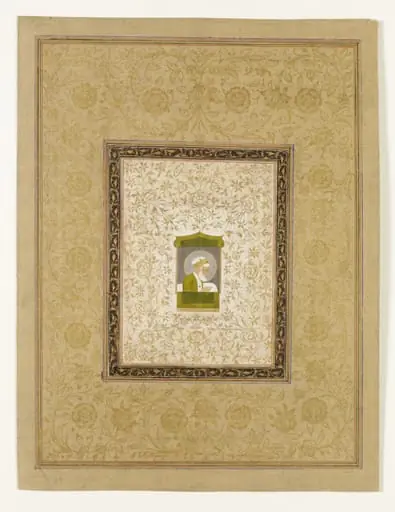
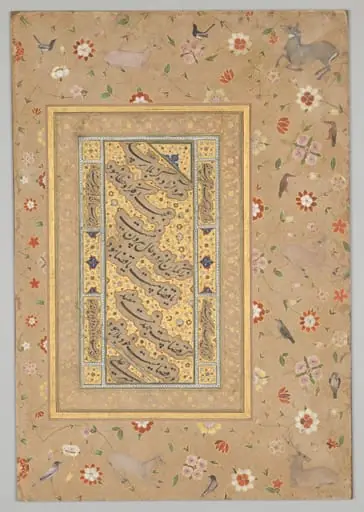
Shamsa (sunburst) with portrait of Aurangzeb (1618–1707), from the Emperor's Album (the Kevorkian Album)
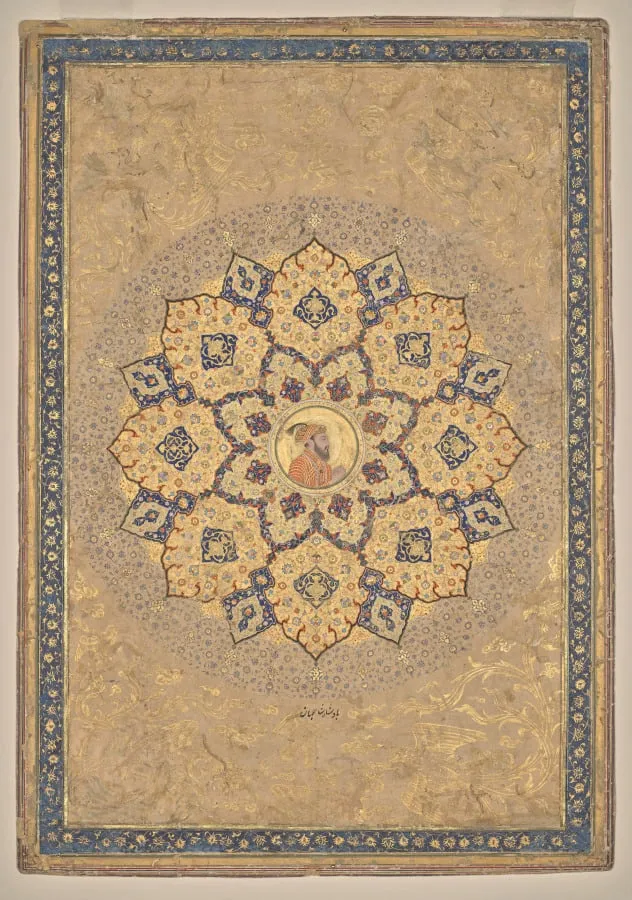
Shamsa (sunburst) with portrait of Aurangzeb (1618–1707), from the Emperor's Album (the Kevorkian Album) is an unspecified painting by the Baroque artist Bichitr. It dates from 1648 and is held in the collection of the Cleveland Museum of Art.
- Accession no.
- 2013.331
- Credit line
- Gift in honor of Madeline Neves Clapp; Gift of Mrs. Henry White Cannon by exchange; Bequest of Louise T. Cooper; Leonard C. Hanna Jr. Fund; From the Catherine and Ralph Benkaim Collection
About this work
Overview
This illuminated page once served as the closing folio of an imperial Mughal album, featuring a meticulously crafted sunburst design in gold and lapis lazuli.
This illuminated page once served as the closing folio of an imperial Mughal album, featuring a meticulously crafted sunburst design in gold and lapis lazuli. Originally devoid of portraiture, it functioned as a symbolic representation of divine radiance legitimizing imperial authority. The portrait of Aurangzeb was later inserted over the central gold disc, transforming the page from a spiritual emblem into a personal assertion of power following his ascension to the throne.
Subject & Meaning
The sunburst, a traditional Mughal motif, symbolized the divine light sanctioning the emperor’s rule. When Aurangzeb replaced the empty center with his own likeness, the image shifted from a metaphysical statement to a political declaration. His inclusion of prayer beads in his right hand underscores his public devotion and signals a departure from the pluralistic court culture of his predecessors, aligning his image with religious austerity.
Technique & Style
The sunburst was executed with fine brushwork using gold leaf and ground lapis lazuli, arranged in geometric and floral patterns with exacting symmetry. The portrait of Aurangzeb, painted in a naturalistic Mughal style, contrasts with the ornamental background, suggesting it was added separately. The precision of the illumination reflects the high standards of imperial ateliers, while the portrait’s insertion reveals a pragmatic reuse of existing materials.
History & Provenance
The album was compiled during Shah Jahan’s reign, with the sunburst page intended as a ceremonial finale. After Aurangzeb seized power in 1658, he appropriated the imperial library and altered this page to assert his legitimacy. The portrait’s placement over the original design indicates a deliberate act of reclamation, turning a symbol of his father’s divine mandate into a record of his own succession.
Context
Mughal imperial albums were curated as visual archives of power, blending poetry, calligraphy, and portraiture. Prior rulers embraced religious pluralism, but Aurangzeb’s reign marked a turn toward orthodoxy. His portrait on this page reflects not only personal authority but also a broader cultural shift, where courtly expression became more rigid and doctrinally aligned, distancing itself from earlier syncretic traditions.
Legacy
The altered shamsa stands as a rare physical record of dynastic transition within a Mughal album. Its layered composition, original symbolism overwritten by political necessity, offers insight into how imperial imagery was manipulated to suit new rulers. As part of the Kevorkian Album, it remains a key artifact for understanding the intersection of art, authority, and religious identity in late Mughal India.
Artist & collection

Artist
Bichitr was an Indian painter during the Mughal period, patronized by the emperors Jahangir and Shah Jahan. The earliest known painting of his is a mature work from c. 1615.