Artwork
Force of a Bottle
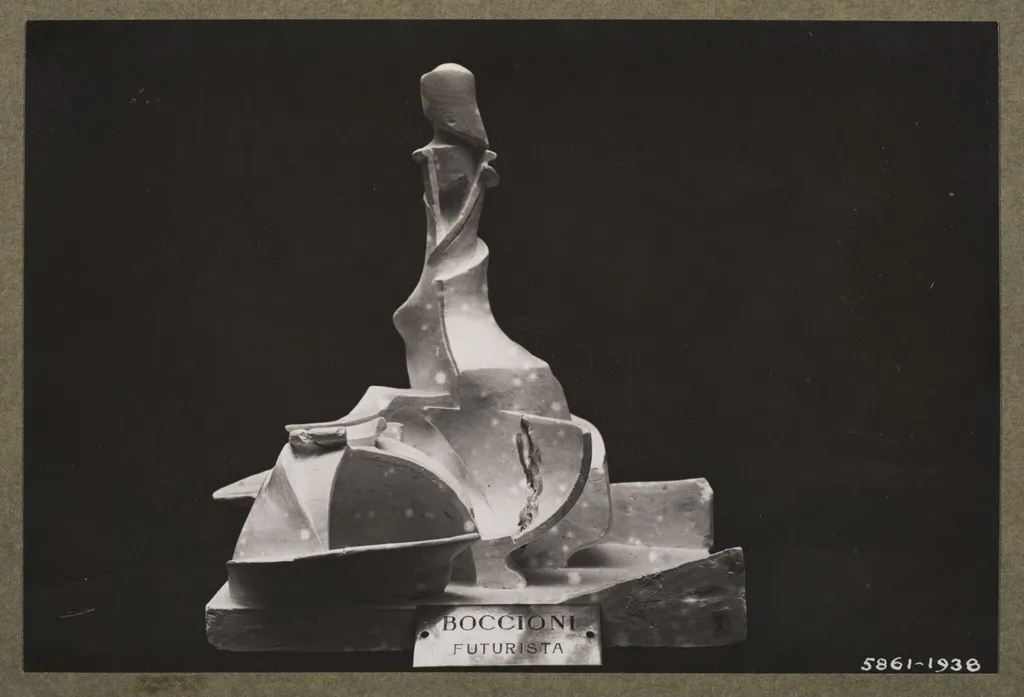
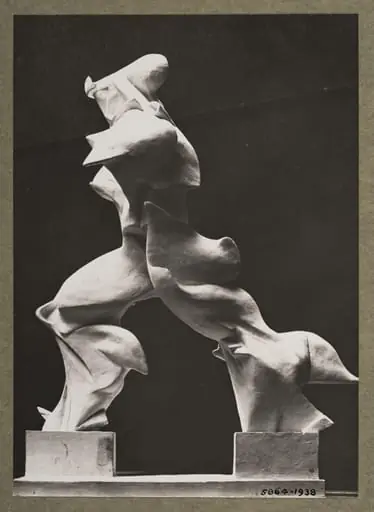
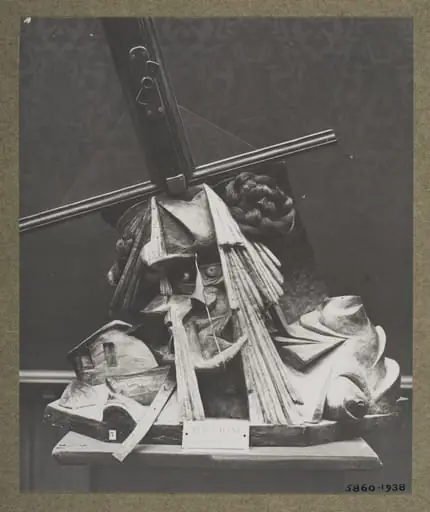
Force of a Bottle is a photographic photography by Umberto Boccioni. It is held in the collection of the Victoria and Albert Museum.
About this work
Overview
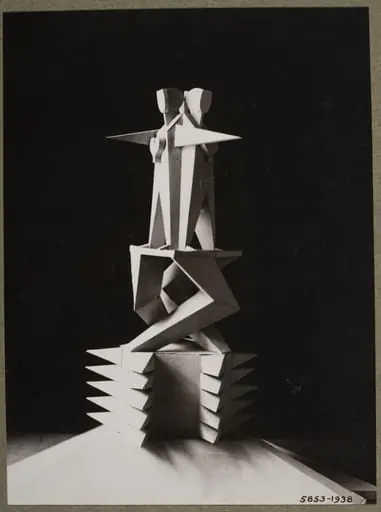
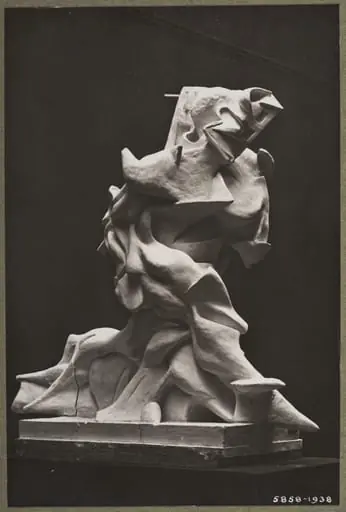
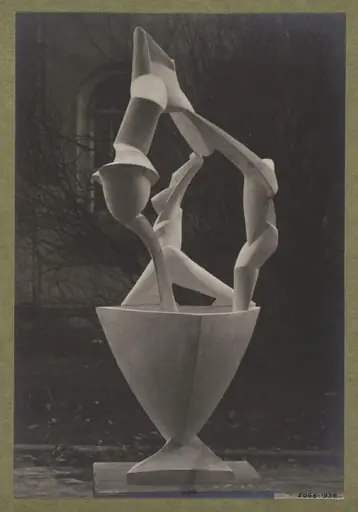
The image is mounted on green cardstock and was among a group of photographs sent to William Kineton Parkes during his 1920s survey of sculptors.
A black-and-white photograph from 1920 captures a sculptural work by Umberto Boccioni titled Force of a Bottle. The image is mounted on green cardstock and was among a group of photographs sent to William Kineton Parkes during his 1920s survey of sculptors. Parkes later bequeathed the collection to the Archive of Art and Design in 1938, preserving this visual record of Boccioni’s experimental form.
Subject & Meaning
The sculpture depicts an abstracted human figure composed of jagged, intersecting planes, evoking mechanical fragmentation rather than organic form. The tilted head, obscured by a dark, hat-like mass, and the distorted limbs suggest motion or disruption. The inscription 'Boccioni Futurista' on the base anchors the work within the Futurist ethos, which sought to express dynamism, industrial energy, and the rupture of traditional representation.
Technique & Style
Boccioni rendered the figure through sharp, angular volumes that reject naturalistic modeling. The sculpture’s fractured surfaces and asymmetrical posture reflect his interest in Cubist decomposition and kinetic energy. The photograph, taken in monochrome, emphasizes contrast and geometric tension, translating the sculpture’s physical presence into a flat, graphic record that aligns with Futurist visual strategies.
History & Provenance
The photograph was one of many submitted to William Kineton Parkes in the 1920s as part of his research initiative, which collected responses and images from contemporary sculptors. After Parkes’s death in 1938, his archive, including this image, was donated to the Archive of Art and Design. The photograph’s survival offers insight into Boccioni’s posthumous influence and the circulation of avant-garde work through institutional networks.
Context
Created after Boccioni’s death in 1916, this work reflects the lingering impact of his Futurist theories on sculptural practice. Though he did not live to see its full reception, the piece aligns with his 1912 manifesto advocating for sculpture that captures movement and modernity. The photograph’s inclusion in Parkes’s survey underscores how his ideas continued to shape artistic discourse in the early 1920s.
Legacy
The photograph preserves a fleeting moment in the evolution of modernist sculpture, documenting a form that challenged classical ideals. As part of Parkes’s archive, it contributes to the historical record of how avant-garde works were documented, disseminated, and interpreted by contemporaries. Its survival allows ongoing study of Boccioni’s influence beyond his lifetime.
Artist & collection

Artist
Umberto Boccioni was an influential Italian painter and sculptor. He helped shape the revolutionary aesthetic of the Futurism movement as one of its principal figures. Despite his short life, his approach to the…

![Mia madre che lavora [My Mother Working], by Umberto Boccioni](https://artifactworldgallery.com/img/umberto-boccioni--mia-madre-che-lavora-my-mother-working--ce84f1205dd9eec1-w320.webp)
![Woman Reading [Donna che legge], by Umberto Boccioni](https://artifactworldgallery.com/img/umberto-boccioni--woman-reading-donna-che-legge--d9496ecdedc4f414-w320.webp)
![Periphery [Periferia], by Umberto Boccioni](https://artifactworldgallery.com/img/umberto-boccioni--periphery-periferia--ea91379039261e85-w320.webp)