Artwork
Bolshevik
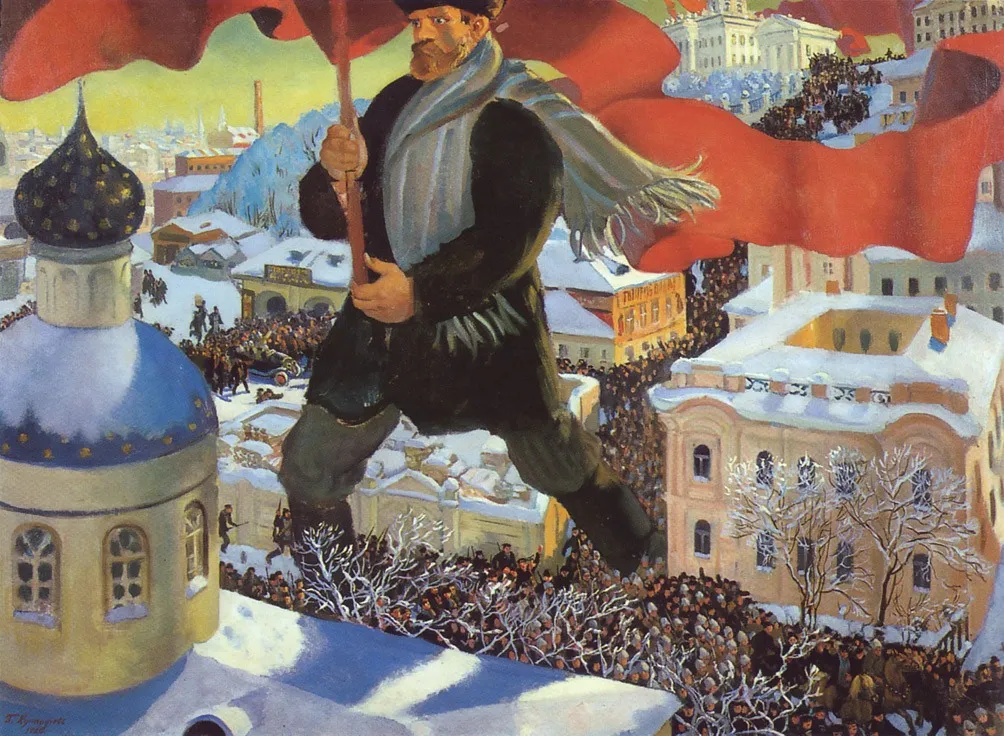
Bolshevik is an oil painting by the Naïve symbolist artist Boris Kustodiev. It dates from 1920 and is held in the collection of the Tretyakov Gallery. Created in 1920 by Boris Mikhailovich Kustodiev, this oil painting captures a dramatic moment from the early Soviet era.
About this work
Subject & Meaning
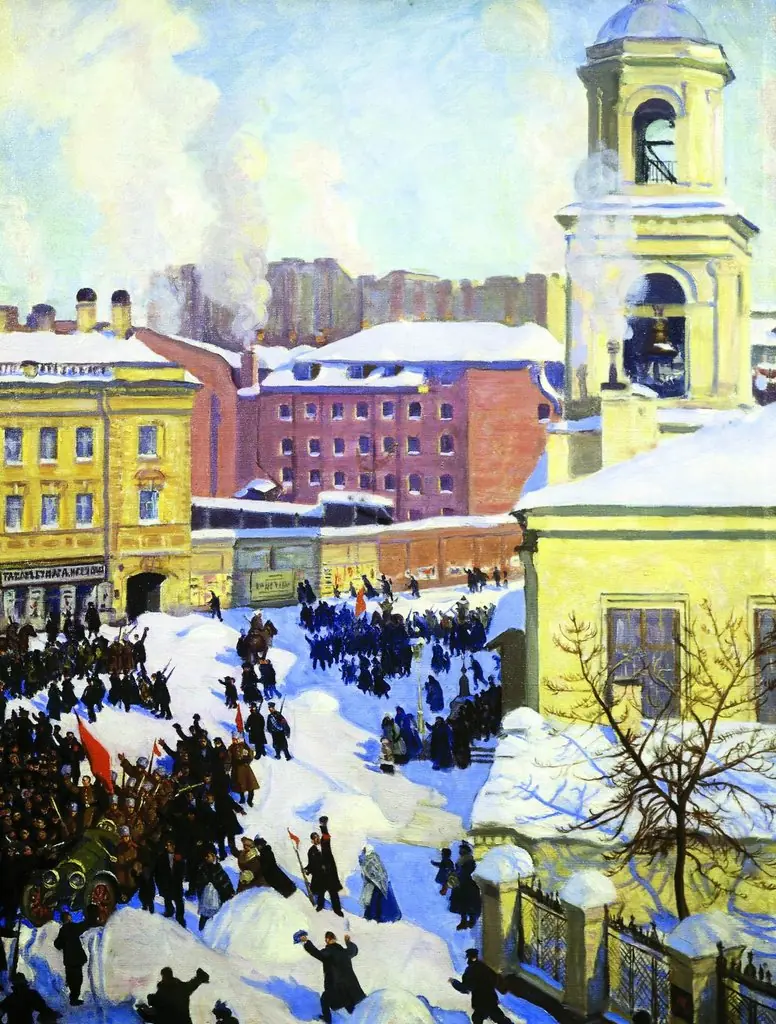
The painting depicts a towering Bolshevik figure carrying a red flag, marching through a crowded urban street lined with buildings, churches and domes.
The painting depicts a towering Bolshevik figure carrying a red flag, marching through a crowded urban street lined with buildings, churches and domes. The scene is set during the October Revolution of 1917, symbolizing the arrival of a new ideological order. Kustodiev renders the Bolshevik as a quasi‑divine revolutionary, reflecting his attempt to understand the causes and consequences of the revolution and to express a spontaneous sentiment toward Bolshevism as the new god of a communist paradise.
The work was created in 1920, measures 101 × 140.5 cm, and is housed in the Tretyakov Gallery in Moscow.
Technique & Style
Executed in 1920, Bolshevik is an oil painting on canvas measuring 101 cm in height and 140.5 cm in width. The work is classified within the naive symbolism movement, a stylistic approach the artist employed to create an allegorical representation of the October Revolution. Visually, the composition features a gigantic central figure holding a floating red flag, striding over a dense crowd situated among churches and palaces.
This formal arrangement utilizes vivid colors to depict the bustling street scene and the towering protagonist, reflecting Kustodiev's attempt to express a spontaneous sentiment toward Bolshevism through a symbolic, rather than strictly realistic, lens.
History & Provenance
Boris Kustodiev’s Bolshevik was painted in 1920, as confirmed by the artist’s date and the Tretyakov Gallery’s records.
The work was created during the immediate post-revolutionary period, reflecting Kustodiev’s turn toward revolutionary themes after years of depicting merchant life. Although paralyzed from 1915 onward, he followed the 1917 revolutions from his Moscow window and later painted directly from his recollections, as recounted by his daughter Irina, who described his emotional response to the sight of red flags in the streets during the February Revolution.
The painting was not commissioned but emerged from Kustodiev’s personal reckoning with the October Revolution and the Bolshevik seizure of power. Initially hesitant to exhibit it, fearing political misinterpretation, he ultimately submitted Bolshevik to critical acclaim as a canonical work of early Soviet art in the naïve-symbolist vein.
Since its completion, the painting has remained in Russia and is now held by the Tretyakov Gallery in Moscow.
Bolshevik is held by the Tretyakov Gallery in Moscow, which owns the painting as part of its collection. The work was acquired by the Russian state and subsequently entered the gallery's holdings, where it remains on display.
The French-language source notes that Kustodiev initially hesitated to send the canvas to an exhibition, fearing it would be read as a provocation against Soviet authorities. His concerns were ultimately dispelled when critics received the work as a classic of early post-revolutionary Soviet art in the naïve-symbolist mode, which helped secure its acceptance into the institutional canon and its eventual placement at the Tretyakov Gallery.
Context
Critical reception of Kustodiev's Bolshevik has consistently highlighted its symbolic power and stylistic uniqueness within early Soviet art. Scholars note the work's allegorical portrayal of revolutionary fervor, with contemporary critics characterizing it as a rare, almost naive symbolist expression that resonated with Soviet authorities despite its potential provocation. The painting's debut at the Tretyakov Gallery was interpreted as a significant endorsement of the new regime's cultural vision, cementing its status as a foundational piece of revolutionary art.
Its depiction of a colossal, flag-bearing figure navigating a crowded street scene was praised for capturing the spontaneous energy of the February Revolution, though later interpretations emphasized its complex relationship with Soviet ideology. The work remains a focal point in scholarship on the artist's shift from bourgeois genre scenes to revolutionary subjects, reflecting broader debates about art's role in the early Soviet state.
Legacy
The legacy of Bolshevik lies in its symbolic portrayal of the October Revolution as a transformative, almost divine, moment in Soviet history. Created by Boris Kustodiev in 1920, the painting was initially met with caution by the artist, who feared it might be seen as a provocation by Soviet authorities, yet it was later celebrated as a classic of early Soviet art and a representative example of naive symbolism. Today it remains on display at the Tretyakov Gallery in Moscow, where it continues to be referenced as an iconic visual narrative of the revolutionary era.
Overview
Created in 1920 by Boris Mikhailovich Kustodiev, this oil painting captures a dramatic moment from the early Soviet era. A bearded man in a long coat soars forward, his red banner unfurled like a mantle against a wintry cityscape. Below, countless tiny figures march through snow‑filled streets, while domed structures and spires punctuate the background, emphasizing the scale of the gathering.
Artist & collection
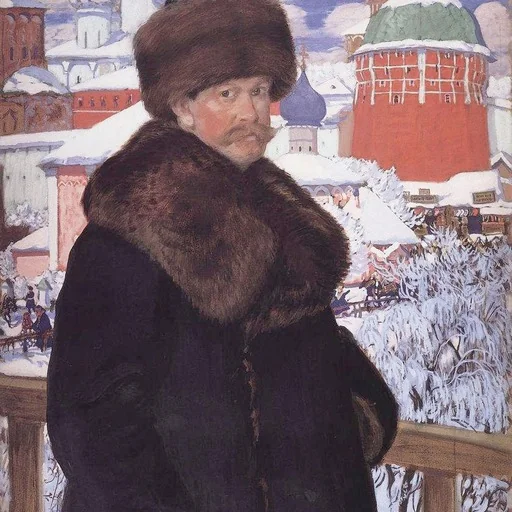
Artist
Boris Mikhaylovich Kustodiev (Russian: Борис Михайлович Кустодиев; 7 March 1878 – 28 May 1927) was a Russian painter, draughtsman, and stage designer during the Modernist period.