Movement
Naïve symbolism
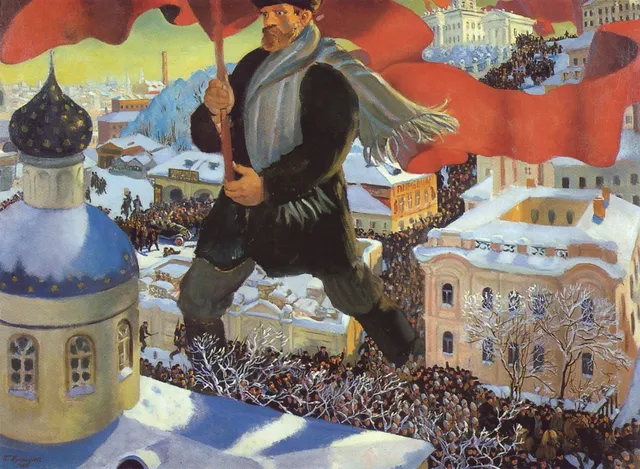
Naïve symbolism is an art movement of the 1890–1950 period. The gallery holds 1 work in this movement. Browse Naïve symbolism paintings, portraits, pictures and artworks from the world's public-domain museum collections.
"Naïve symbolism" is less a formally organized school than a descriptive crossing of two currents that emerged in late nineteenth-century Europe: Symbolism and Naïve art. Symbolist painting arose in France in the 1880s as a reaction against the naturalism of Realist and Impressionist art, favouring dream, myth and inner states over observed fact—its theorists looked to figures such as Gustave Moreau and Odilon Redon. In parallel, self-taught painters working outside the academies won serious attention, above all Henri Rousseau, a former Paris customs official who took up painting in earnest around 1893 and exhibited at the Salon des Indépendants. Where the two meet—untrained, deliberately "innocent" handling marshalled to carry mysterious, poetic meaning—is the territory this term names.
The shared visual language is immediately recognisable: flattened, frontal space; firm contours and smooth, unmodulated colour; meticulous detail held in a composition that ignores academic perspective and proportion. Scale is bent to feeling rather than optics, and ordinary motifs—a sleeping figure, an animal, a village, a banner—are charged with symbolic weight. The faux-naïve surface is the point: its calm, storybook clarity makes the strangeness underneath feel inevitable rather than contrived.
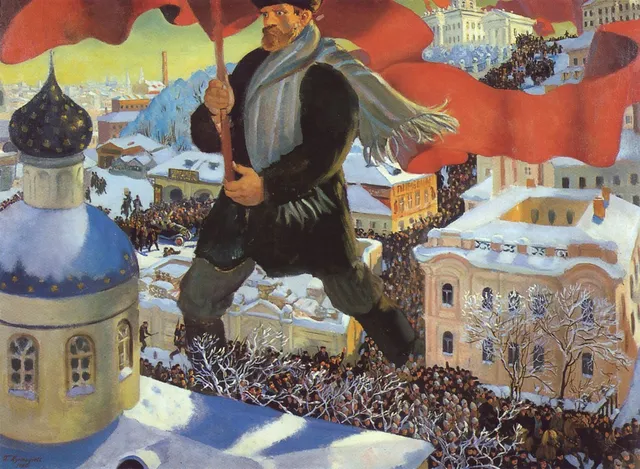
Rousseau is the central figure. His Sleeping Gypsy (1897) sets a lion beside a recumbent lute-player under a still moon, while The Dream (1910) places a nude on a divan within a luminous jungle—both poised between waking and reverie. Marc Chagall extended the idiom eastward in I and the Village (1911), fusing memories of his native Vitebsk with floating figures and folk emblems. The Georgian Niko Pirosmani, painting taverns and animals on oilcloth and rediscovered by the Russian avant-garde in the 1910s, gave the tendency a starker, vernacular edge. Boris Kustodiev's Bolshevik (1920, Tretyakov Gallery)—held in this collection—belongs here too: a folktale giant strides over Moscow bearing a vast red banner, revolution rendered as modern myth.
The approach proved unexpectedly influential. Picasso and the poet Guillaume Apollinaire championed Rousseau, and the Surrealists embraced his dream-logic as a precursor to their own. As a sensibility rather than a programme, naïve symbolism overlaps with Primitivism and anticipates Magic Realism, and it continues to inform self-taught and outsider painters who pursue meaning through deliberate simplicity.
Works
Frequently asked questions
What is Naïve symbolism?
Naïve symbolism is an art movement. A blend of untrained, 'naïve' directness with dreamlike symbolic content.
When did Naïve symbolism take place?
Naïve symbolism dates from 1890–1950.
Where can I see Naïve symbolism works?
Naïve symbolism works in the collection are held by Tretyakov Gallery.