Artwork
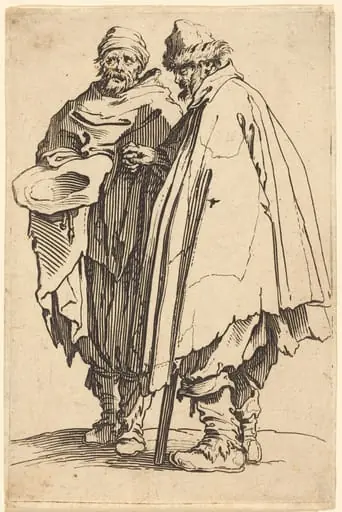
Blind Beggar and Companion
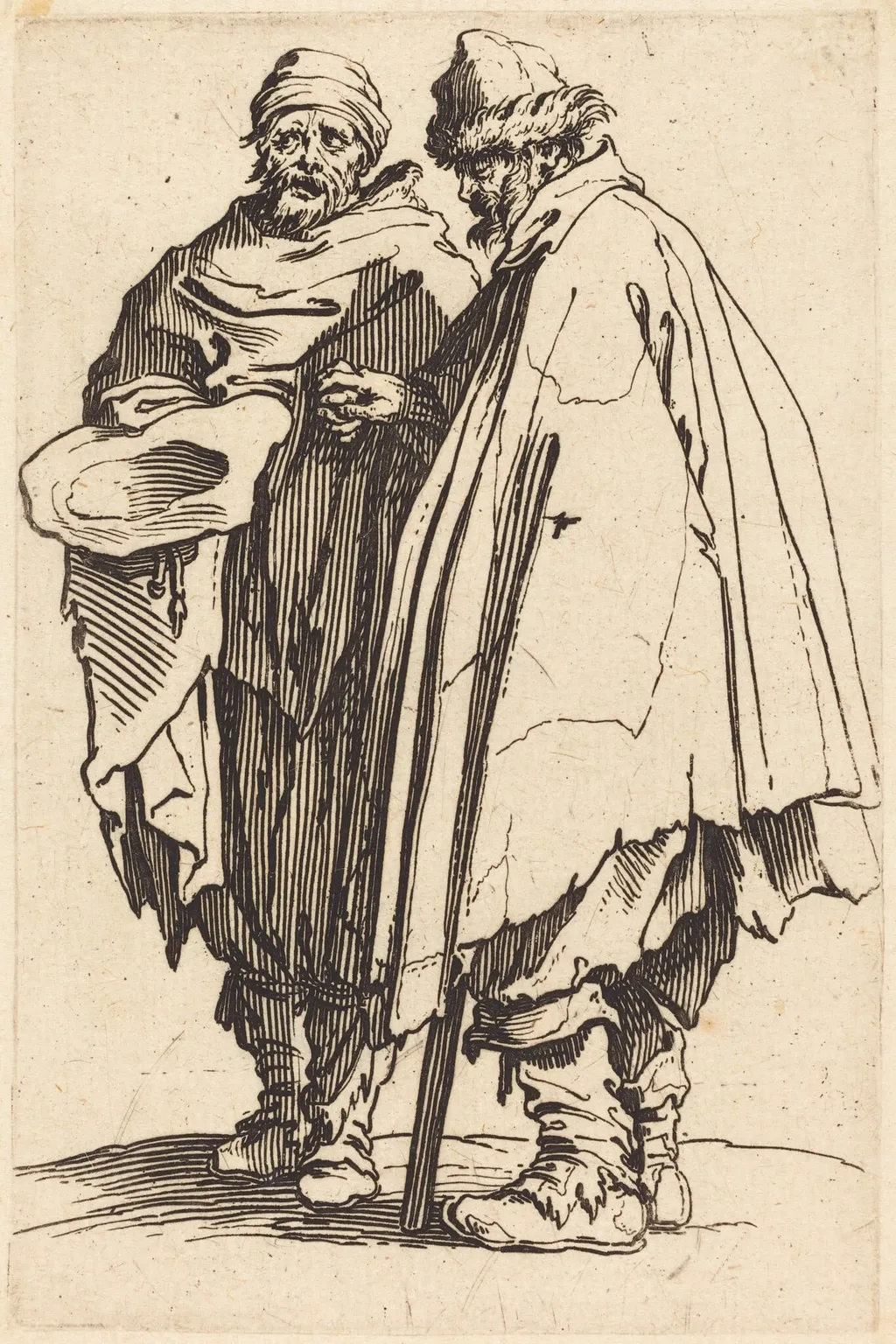
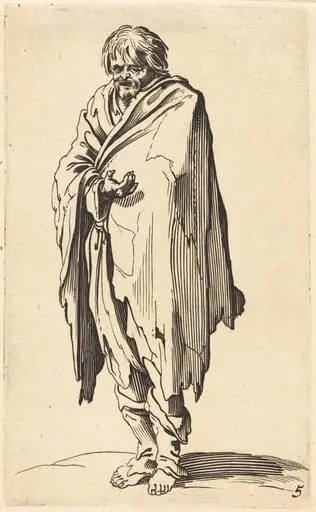
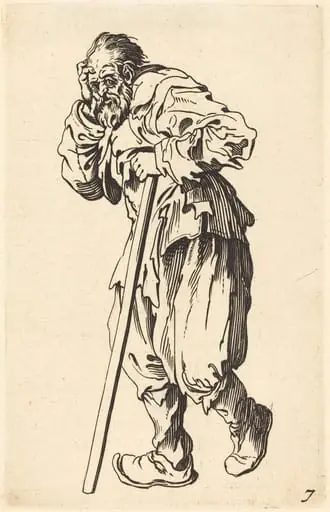
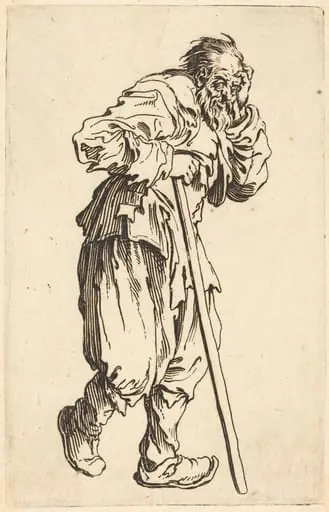
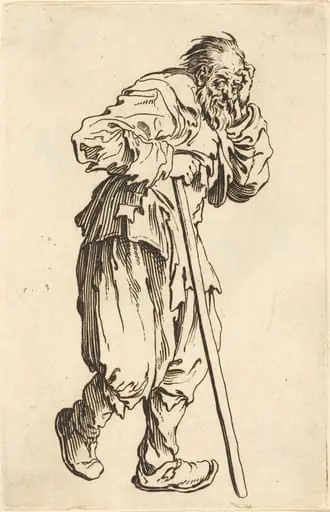
Blind Beggar and Companion is an ink print by the Baroque artist Jacques Callot. It dates from 1622 and is held in the collection of the National Gallery of Art.
About this work
Overview
Jacques Callot created this etching around 1622, capturing a moment of quiet dependence between two marginalized men. Executed on laid paper, the work belongs to a large corpus of prints in which Callot observed everyday life in early 17th-century Europe. His focus on figures often overlooked by society reflects a documentary impulse, grounded in precise observation rather than idealization.
Subject & Meaning
The image portrays a blind man leaning on his companion, both figures appearing weary and disheveled. Their proximity suggests mutual reliance, not charity. The companion, dressed in a long coat and hat, offers physical support but shares the same air of hardship. Callot avoids sentimentality, presenting their condition as a quiet fact of social reality, not a moral lesson.
Technique & Style
Callot used etching to achieve fine, controlled lines on a metal plate, allowing subtle gradations of tone and texture. The worn fabric, weathered faces, and the blind man’s looped cane are rendered with meticulous detail. His technique emphasizes surface and posture over dramatic expression, lending the scene an unembellished, almost reportorial quality.
History & Provenance
The print is one of over 1,400 etchings produced by Callot during his career. While its specific early ownership is undocumented, it was likely circulated among collectors and artists in Lorraine and France. As part of his broader studies of urban and rural life, this work aligns with other depictions of beggars and soldiers that circulated widely in print form.
Context
In the early 1600s, widespread poverty and displacement followed decades of religious conflict and economic strain across Europe. Callot, based in Nancy and later Florence, observed these conditions firsthand. His depictions of beggars, soldiers, and laborers formed a visual record of social fragility, distinct from the grand narratives favored by contemporaries.
Legacy
Callot’s unflinching portrayals of the marginalized influenced later generations of printmakers, including Goya and Daumier. His commitment to observing ordinary lives with technical precision helped establish etching as a medium for social commentary. This work remains a quiet testament to the dignity found in vulnerability, without embellishment or judgment.
Own this work as a print
Artist & collection
Artist
Jacques Callot (French: ; c. 1592 – 1635) was a baroque printmaker and draftsman from the Duchy of Lorraine. He is an important person in the development of the old master print. He made more than 1,400 etchings that…

 Holy Family at supper
 Restoration of the Aqueduct at Pisa
 Restoration of the Aqueduct at Pisa
 Square in Paris with Many Figures
 Square in Paris with Many Figures
 Horsemen Attacked by Robbers
 HOW WILL A COVERED PART BE CORRECTED?HOW WIKA A COVERED HEART DEED CORRECTED?
![Christ Walking on the Water [second plate], by Jacques Callot](https://artifactworldgallery.com/img/jacques-callot--christ-walking-on-the-water-second-plate--2069f3bfe4cb2126-w320.webp) Christ Walking on the Water [second plate]
Christ Walking on the Water [second plate]