Artwork
Three Gentlemen
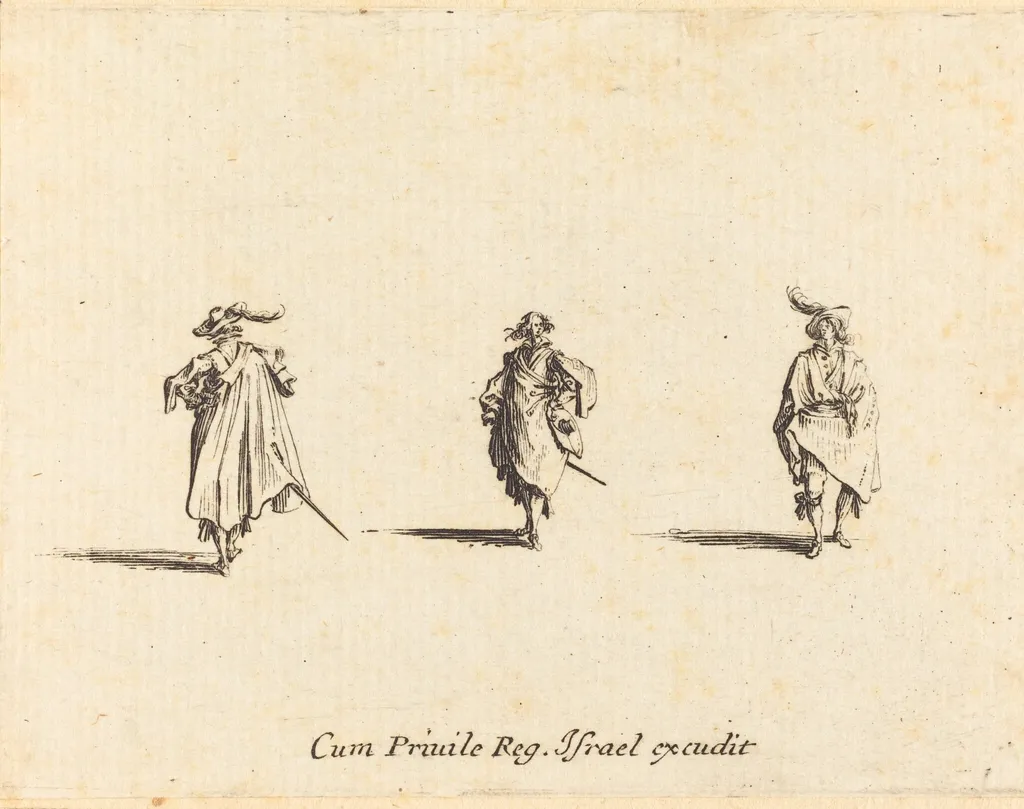
Three Gentlemen is an ink print by the Baroque artist Jacques Callot. It dates from 1634 and is held in the collection of the National Gallery of Art.
About this work
Overview
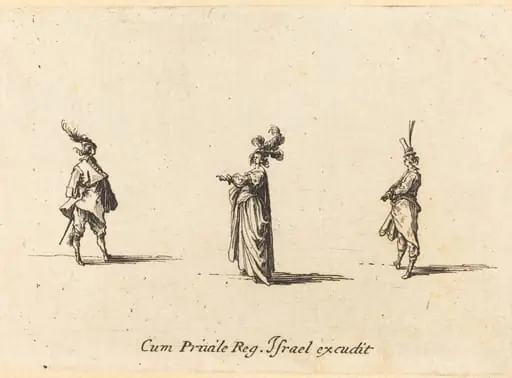
This piece presents three figures in motion, rendered with fine, incised lines that define both form and texture, characteristic of his approach to printmaking.
Created around 1634, this etching on laid paper is one of over 1,400 works by Jacques Callot, a French artist from the Duchy of Lorraine. Known for his meticulous technique and keen observation of daily life, Callot used etching to capture fleeting moments with precision. This piece presents three figures in motion, rendered with fine, incised lines that define both form and texture, characteristic of his approach to printmaking.
Subject & Meaning
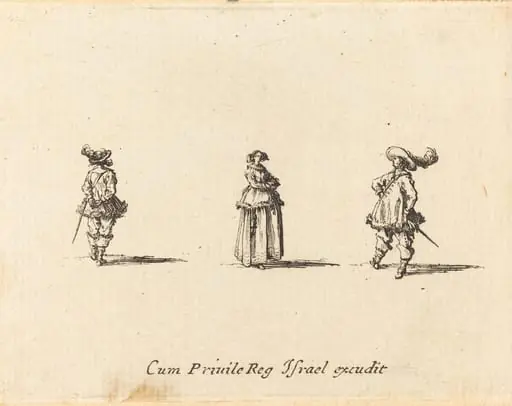
The three men, dressed in elaborate 17th-century attire, appear as figures of leisure or minor nobility, each in a distinct posture. Their garments, long coats, capes, and feathered hats, are richly detailed but disheveled, suggesting movement or haste. The absence of narrative context invites interpretation: they may be courtiers en route to an engagement, or travelers caught in a moment of transition, reflecting Callot’s interest in the quiet dramas of everyday life.
Technique & Style
Callot employed etching to achieve fine, controlled lines that convey both texture and motion. The scratchy yet deliberate strokes define fabric folds, hat brims, and the uneven ground beneath the figures. The paper’s laid texture enhances the tactile quality of the image, while the density of line work demonstrates his mastery of the medium. His technique allowed for rapid yet intricate rendering, ideal for capturing transient gestures without sacrificing detail.
History & Provenance
This print originates from Callot’s prolific period in the early 1630s, when he was active in France and Italy, producing scenes drawn from contemporary society. While the specific provenance of this sheet is undocumented, it aligns with his broader body of work that circulated widely among collectors and artists. Its survival reflects the demand for his prints, which were prized for their technical innovation and observational depth.
Context
In the 1630s, etching emerged as a favored medium for artists seeking to document social types and urban life. Callot’s work responded to a growing interest in realism and the depiction of ordinary figures, even among the elite. His prints, including this one, contributed to a visual culture that valued nuance over idealization, offering a window into the material and behavioral details of early modern Europe.
Legacy
Callot’s influence extended through generations of printmakers who adopted his fine-line etching methods. His ability to render complex scenes with clarity and economy set a standard for narrative printmaking. Though this particular image is not among his most famous, it exemplifies his enduring contribution: transforming the etching into a vehicle for subtle, lifelike observation rather than mere illustration.
Own this work as a print
Artist & collection
Artist
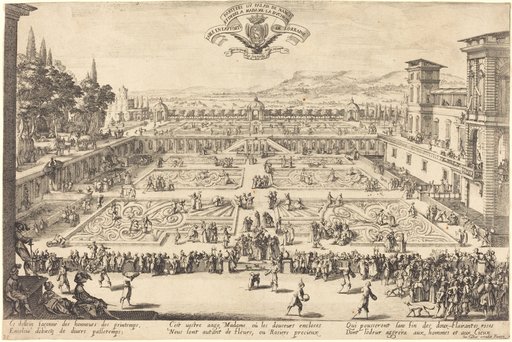
Jacques Callot (French: ; c. 1592 – 1635) was a baroque printmaker and draftsman from the Duchy of Lorraine. He is an important person in the development of the old master print. He made more than 1,400 etchings that…

 Holy Family at supper
 Restoration of the Aqueduct at Pisa
 Restoration of the Aqueduct at Pisa
 Square in Paris with Many Figures
 Square in Paris with Many Figures
 Horsemen Attacked by Robbers
 HOW WILL A COVERED PART BE CORRECTED?HOW WIKA A COVERED HEART DEED CORRECTED?
![Christ Walking on the Water [second plate], by Jacques Callot](https://artifactworldgallery.com/img/jacques-callot--christ-walking-on-the-water-second-plate--2069f3bfe4cb2126-w320.webp) Christ Walking on the Water [second plate]
Christ Walking on the Water [second plate]
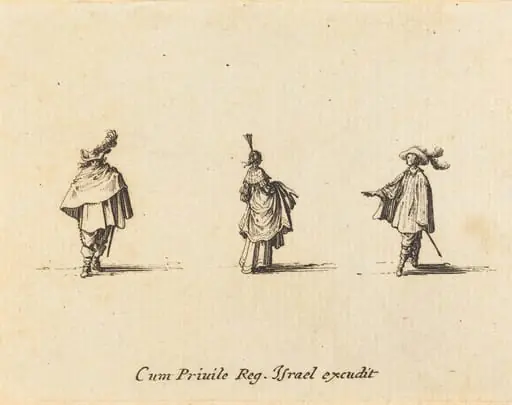 Lady with Dress Gathered Up, and Two Gentlemen
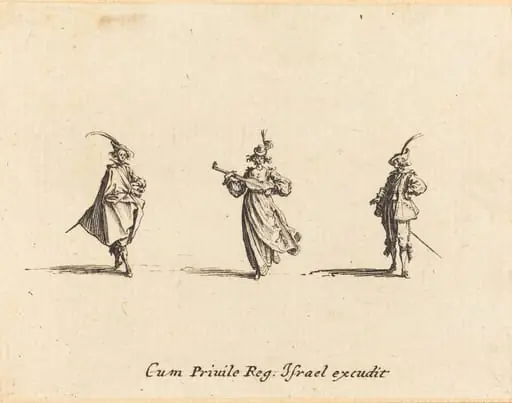 Lady with String Instrument, and Two Gentlemen
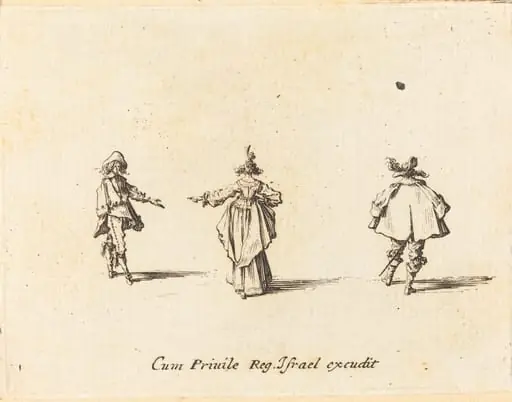 Lady with Outstretched Arm, Seen from Behind, and Two Gentlemen
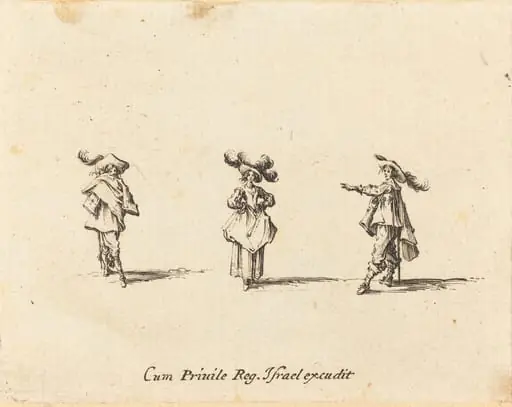 Lady with Large Plumes, and Two Gentlemen
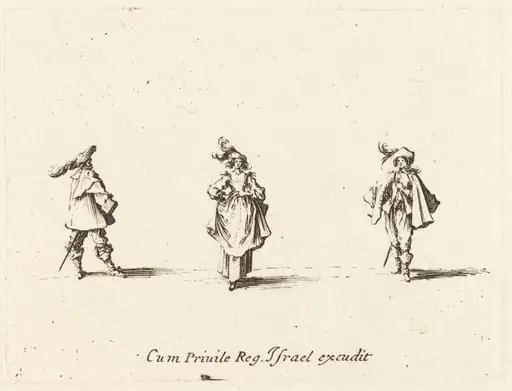 Lady with Plumes, and Two Gentlemen
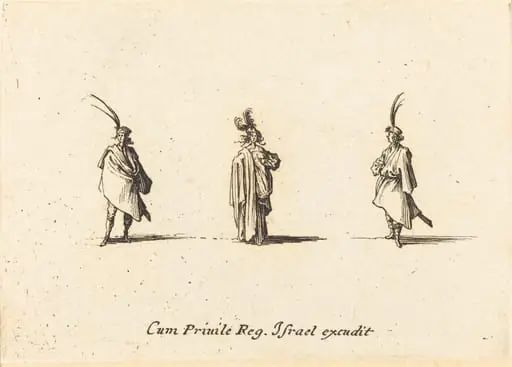 Lady in Long Cloak, and Two Gentlemen
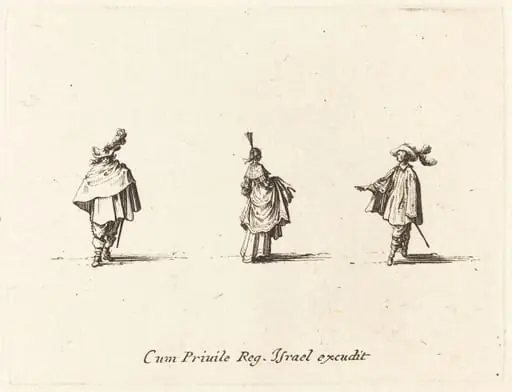 Lady with Dress Gathered Up, and Two Gentlemen
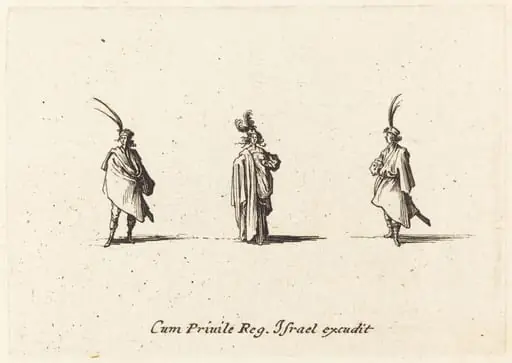 Lady in Long Cloak, and Two Gentlemen
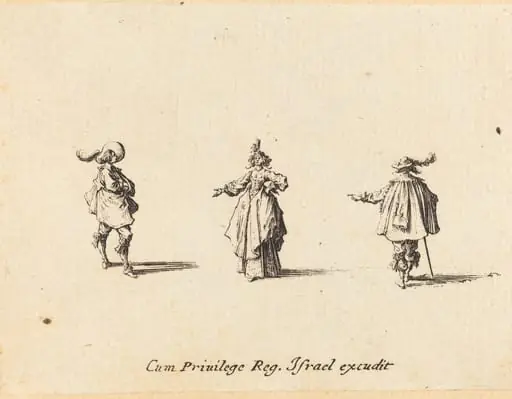 Lady with Outstretched Arm, and Two Gentlemen
 Lady with Plumed Hat, and Two Gentlemen
- Three Gentlemen
 Lady with Arms Folded, and Two Gentlemen