Artwork
Saint Martin with His Horse in a Ship
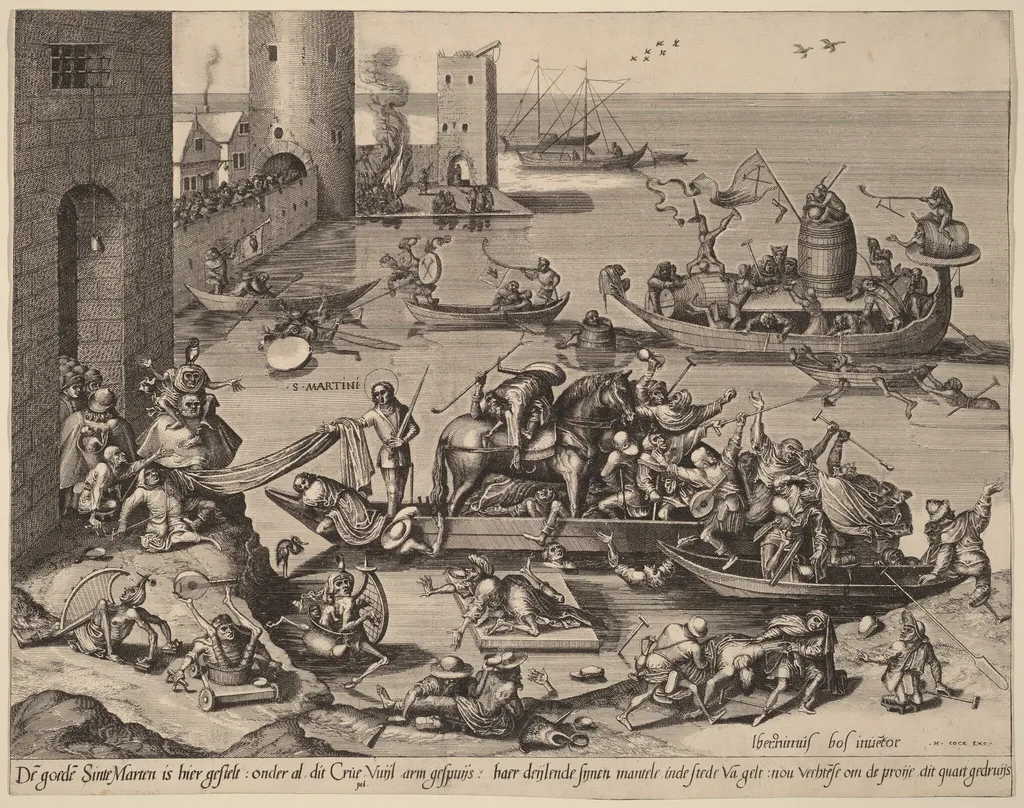
Saint Martin with His Horse in a Ship is an ink print by the Renaissance artist Lucas van Doetechum. It dates from 1561 and is held in the collection of the National Gallery of Art.
- Inscription
- Inscribed:within image at center left, in plate: .S. MARTINI.; lower right in plate: Jheronimus bos invetor / H. COCK EXC.; across bottom in plate below image: De[n] goede[n] Sinte Marten is hier gestelt: onder al dit Cruepel[en], Vuijl arm gespuijs: haer deijlende sijnen mantele inde stede va[n] gelt; nou vechte[n] se om de proije, dit quaet gedruijs
About this work
Overview
It stands as a distinct example of how sixteenth-century artists adapted established iconography to create dynamic, emotionally charged compositions.
Created in 1561 by Lucas van Doetechum, 'Saint Martin with His Horse in a Ship' is an etching and engraving on laid paper that reinterprets the traditional hagiography of Saint Martin of Tours. The work depicts the saint's famous act of charity, dividing his cloak with a beggar, transposed into a tumultuous maritime disaster rather than a static roadside encounter. The composition is densely packed and chaotic, centering on the mounted saint who extends his cloak while surrounded by sinking vessels, burning buildings, and panicked figures.
This dramatic setting transforms the religious narrative into a scene of apocalyptic urgency, with the background dominated by a town engulfed in flames and the sea filled with struggling sailors. Van Doetechum, a Dutch printmaker active in the mid-sixteenth century, utilizes the medium's capacity for fine line work to render the complex interplay of human and animal figures amidst the destruction. The piece reflects the Northern Renaissance interest in detailed, narrative-driven prints that combine religious devotion with the era's fascination with dramatic, often catastrophic, visual spectacles.
It stands as a distinct example of how sixteenth-century artists adapted established iconography to create dynamic, emotionally charged compositions.
Subject & Meaning
The central act references the legend of Saint Martin of Tours, who famously divided his cloak with a destitute traveler. By placing this charitable gesture amid a disaster‑filled seascape, the image juxtaposes compassion with turmoil, suggesting the saint’s virtue persists even in the midst of collective distress.
Technique & Style
Van Doetechum combines etching’s fine line work with the deeper, more decisive strokes of engraving, allowing a layered effect that distinguishes foreground detail from background atmosphere. The crowded arrangement of miniature figures and the precise rendering of textures, such as the rippling sea and flickering flames, demonstrate the artist’s skill in managing complex narrative space within a single print.
History & Provenance
Created in the mid‑sixteenth century, the print reflects the Northern European tradition of religious narrative prints intended for devotional or didactic use. While specific ownership records are scarce, the work survives in several museum collections, attesting to its circulation among collectors of early modern prints.
Context
The image belongs to a period when printmaking served both as a means of disseminating biblical and hagiographic stories and as a vehicle for moral instruction. Van Doetechum’s choice to embed Saint Martin’s act within a disaster scene aligns with contemporary concerns about human vulnerability and the need for charitable intervention.
Own this work as a print
Artist & collection


 Untitled
 The Re-embarkation of the Troops
 Fortitude
 The Re-embarkation of the Turks
 The Followers of Solon Defending the Temple of Venus
 Hope
Hope Windy Harbor
 The Re-embarkation of the Troops
 The Taskmaster of the Pharaoh Beating the Israelites
 The Firing Squad
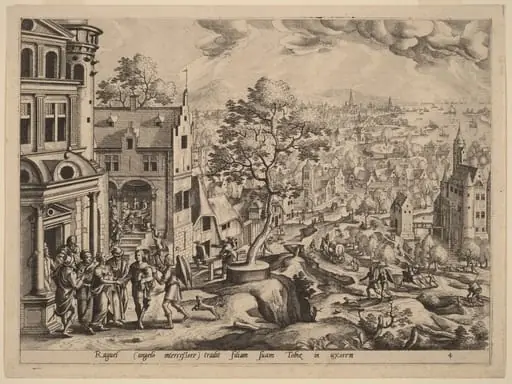 Tobias and the Angel Arriving at Raguel's House
- Saint Martin with His Horse on a Ship