Artwork
The painter Hugo van der Goes in the Rouge-Cloître Abbey
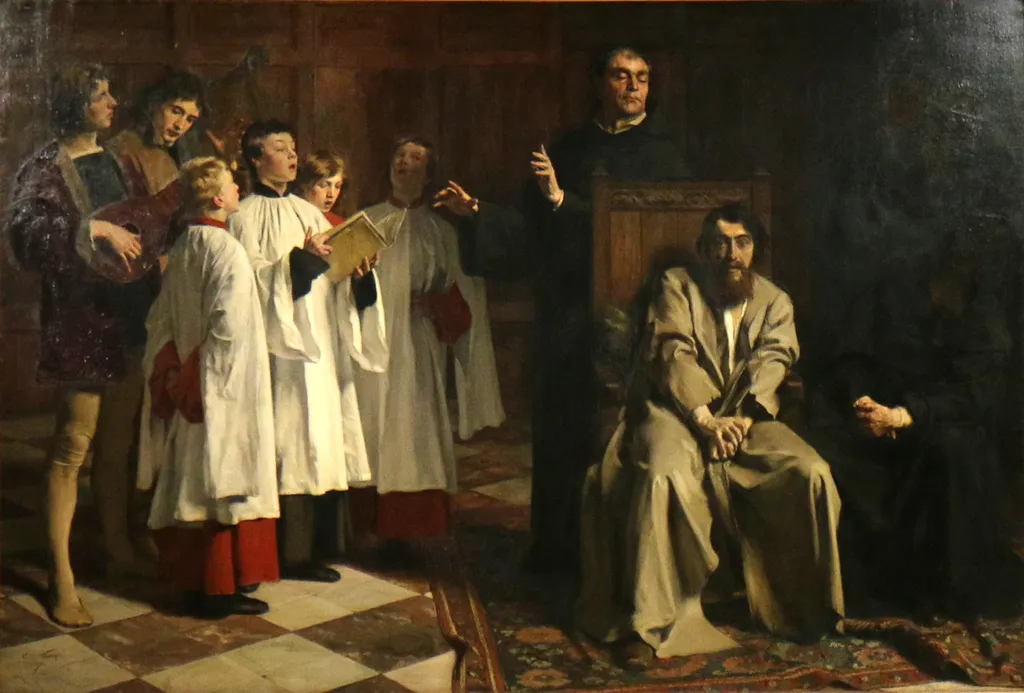
The painter Hugo van der Goes in the Rouge-Cloître Abbey is an oil painting by the Realist artist Emile Wauters. It dates from 1872 and is held in the collection of the Royal Museums of Fine Arts of Belgium.
About this work
Subject & Meaning
The composition visualizes the intersection of artistic genius and mental illness, anchoring the subject within the architectural context of the abbey.
The painting depicts the 15th-century artist Hugo van der Goes experiencing a mental disorder while situated within the choir of the Red Cloister (Rouge-Cloître) Abbey. The scene includes a priest and a chair, framing the central figure in a moment of psychological crisis. As a history painting, the work interprets the historical narrative of Van der Goes's famous breakdown, portraying his descent into madness within a specific religious setting.
The composition visualizes the intersection of artistic genius and mental illness, anchoring the subject within the architectural context of the abbey.
Technique & Style
Emile Wauters executed The painter Hugo van der Goes in the Rouge-Cloître Abbey in 1872 using oil paint applied to a canvas support. The work is classified as a history painting that dramatizes the mental disorder of the subject, Hugo van der Goes, within the setting of the Red Cloister. The composition features a priest and a chair alongside the central figure in the choir.
The finished canvas measures 186 cm in height and 275 cm in width. It is currently held in the collection of the Royal Museums of Fine Arts of Belgium.
History & Provenance
Emile Wauters executed this history painting in 1872, depicting the artist Hugo van der Goes during his time at the Rouge-Cloître Abbey. The work, created using oil paint on canvas, portrays the subject alongside elements such as a chair, a priest, and a choir, while also addressing themes of mental disorder within the monastic setting.
The painting currently resides in the collection of the Royal Museums of Fine Arts of Belgium, where it is held as part of their permanent holdings. No further details regarding specific commissions, earlier ownership chains, or exhibition history prior to its current location are provided in the available records.
The painting is held by the Royal Museums of Fine Arts of Belgium, as recorded in its Wikidata entry.
No specific inventory or accession number is documented in the available sources, and no exhibition history beyond its inclusion in the Royal Museums of Fine Arts of Belgium collection is recorded.
Overview
This oil painting, created in 1872 by Belgian Realist painter Emile Wauters, depicts a scene set in the Rouge-Cloître Abbey, featuring the 15th-century Flemish artist Hugo van der Goes in an unconventional context.
Context
The painting situates a renowned figure of the Flemish Primitives, Hugo van der Goes, within a later, Realist artistic framework, bridging two distinct periods of Belgian artistic heritage. The choice of setting and subjects may reflect 19th-century interests in historical and religious themes.
Legacy
While specific impacts or renowned exhibitions of this piece are not detailed, its presence in a national museum collection underscores its value as a representation of Belgian artistic dialogue across centuries, and as an interpretation of van der Goes' persona in a unique, observant role.
Own this work as a print
Artist & collection
Artist
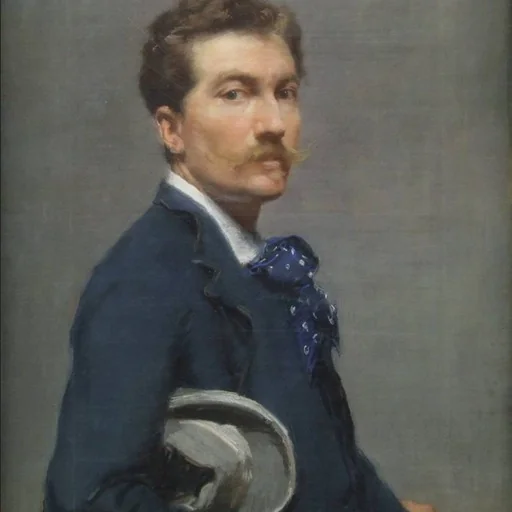
Emile Wauters (19 November 1846 – 11 December 1933) was a Belgian painter. He was born in Brussels. Successively the pupil of Portaels and Jean-Léon Gérôme, he produced in 1868 The Battle of Hastings: the Finding of the…

Museum
Royal Museums of Fine Arts of Belgium
Continue through works from the same source collection.
- Interior with an Organist and a Procession
 Exorcism of Joanna of Castile
 Village School at Wróblewice
 Before Blessing at the Church of Hoogstraten
 Capuchinos en el coro
 The Settlement
 A May Service for Young Women
 Offering to the fatherland by the Widow of Jacob van Artevelde
 The Trental Mass for Berthal de Haze
 Cervantes en sus últimos días escribe la dedicatoria del Quijote al conde de Lemos
 San Hermenegildo en la prisión
 Jan Hus at Constance