Artwork
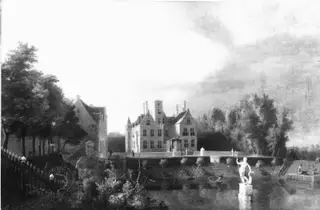
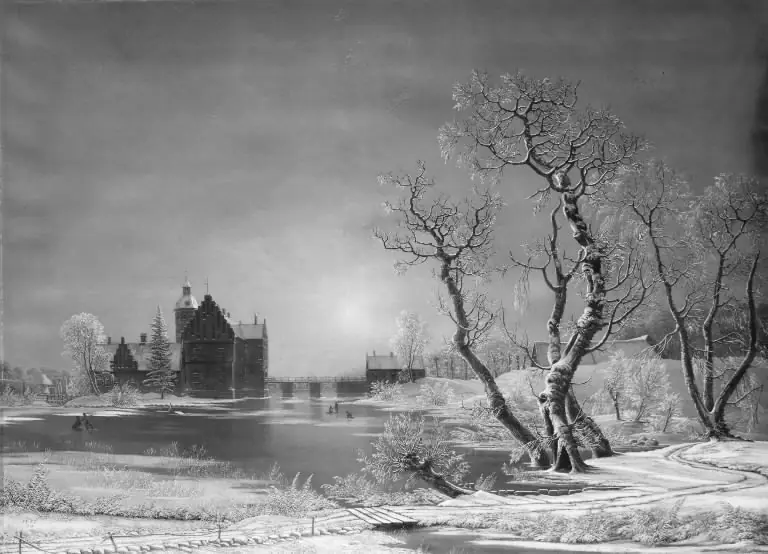
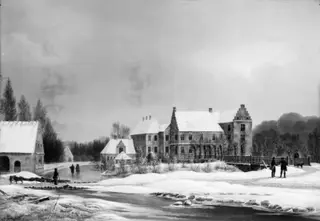
Prospekt af hovedgården Lykkesholm på Fyn. Vinter
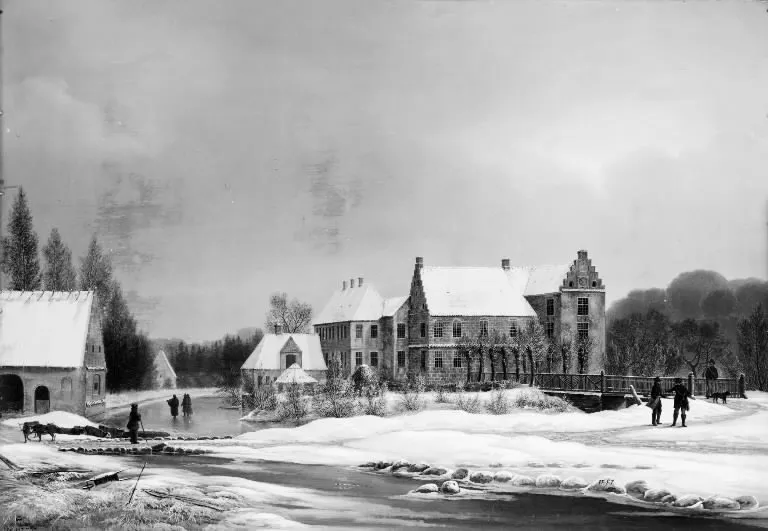
Prospekt af hovedgården Lykkesholm på Fyn. Vinter is an unspecified painting by the Biedermeier artist F.M.E. Fabritius de Tengnagel. It dates from 1834 and is held in the collection of the Statens Museum for Kunst. Frederik Michael Ernst Fabritius de Tengnagel's 1834 painting, "Prospekt af hovedgården Lykkesholm på Fyn.
About this work
Snow covers the ramparts of Lykkesholm manor near Orbaek on Funen in F.M.E. Fabritius de Tengnagel's 1834 winter scene. A former Funen Dragoon cornet, he was the only Danish painter of his generation to specialize in winter landscapes. Hans Christian Andersen, who began visiting in 1832, called the estate the most beautiful place on the island.
Overview
The composition captures the estate, situated on a four-sided rampart, blanketed in snow, with bare trees and frozen ground framing the main structure.
Frederik Michael Ernst Fabritius de Tengnagel's 1834 painting, "Prospekt af hovedgården Lykkesholm på Fyn. Vinter," depicts the historic Lykkesholm manor on the Danish island of Funen. The composition captures the estate, situated on a four-sided rampart, blanketed in snow, with bare trees and frozen ground framing the main structure.
This work exemplifies the artist's distinctive concentration on winter landscapes, a specialization that set him apart from his contemporaries. It is held in the collection of Statens Museum for Kunst.
Subject & Meaning
The painting presents Lykkesholm manor near Ørbæk, a fortified estate surrounded by water and forest, under the stark conditions of winter. The leafless trees and snow-covered terrain emphasize the season's quietude. This specific location held cultural significance, notably attracting the attention of author Hans Christian Andersen.
Andersen first visited Lykkesholm in 1832 and frequently returned, considering it the most beautiful site on Funen and drawing inspiration for his literary works from its atmosphere. The canvas thus serves as a visual document of a place cherished by a prominent figure.
History & Provenance
Born into an ennobled family on Funen in 1781, Frederik Michael Ernst Fabritius de Tengnagel initially pursued a military career, serving as a cavalry officer and earning the title Krigsråd. He transitioned to art in 1813, studying with Jens Peter Møller and later absorbing the stylistic principles of Norwegian Romantic painter Johan Christian Dahl. Fabritius de Tengnagel's singular focus on winter scenes, encompassing country houses, coasts, and woodlands, garnered him a receptive audience during his lifetime. The painting is now part of the collection at Statens Museum for Kunst.
Context
Fabritius de Tengnagel distinguished himself from other Danish painters of his era by almost exclusively dedicating his practice to winter landscapes. While his contemporaries explored diverse subjects, he consistently rendered snow-laden scenes of estates, coastlines, and forests. Concurrently, the manor of Lykkesholm itself was gaining recognition beyond its architectural merit.
Its picturesque setting captivated Hans Christian Andersen, who frequently visited and drew upon its ambiance for his creative writing, solidifying its place in Danish cultural imagination.
Artist & collection
Artist
Frederik Michael Ernst Fabritius de Tengnagel (2 January 1781 – 27 May 1849) was a Danish military officer and landscape painter. As a painter, he specialized in winter landscapes.