Artwork
Lourdes, 1914, 25th International Eucharistic Congress
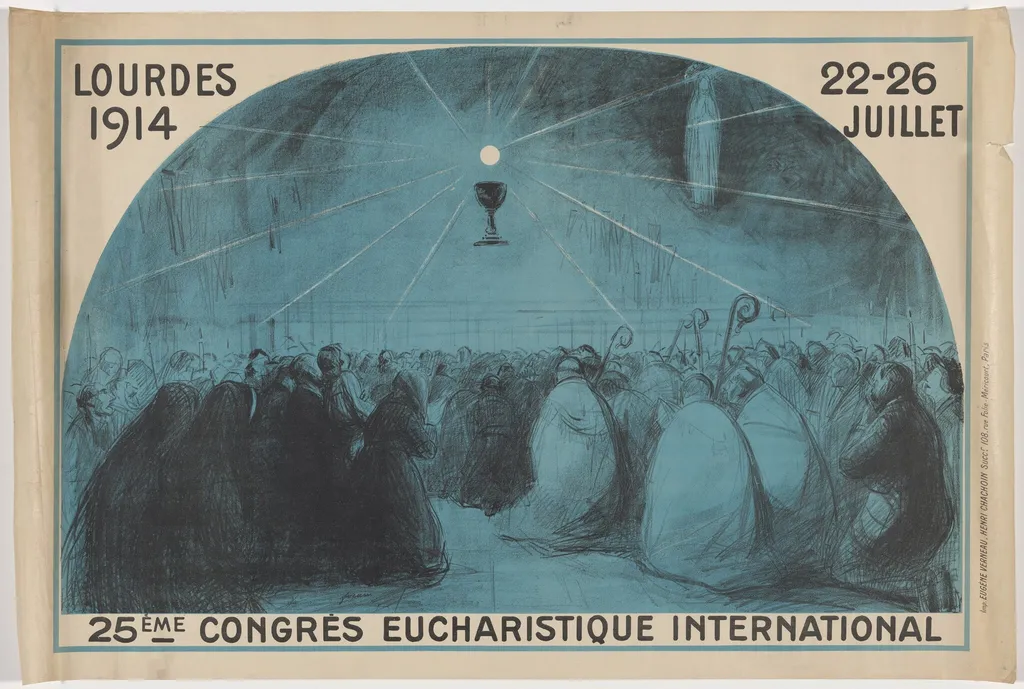
Lourdes, 1914, 25th International Eucharistic Congress is an ink print by Jean-Louis Forain. It dates from 1914 and is held in the collection of the National Gallery of Art.
- Inscription
- Inscribed:"forain" lower center composition, in stone. "LOURDES / 1914" upper left composition, black ink. "22-26 / JUILLET" upper right composition, black ink. "25 ÉME[underlined] CONGRÉS EUCHARISTIQUE INTERNATIONAL" lower composition, black ink. "Imp. EUGÈNE VERNEAU, HENRI CHACHOIN Succr. 108, rue Folie-Méricourt, Paris" lower right margin, black ink. "5" lower right margin, graphite, unknown hand. Verso: none.
- Markings
- Marked:"National Gallery of Art" verso, black stamped ink, (Lugt 1932d). "73" [encircled] verso, black stamped ink.
About this work
The bottom reads "25ème Congrès Eucharistique International," which means it was a religious meeting focused on the Eucharist.
This poster shows a crowded outdoor gathering under a big blue tent. At the front, a group of people kneels facing a raised platform with a golden cup on it. The crowd holds umbrellas and parasols, and the scene feels busy but orderly. The background has a few tall poles and a bright light shining down.
The text at the top says "Lourdes 1914" and "22-26 Juillet," hinting this was a big event in July. The bottom reads "25ème Congrès Eucharistique International," which means it was a religious meeting focused on the Eucharist.
If you like this style, look up lithography to see how artists create prints like this.
Overview
Created in 1914 by Jean-Louis Forain, this lithograph served as a promotional poster for the 25th International Eucharistic Congress in Lourdes. Executed in blue and black ink on wove paper, it reflects Forain’s mastery of printmaking and his ability to translate complex social scenes into graphic form. The work was produced for a major religious gathering, blending civic function with artistic expression.
Subject & Meaning
The poster captures a moment during a large outdoor religious assembly centered on the Eucharist. A group kneels before a raised platform holding a golden chalice, while a dense crowd, many holding umbrellas and parasols, observes in quiet reverence. The composition conveys solemnity amid public spectacle, emphasizing communal devotion rather than individual piety. The inclusion of dates and event title situates the scene within a specific historical and spiritual context.
Technique & Style
Forain employed lithography to achieve sharp contrasts and fluid line work, using only blue and black to define forms and atmosphere. The composition relies on layered silhouettes and subtle tonal gradations to suggest depth and movement within the crowd. His approach is restrained yet dynamic, avoiding ornamental excess in favor of clear, readable structure, a hallmark of his graphic work during this period.
History & Provenance
Commissioned for the 1914 Eucharistic Congress in Lourdes, the poster was distributed widely to announce the event, which drew pilgrims from across Europe. Its production coincided with the outbreak of World War I, lending the gathering an added weight as one of the last large international religious assemblies before global conflict disrupted such gatherings. The poster’s survival reflects its role as both a functional announcement and a cultural artifact.
Context
The 25th International Eucharistic Congress was part of a broader Catholic revival in early 20th-century Europe, emphasizing devotion to the sacrament of Holy Communion. Lourdes, already a major pilgrimage site due to Marian apparitions, provided symbolic resonance. Forain’s poster aligns with a trend of commissioning respected artists to design official event graphics, merging religious authority with modern visual culture.
Legacy
Though not widely exhibited as fine art, the poster remains a significant example of early 20th-century religious graphic design. It illustrates how artists like Forain applied their skills to civic and spiritual events, bridging fine art and public communication. Its restrained aesthetic and historical specificity continue to inform studies of print culture and religious visual propaganda in pre-war Europe.
Own this work as a print
Artist & collection

Artist
Jean-Louis Forain (French pronunciation:; 23 October 1852 – 11 July 1931) was a French Impressionist painter and printmaker, working in media including oils, watercolour, pastel, etching and lithograph.

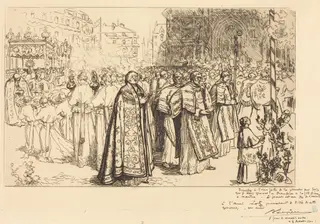 Return of the Procession to Nante Cathedral (Rentree de la Procession a la Cathedral de Nantes)
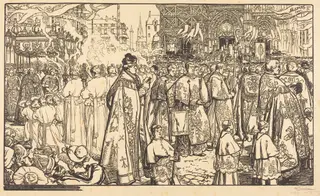 Corpus Christi Procession at Nantes (Procession de la Fete Dieu a Nantes)
 Choristers, 1st plate (Le lutrin)
 The Newly Elected Doge Presented to the People in San Marco
 Saint Joseph Church, Madrid
 Interior of St. Peter’s, with the Illumination of the Cross of St. Peter
 Chapel of the Convent of St. Saba
 MacBeth
 Untitled