Artwork
Napoléon signs his abdication at Fontainebleau 11 April 1814
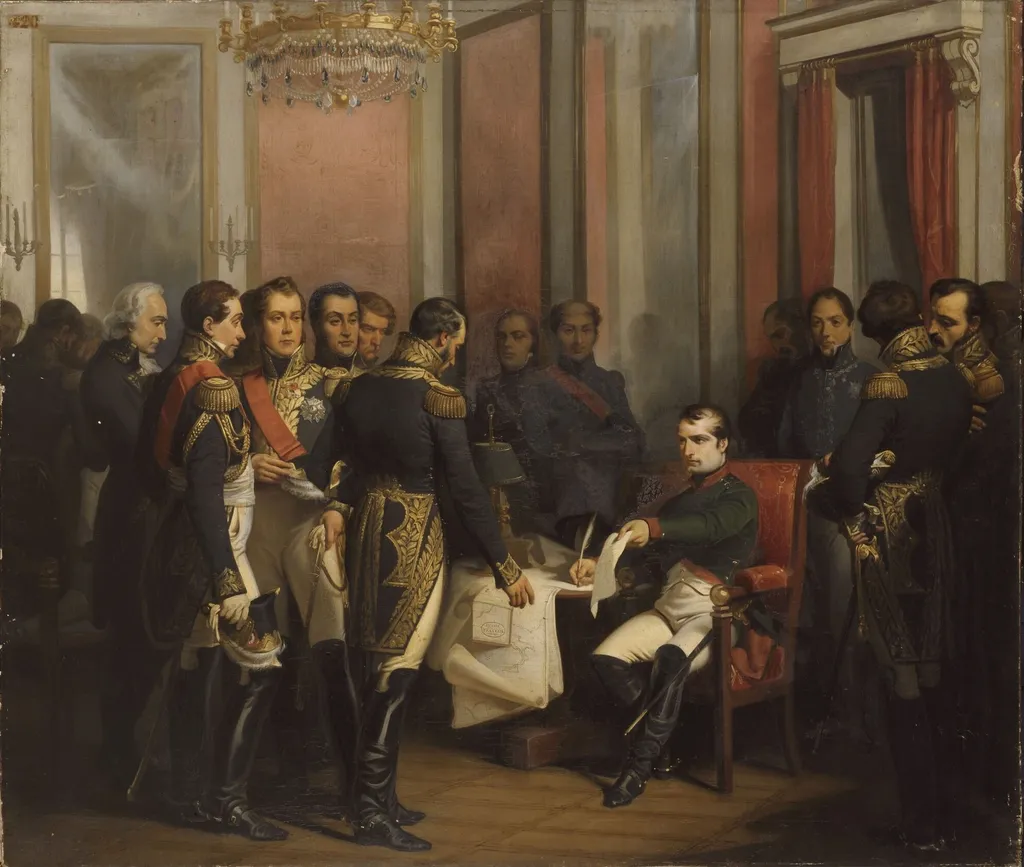
Napoléon signs his abdication at Fontainebleau 11 April 1814 is an oil painting by François Bouchot. It is held in the collection of the Palace of Versailles.
About this work
Subject & Meaning
François Bouchot's 1843 history painting depicts the pivotal moment of Napoleon Bonaparte signing his abdication at the Palace of Fontainebleau.
François Bouchot's 1843 history painting depicts the pivotal moment of Napoleon Bonaparte signing his abdication at the Palace of Fontainebleau. The composition centers on the Emperor surrounded by his key marshals and officials, including Michel Ney, Étienne Macdonald, Armand de Caulaincourt, and Hugues-Bernard Maret, who witnessed or facilitated the surrender. A map is visible within the scene, grounding the narrative in the specific geopolitical realities of the 1814 campaign.
By assembling these specific historical figures in the act of signing, the work serves as a formal visual record of the end of Napoleon's first reign, emphasizing the collective presence of his inner circle during this decisive political transition.
Technique & Style
The painting is executed in oil on canvas, measuring 136 cm by 160.5 cm, and depicts the moment of Napoleon's abdication at Fontainebleau on 11 April 1814. François Bouchot, a French academic painter, created the work in 1843, reflecting the historical narrative style characteristic of 19th‑century French history painting. The composition emphasizes formal clarity and precise brushwork typical of the period, presenting the scene with a restrained palette and balanced arrangement of figures.
History & Provenance
The oil painting depicting Napoleon signing his abdication at Fontainebleau was created in 1843 by French artist François Bouchot in collaboration with Gaetano Ferri. It measures 136 cm in height and 160.5 cm in width and was first exhibited at the Salon of 1843. The work entered the collection of the Museum of the History of France at the Palace of Versailles, where it remains part of the national heritage.
Its provenance includes documentation in the Joconde database under inventory numbers MV 1774, INV 2752, and LP 5630, confirming its status as a history painting in the French national collection.
The painting is held in the collection of the Museum of the History of France at the Palace of Versailles in France. Its official inventory numbers are MV 1774, INV 2752, and LP 5630, with the Joconde database reference 000PE006476. The work was first exhibited at the Salon of 1843, the year of its creation, before entering the national museum holdings.
It remains part of the permanent display within the Musée national des châteaux de Versailles et de Trianon.
Context
The painting depicting Napoleon's abdication was created in 1843 by François Bouchot in collaboration with Gaetano Ferri, as documented in the Joconde catalogue and corroborated by the Museum of the History of France's records. Executed in oil on canvas, it measures 136 cm by 160.5 cm and was first exhibited at the Salon of 1843, establishing it within the tradition of French historical painting. The work, housed at the Palace of Versailles, captures the political transition following Napoleon's abdication on 11 April 1814, reflecting 19th-century interpretations of pivotal moments in French imperial history.
Scholarly attention has focused on the artwork's composition and iconography, particularly its detailed portrayal of key figures such as Michel Ney and Armand Augustin Louis de Caulaincourt, which provides insight into contemporary narratives of authority and transition. Its inclusion in major institutional collections and exhibitions underscores its significance in the visual historiography of the Napoleonic era, linking artistic representation to broader historical discourse.
The painting's provenance and exhibition history, including its display at the Salon of 1843, highlight its role in shaping public memory of Napoleon's downfall, while its technical execution and collaborative authorship reflect the artistic practices of mid-19th-century France.
Overview
François Bouchot’s 1843 oil on canvas records the moment of Napoleon’s abdication at Fontaine‑la‑Grande on 11 April 1814. The composition gathers three senior figures of the Empire in an opulent interior, emphasizing the solemnity of the political act.
Own this work as a print
Artist & collection

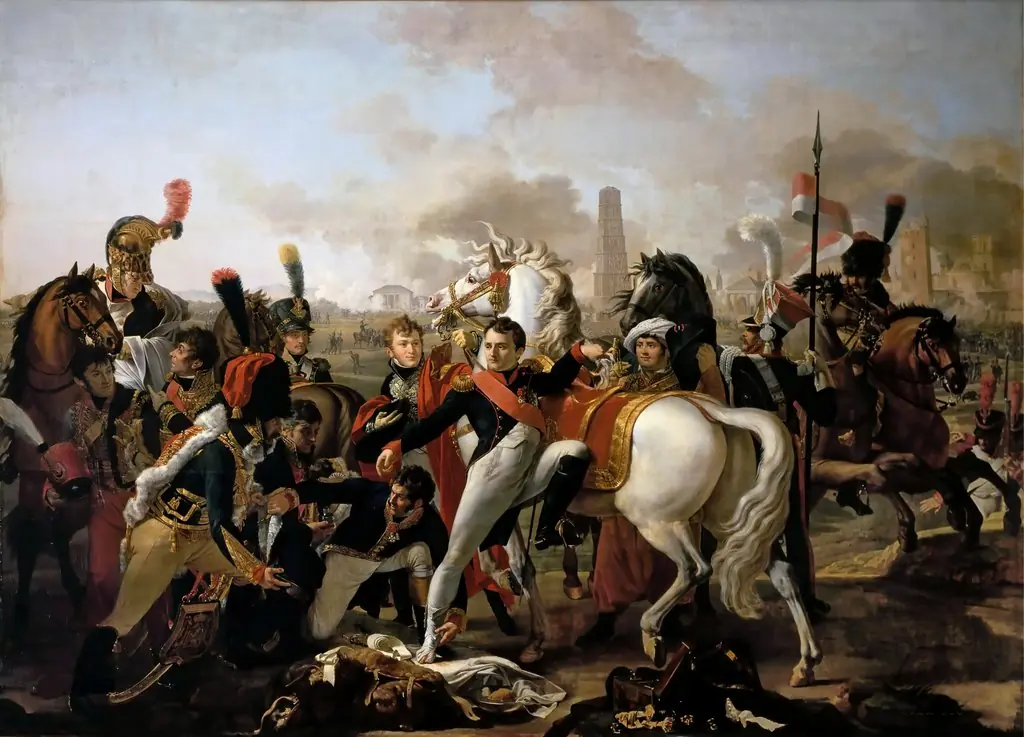 Napoleon dismounting with an injured foot at Regensburg, aided by the Surgeon, Yvan, April 23, 1809
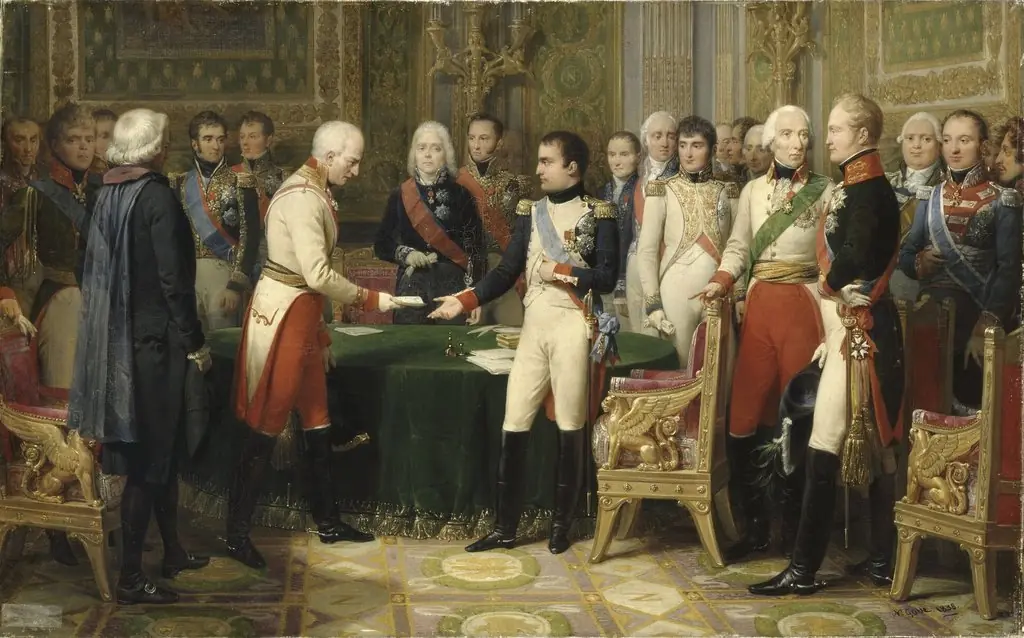 Napoleon I receiving Baron Vincent, the Austrian Ambassador, at Erfurt, 1808
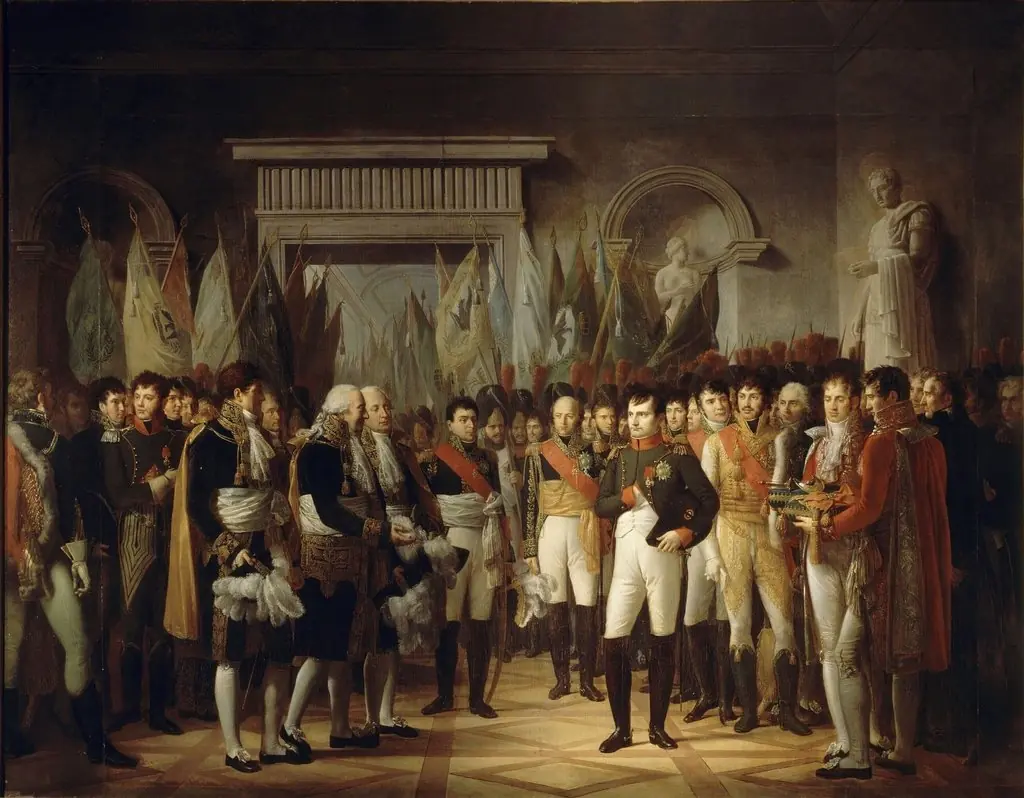 The Emperor receiving the deputies of the Conservative Senate in Berlin at the royal palace, 19 November 1806
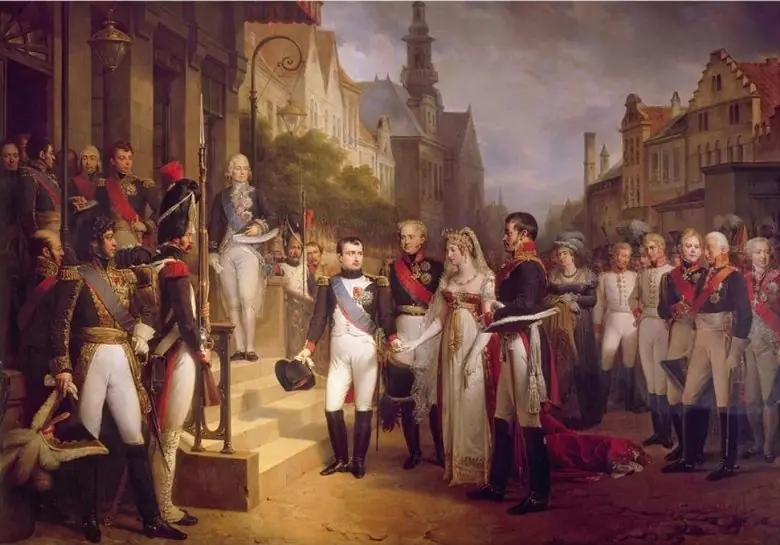
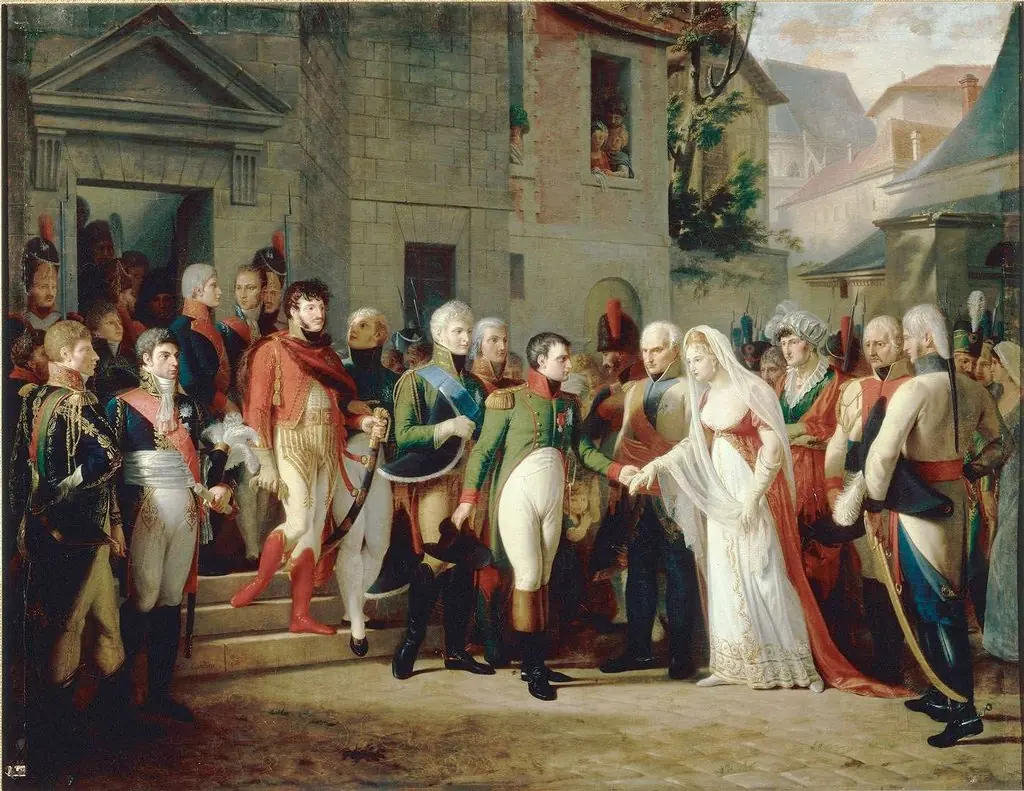 Napoleon I receives the Queen of Prussia in Tilsitt
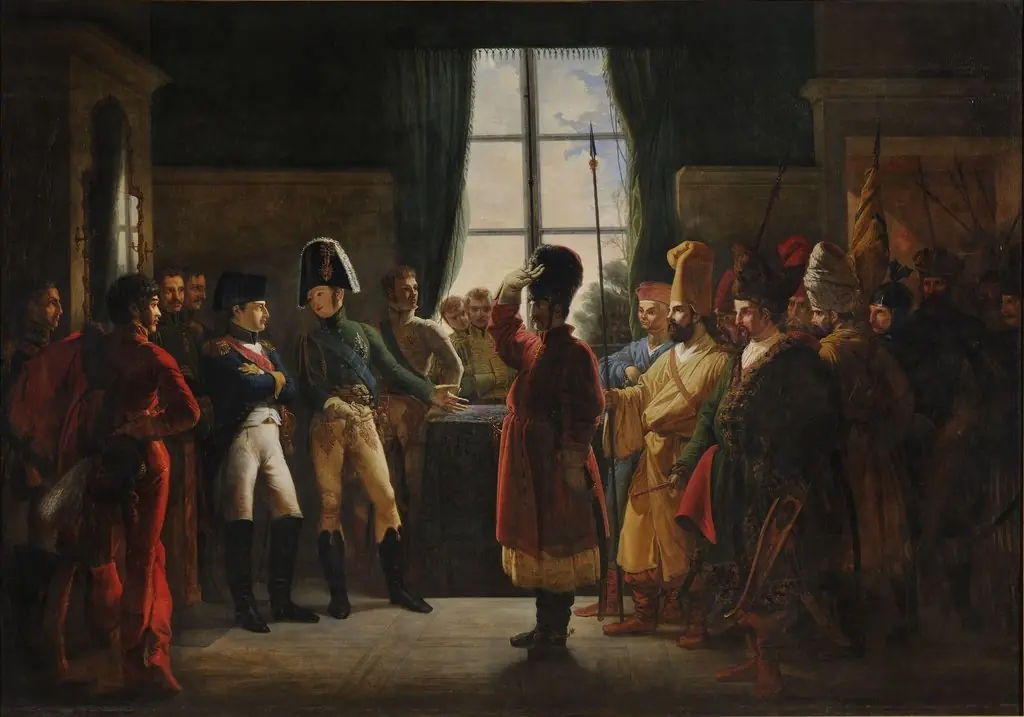 Alexander I presents to Napoleon I the Kalmyks, Cossacks and Baskirs of the Russian army, July 9, 1807
 The Emperor Napoleon in His Study at the Tuileries
 The Congress of Paris