Artwork
The Virgin and Child
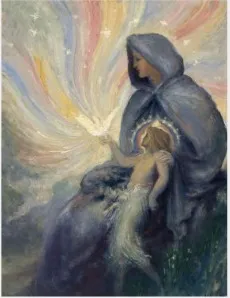
The Virgin and Child is an unspecified painting by the Symbolist artist George William Russell. It dates from 1911 and is held in the collection of the National Gallery of Ireland.
About this work
Overview
The Virgin and Child is an oil painting by the Irish artist, poet, and mystic George William Russell (1867-1935), who worked under the pseudonym Æ (or AE).
The Virgin and Child is an oil painting by the Irish artist, poet, and mystic George William Russell (1867-1935), who worked under the pseudonym Æ (or AE). The painting measures 61 by 46 centimetres and is held in the collection of the National Gallery of Ireland in Dublin. Russell, a central figure in the Irish Literary Revival and a devoted follower of Theosophy, produced a body of visionary paintings that fused religious symbolism with the mystical and folkloric traditions of Ireland. This particular work exemplifies his characteristic approach: a luminous, dreamlike treatment of religious subject matter that transcends conventional devotional imagery.
Subject & Meaning
The painting depicts the Madonna and Child, a foundational subject in Christian art. The Virgin Mary sits robed in a voluminous blue-grey hooded cloak that envelops her form, her face downturned in contemplation as she gazes toward the infant she supports. The Christ Child, partially draped in white, reaches upward with one arm toward a radiant burst of light emanating from the upper left. This radiance sends sweeping arcs of pale yellow, pink, blue, and white across the background, resembling stylised aurora, while small star-like shapes punctuate the upper sky. A faint circular halo or nimbus surrounds the child's head. The iconography draws upon traditional Marian devotion, yet Russell's treatment infuses it with Theosophical and mystical overtones. The upward reach of the child toward celestial light, the merging of human and divine through soft atmospheric transitions, and the dreamlike quality of the vision all reflect Russell's belief in the unity of all creation and his practice of depicting spiritual visions he had experienced since childhood. The dark green vegetation in the lower right anchors the scene in a natural world that Russell consistently portrayed as infused with the supernatural.
Technique & Style
Russell executed the work in oil on canvas, employing a technique of smooth, blended brushwork that creates an atmospheric, dreamlike quality with gentle transitions between forms and light. Shadows remain soft and diffused throughout, with no visible impasto, producing a polished finish that emphasises the immaterial and visionary character of the scene. The palette is dominated by soft blues, greys, and whites, with warm luminous accents provided by the radiance in the upper left. This handling aligns with Russell's broader practice, in which figures and landscape merge tonally, and the boundary between earth and sky is deliberately blurred so that forms appear to drift into one another's space. The approach shares affinities with Symbolist and late nineteenth-century aesthetic tendencies toward evocation rather than description, prioritising mood and spiritual suggestion over naturalistic detail.
History & Provenance
The painting's provenance and exhibition history are not documented in the available sources. The work is currently located at the National Gallery of Ireland, though the specific date of its accession is not provided. Russell's artistic career was shaped by financial constraints; although he attended the Metropolitan School of Art in Dublin, his family could not support his artistic vocation, and he worked throughout his life as a writer, editor, and agricultural organiser, painting in the time remaining to him. His paintings were never a reliable source of income, and concerns about poverty persisted into his later years.
Context
Russell occupies a distinctive position in Irish cultural history. Born in Lurgan, County Armagh, he moved to Dublin at age eleven and later studied at the Metropolitan School of Art, where he formed a lifelong, sometimes contentious friendship with W. B. Yeats. In the 1880s he lived at the Theosophical Society lodge in Dublin, and Theosophy became the dominant intellectual and spiritual framework for his creative work. The Theosophical emphasis on the unity of all creatures and the shared origin of all beings informed his artistic vision, in which the Sídhe of Irish folklore, the natural landscape, and Christian iconography could coexist as manifestations of a single mystical reality. Russell's paintings emerged during the period known as the Celtic Twilight, a revival of interest in Celtic mythology and Irish folklore that engaged artists, writers, and poets including the Yeats brothers. His work also belongs to a broader European Symbolist context, in which artists sought to express invisible realities and subjective states through colour, light, and atmospheric effect. Critical reception of Russell has tended to emphasise his literary and political contributions, yet his paintings constitute a significant, if understudied, aspect of his output, representing one of the most sustained visual articulations of Irish mystical nationalism.
Legacy
Russell's visual legacy remains intertwined with his literary and political reputation. His paintings, including The Virgin and Child, continue to be studied as expressions of a distinctive Irish mystical sensibility that sought to reconcile indigenous folklore, Christian tradition, and Eastern-influenced spiritual philosophy. The work's residence in the National Gallery of Ireland ensures its accessibility as a key example of Russell's painted oeuvre, though detailed scholarly attention to individual paintings remains less extensive than that devoted to his writings. The painting's afterlife is perhaps best understood through the broader cultural project it represents: the attempt to forge a visual language for Irish identity that could encompass the visionary and the national, the ancient and the modern, the local landscape and the transcendent. In this respect, The Virgin and Child stands as a significant, if quiet, monument to an alternative strand of Irish modernism, one that privileged illumination over materiality and spiritual communion over doctrinal certainty.
Artist & collection
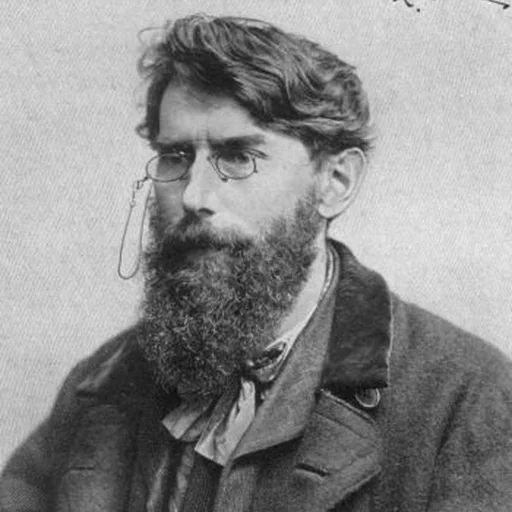
Artist
George William Russell (10 April 1867 – 17 July 1935), who wrote with the pseudonym Æ (often written AE or A.E.), was an Irish writer, editor, critic, poet, painter and Irish nationalist.

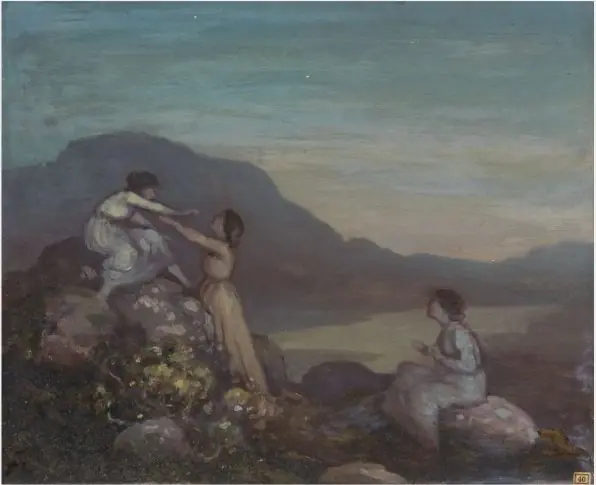 Landscape with Figures
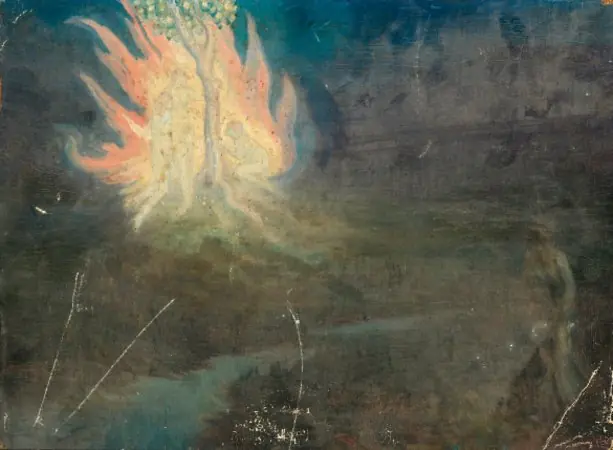 A Landscape with a Woman and Child and three Spirits
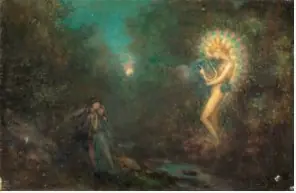
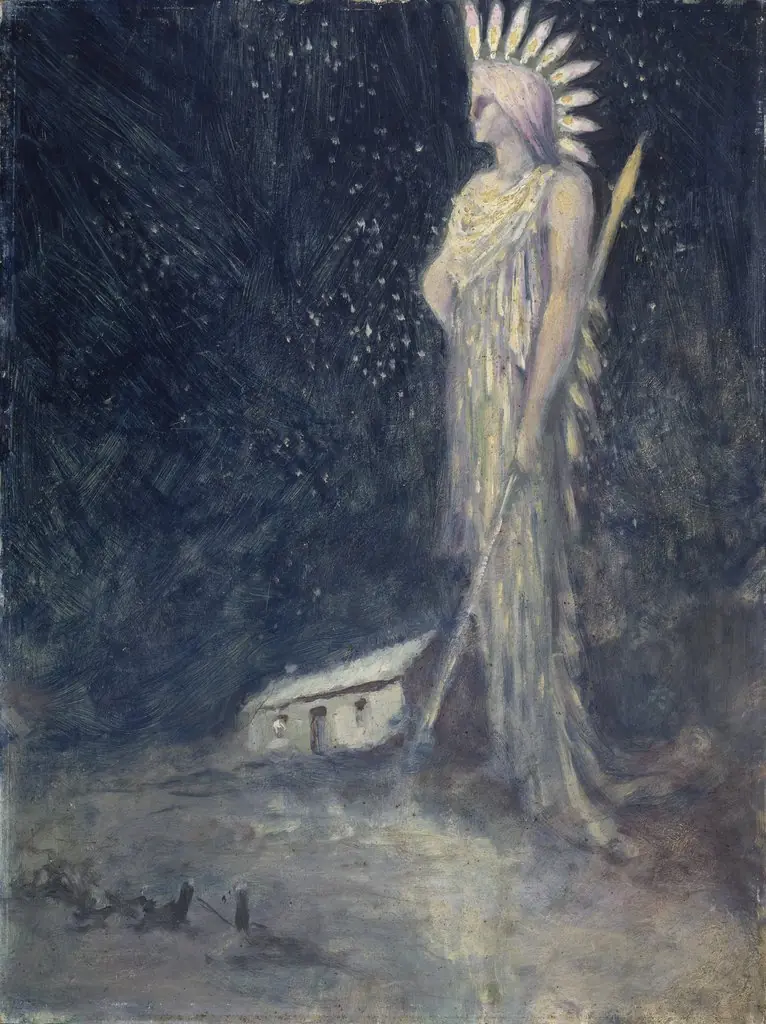 A Spirit or Sidhe in a Landscape
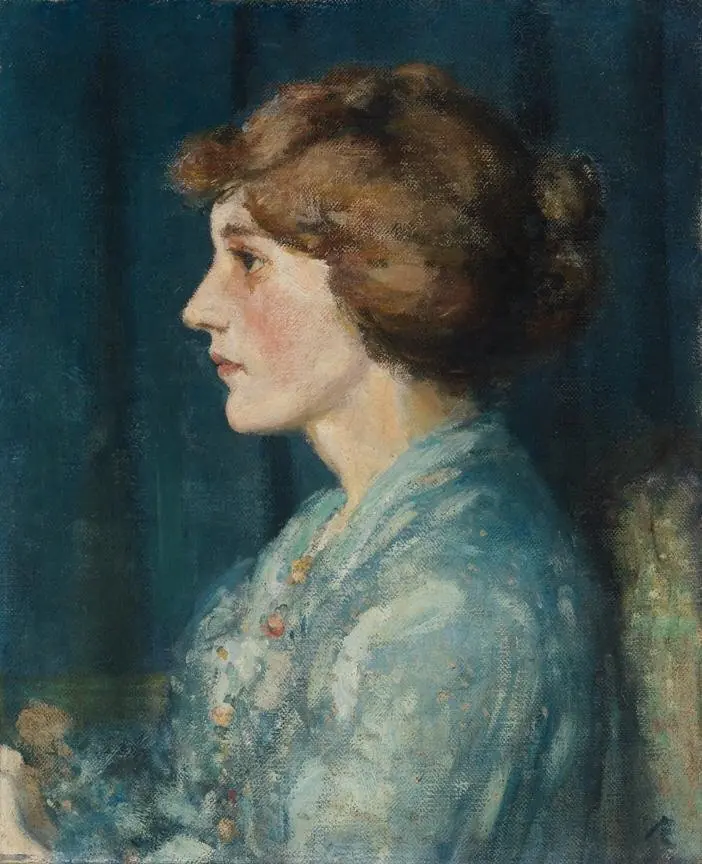 Portrait of Iseult Gonne (Mrs Francis Stuart)
- A Landscape with a Couple, and a Spirit with a Lute
 A Forest Animal
 Portrait of David Houston, Professor at the Royal College of Science
 A Female with a Lyre