Artwork
Combe Bottom
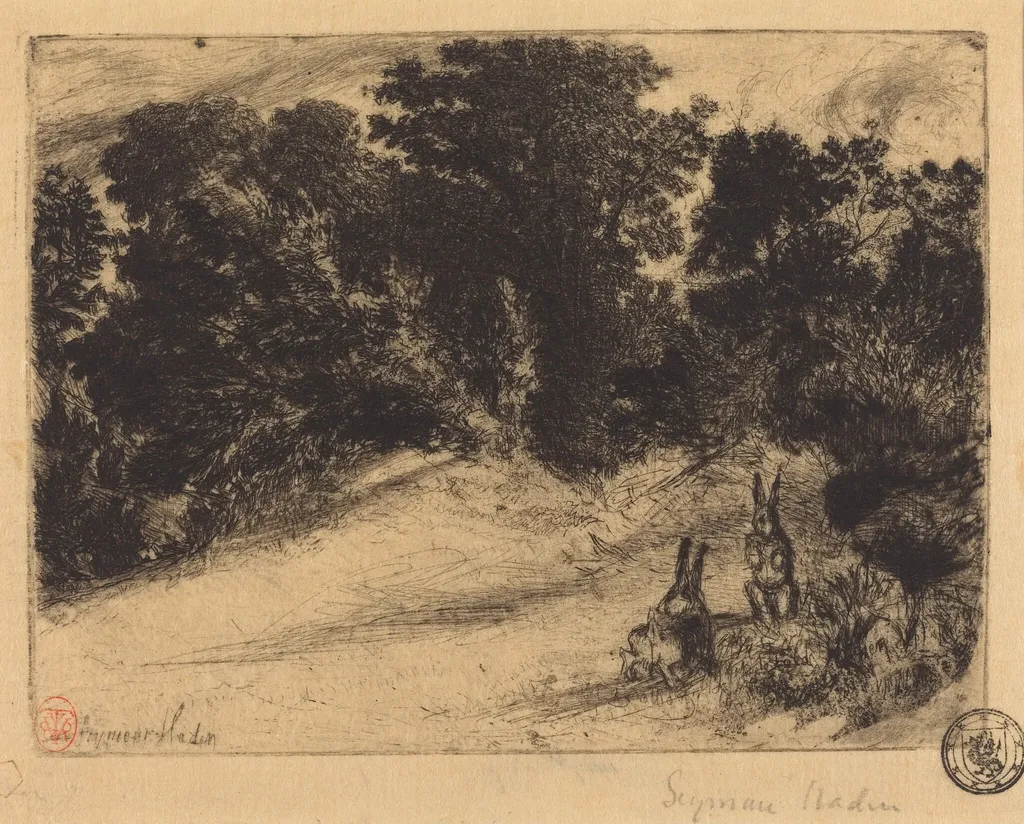
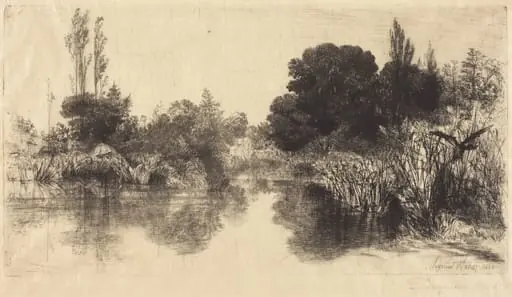
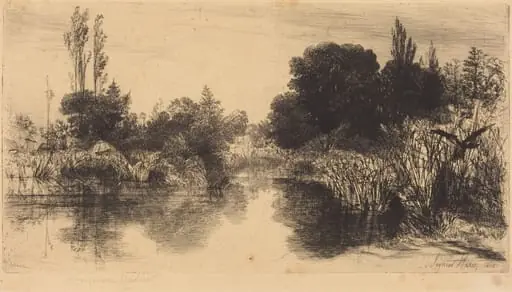
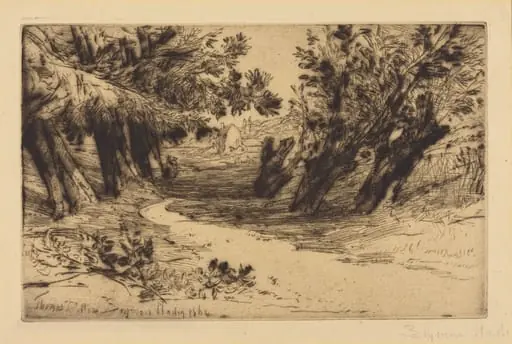
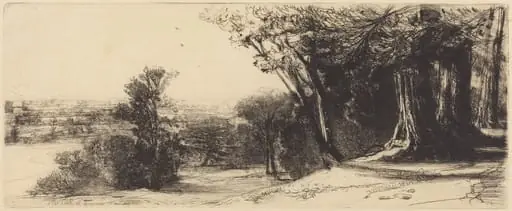
Combe Bottom is an ink print by the Impressionist artist Francis Seymour Haden. It dates from 1860 and is held in the collection of the National Gallery of Art.
About this work
Overview
Combe Bottom, executed in 1860, is a print by Francis Seymour Haden produced through etching and drypoint techniques. The work presents a narrow country lane that meanders amid dense, tangled trees, their twisted branches forming a canopy that limits daylight. A solitary figure occupies a bench on the right side, appearing diminutive within the surrounding foliage.
Subject & Meaning
The composition captures a moment of quiet solitude, emphasizing the contrast between human presence and the overwhelming vigor of nature. The lone figure on the bench suggests contemplation or rest, while the enclosing trees convey a sense of enclosure and the passage of time, inviting viewers to consider the relationship between the individual and the landscape.
Technique & Style
Haden employed a combination of etching and drypoint, using sharp incised lines to delineate each leaf, branch, and shadow. The drypoint element adds a velvety, burr‑rich quality to the darker areas, enhancing texture and depth. The overall effect is a highly detailed, tactile rendering that conveys both the physical density of the forest and the atmospheric dimness of the scene.
History & Provenance
Created in the early phase of Haden’s printmaking career, Combe Bottom reflects his interest in natural subjects and his mastery of intaglio processes. The work has been held in several public collections, including the British Museum, where it is catalogued as part of Haden’s series of rural landscapes produced in the 1860s.
Context
During the mid‑nineteenth century, British artists increasingly explored the countryside as a source of aesthetic and moral reflection. Haden’s choice of a secluded path aligns with contemporary Romantic sensibilities, while his technical approach demonstrates the period’s growing fascination with the possibilities of print media for detailed, reproducible images.
Own this work as a print
Artist & collection