Artwork
Avarice
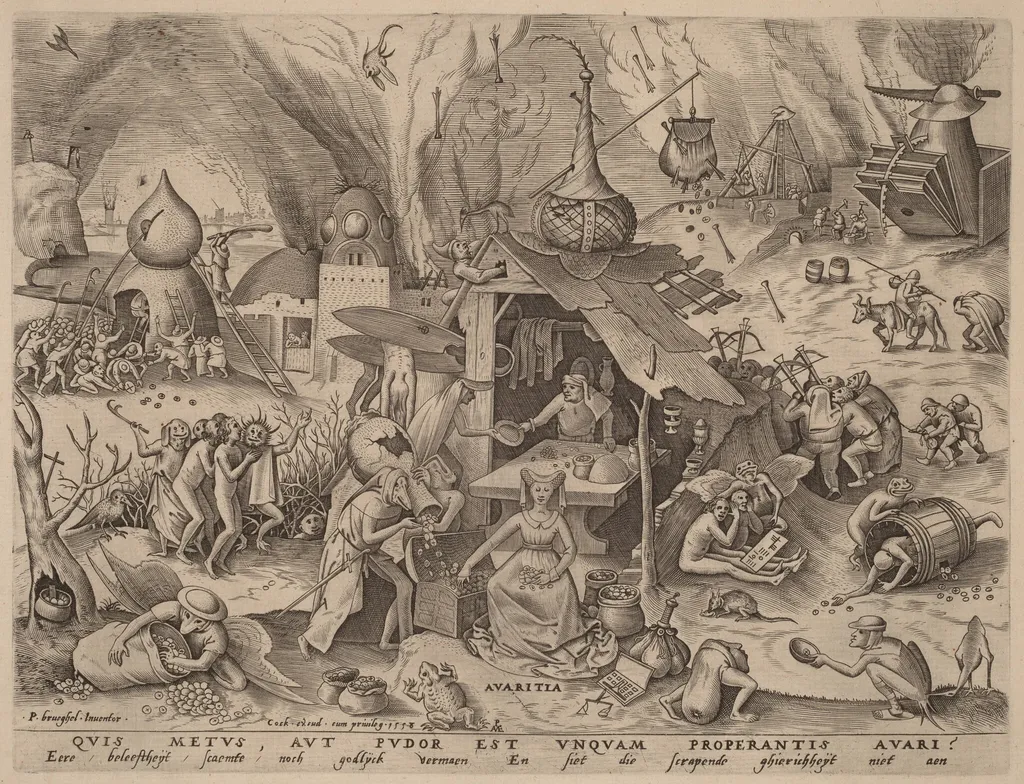
Avarice is an ink print by the Renaissance artist Pieter van der Heyden. It dates from 1558 and is held in the collection of the National Gallery of Art.
- Inscription
- Inscribed:bottom center, in image, in plate: AVARITIA; lower left, in image, in plate: .P. brueghel. Inuentor.; lower left center, in image, in plate: Cock. excud. cum privileg. 1558; lower center, in image, in plate: PAME [artist's monogram]; in lower margin, in plate: QVIS METVS, AVT PVDOR EST VNQVAM PROPERANTIS AVARI? (Does the greedy miser ever possess fear or shame?) / Eere, beleeftheyt, scaemte, noch godlyck vermaen / En siet die scrapende ghierichheyt niet aen (Scraping Avarice sees neither honor nor courtesy, shame nor divine admonition) [translations from Nadine Orenstein, ed., Pieter Bruegel the Elder: Drawings and Prints. Exhibition catalogue. New York: Metropolitan Museum of Art, 2001, p. 147.]
About this work
Overview
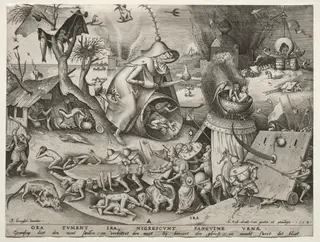
Created in 1558, Avarice is an engraving on laid paper by the Flemish printmaker Pieter van der Heyden. The work presents a densely populated tableau that visualises the vice of greed through a chaotic assembly of figures and objects, centered on a richly dressed woman perched atop a heap of coins.
Subject & Meaning
The composition conveys the corrupting influence of avarice, with the Latin term Avaritia inscribed at the bottom to reinforce the theme. A towering hand balances a scale weighted by a heavy purse, while surrounding characters, engaged in fighting, drinking, and music, suggest how the desire for wealth permeates all levels of society, even the impoverished.
Technique & Style
Van der Heyden employs fine, incised lines characteristic of mid‑16th‑century engraving, achieving a high level of detail on laid paper. The intricate cross‑hatching creates stark contrasts and a sense of depth, while the absence of colour emphasizes the work’s allegorical and moralizing tone.
History & Provenance
Active during a period when printmaking served to spread artistic ideas, van der Heyden was known for reproducing designs by leading Flemish painters. Avarice reflects this practice, translating a complex moral scene into a reproducible format that could reach a broad audience across Europe in the late Renaissance.
Own this work as a print
Artist & collection

Artist
Pieter van der Heyden (c. 1530 - after March 1572) was a Flemish printmaker who is known for his reproductive engravings after works by leading Flemish painters and designers of the 16th century.