Artwork
The Arhat Kanakavatsa
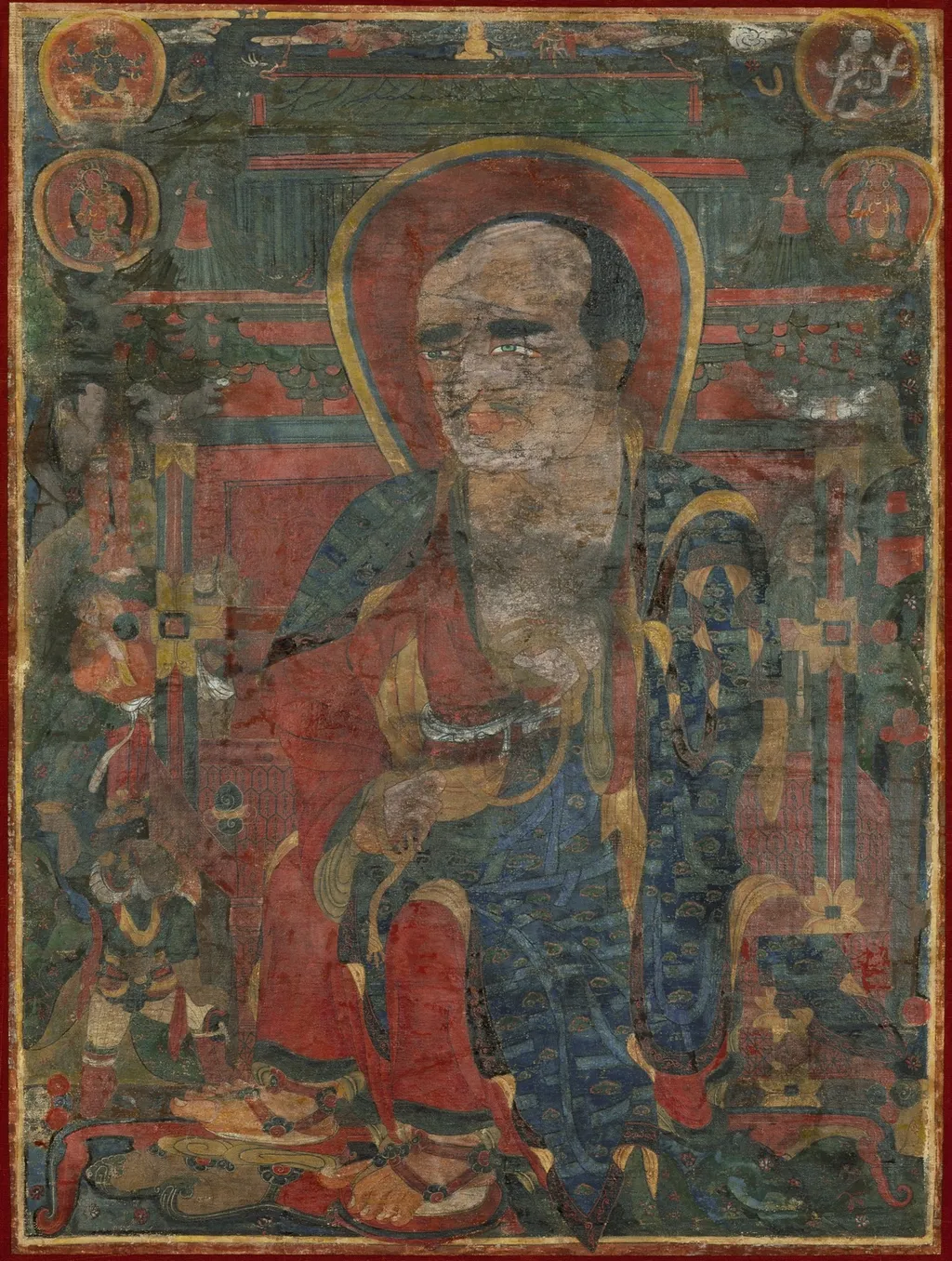
The Arhat Kanakavatsa is an unspecified painting by Unknown. It dates from 1450 and is held in the collection of the Los Angeles County Museum of Art.
About this work
Overview
Surrounding him are numerous smaller figures, some also seated, and the scene is set against a dark green background accented with red and gold tones.
The work titled “The Arhat Kanakavatsa” is a painted composition depicting a solitary figure seated on the floor, dressed in a red robe with blue sleeves and a blue skirt. The central figure, with a shaved head, gazes to his right while holding an indeterminate object in his right hand. Surrounding him are numerous smaller figures, some also seated, and the scene is set against a dark green background accented with red and gold tones.
Subject & Meaning
The principal figure is identified as an arhat, a term for a perfected disciple in Buddhist tradition. The surrounding diminutive figures may represent attendants or symbolic devotees, suggesting a narrative of reverence or instruction. The ambiguous object in the arhat’s hand could be a ritual implement, reinforcing the spiritual context of the scene.
Technique & Style
The painting employs a limited palette dominated by reds, blues, and greens, with gold highlights that accentuate key elements. The composition balances a central, larger figure with a crowd of smaller forms, creating a rhythmic visual hierarchy. The use of flat color areas and stylized outlines reflects a decorative aesthetic common in certain Asian courtly or religious artworks.
History & Provenance
The piece is part of the collection of the Los Angeles County Museum of Art. Its acquisition details, including prior ownership or exhibition history, are not specified in the available information, but its presence in a major U.S. institution indicates recognition of its cultural and artistic significance.
Context
As an illustration of an arhat, the painting aligns with Buddhist iconography that emphasizes the attainment of enlightenment and the transmission of teachings. The inclusion of multiple attendant figures may reflect a narrative scene from Buddhist texts or a devotional setting, situating the work within a broader religious visual tradition.
Artist & collection

 Domestic Scene
 Giacomo and Cardinal Marco, investing Andrea, Abbot of San Zeno, with his Benefice
 The Nymph of Fontainebleau
 Portrait of a Woman
 Madonna and Child with Saints in the Enclosed Garden
 Venus and Minerva
 Family Group of Four on Sofa
 Wall painting from Room H of the Villa of P. Fannius Synistor at Boscoreale
 Untitled
 Preaching Sakyamuni
 The Supreme Physician (Bhaishajyaguru) and His Celestial Assembly
 Votive initiation card (tsakali) with preaching Buddha Shakyamuni
 Sfinții apostoli Pavel și Matei
 An Abbot and His Lineage
 Sakyamuni Buddha
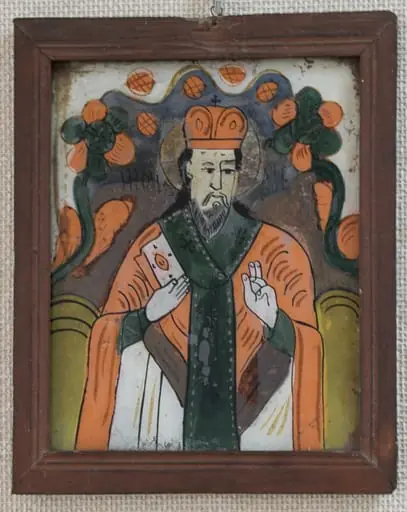 Icoana îl reprezintă pe Sf. Nicolae 3/4 în veșmânt de marea ierarh, cu mitră pe cap, într-un chenar din flori în partea de sus. Desenul este naiv, compoziția simplă, schematică. Sfântul, cu mitră pe cap și aureolă, binecuvintează cu stânga, zugravul a desenat tiparul fără să țină seama de faptul că urma să picteze "în oglindă".În dreapta ține Evanghelia.Părul și barba sunt negre, ceea ce nu corespunde reprezentării canonice a sfântului, dar caracterizează frecvent reprezentarea populară. În partea de sus este realizat un chenar din două flori cu frunze, unite printr-o linie vălurită împodobită cu boboci de floare.Câteva linii sugerează un relief colinar. Cromatica este variată, culori intense, creînd contraste(roșu cu verde).Câmpul este alb murdar. Rama este vopsită cu un roșu șters. Spatele este completat cu o lemn subțire de brad.