Artwork
Figures in Masquerade on the Loggia of the Ducal Palace, Venice
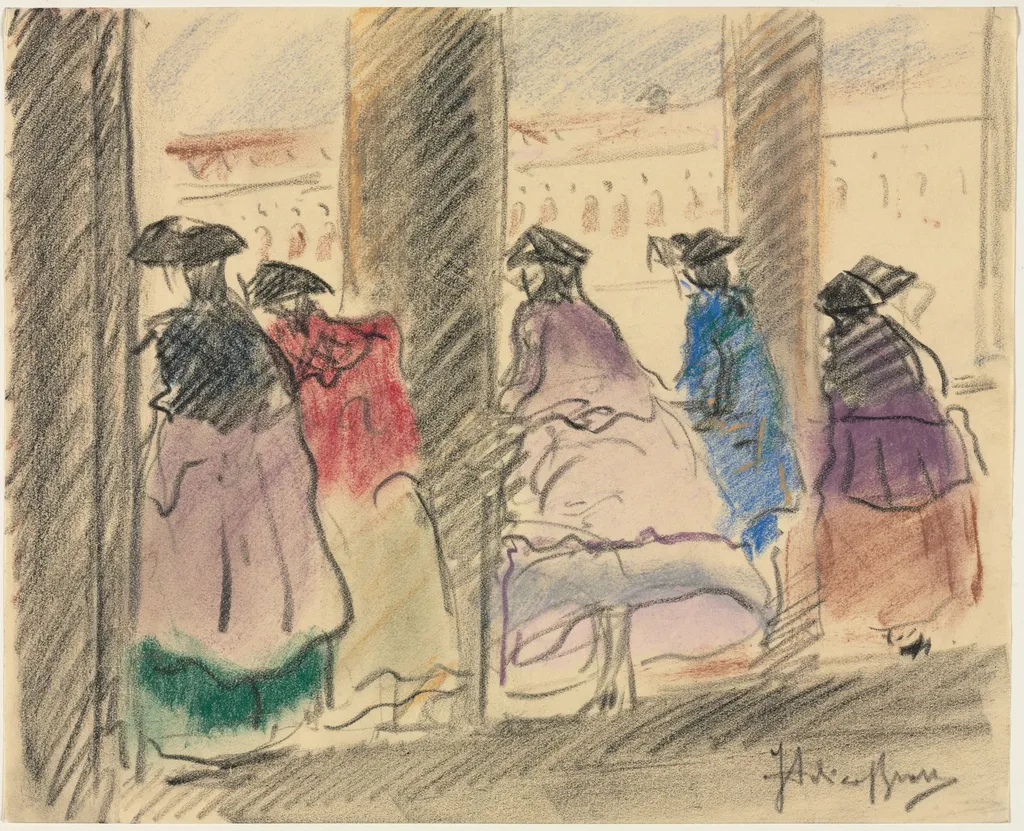
Figures in Masquerade on the Loggia of the Ducal Palace, Venice is a drawing by Italico Brass. It dates from 1925 and is held in the collection of the Cleveland Museum of Art.
- Accession no.
- 1954.656
- Credit line
- The Mary Spedding Milliken Memorial Collection, Gift of William Mathewson Milliken
About this work
Overview
The work is part of the collection at The Cleveland Museum of Art, acquired as a representative example of early 20th-century Italian graphic art.
Created in 1925 by Italico Brass, this drawing captures a lively scene on the loggia of Venice’s Ducal Palace. Executed in ink and watercolor, it depicts masked figures moving through the architectural space, reflecting the artist’s interest in Venetian public life and seasonal rituals. The work is part of the collection at The Cleveland Museum of Art, acquired as a representative example of early 20th-century Italian graphic art.
Subject & Meaning
The drawing portrays individuals in elaborate carnival masks, gathered along the open arcades of the Ducal Palace. These figures suggest participation in Venice’s traditional Carnevale, where social roles were temporarily inverted through disguise. Brass emphasizes movement and anonymity, focusing on the collective ritual rather than individual identity, hinting at themes of concealment and performance in urban society.
Technique & Style
Brass employed fluid ink lines with delicate watercolor washes to define forms and suggest atmospheric depth. The architecture is rendered with precise, angular contours, contrasting with the loose, energetic outlines of the figures. This interplay between structured space and fluid motion reflects a modernist sensibility, balancing observation with expressive interpretation.
History & Provenance
The drawing was completed during Brass’s period of active engagement with Venetian subjects in the 1920s. It entered The Cleveland Museum of Art’s collection in the mid-20th century, likely through a private acquisition or donation. Its preservation reflects institutional interest in documenting regional artistic responses to cultural traditions during the interwar period.
Context
In the 1920s, Venice was undergoing a revival of its historical festivals, partly as a cultural assertion amid Italy’s shifting political landscape. Brass, like other artists of the time, turned to local customs as subjects of artistic inquiry. His drawings of the loggia scenes contribute to a broader trend of documenting Venetian life with both documentary precision and poetic resonance.
Legacy
Though not widely exhibited, the drawing remains a quiet testament to Brass’s ability to capture fleeting moments of public ritual. It contributes to the understanding of how early 20th-century artists engaged with Venice’s layered social fabric, preserving visual records of traditions that were evolving under modern pressures.
Own this work as a print
Artist & collection