Artwork
Christ at home with Martha and Mary
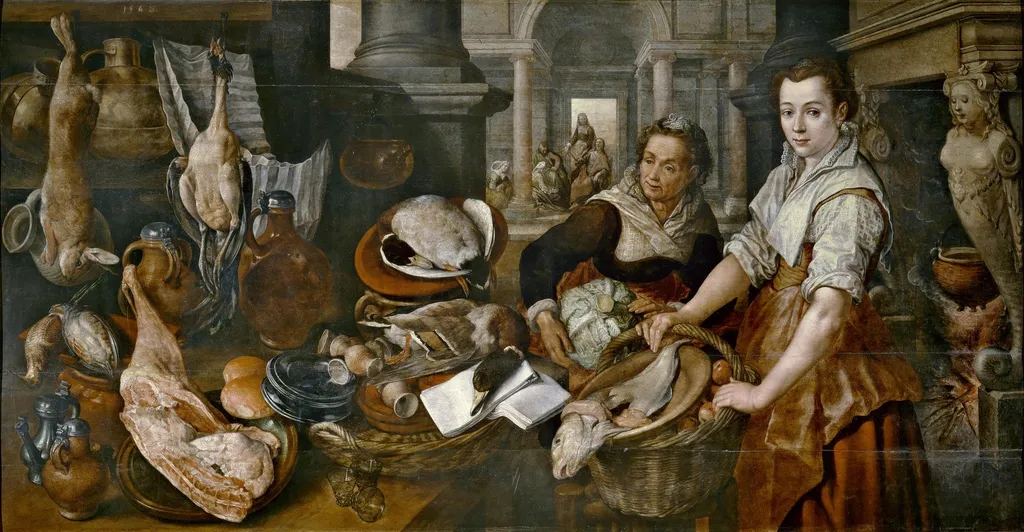
Christ at home with Martha and Mary is an oil painting by the Early Baroque Italian artist Joachim Beuckelaer. It dates from 1568 and is held in the collection of the Museo del Prado.
About this work
Subject & Meaning
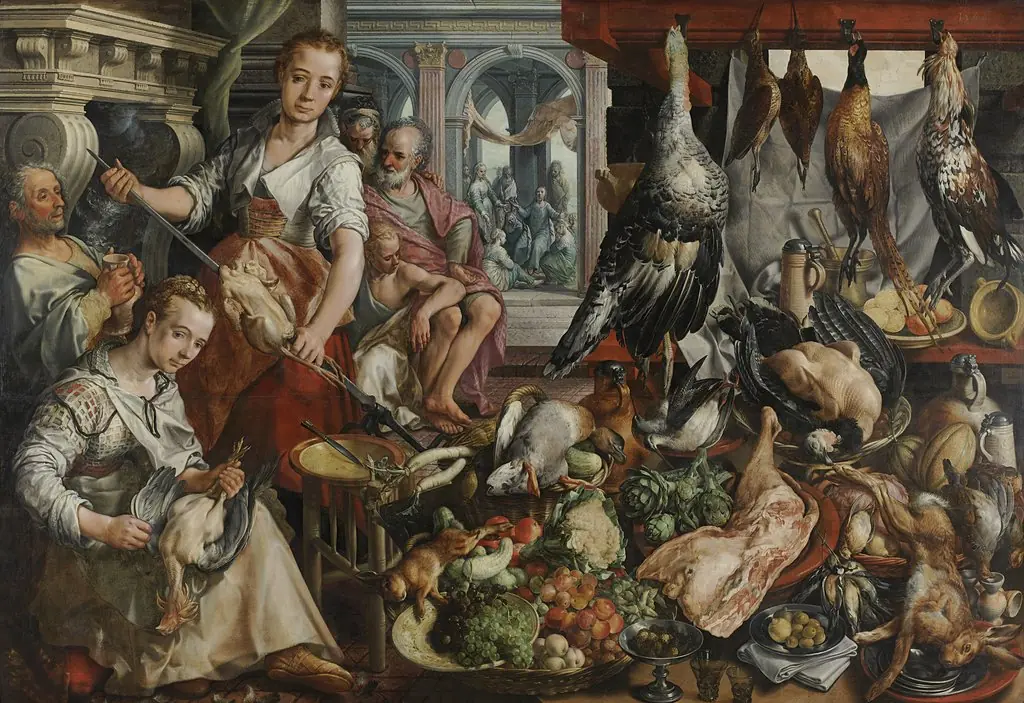
The painting depicts the New Testament episode of Jesus at the home of Martha and Mary, a subject drawn from the Gospel of Luke in which Christ visits the sisters and commends Mary's contemplative devotion over Martha's domestic labors. Beuckelaer embeds this religious narrative within an elaborate kitchen or market setting, where the foreground is filled with still-life elements, bread, wine, a bottle, a cauldron, and assorted kitchen utensils, that function both as genre attributes and as symbolic accessories to the sacred scene.
This fusion of devotional subject with abundant worldly goods reflects a Netherlandish tradition of using everyday objects as carriers of moral and Eucharistic meaning. The bread and wine in particular evoke the sacrament of the Eucharist, lending the domestic encounter between Christ and the two sisters a typological resonance that links Martha's hospitality to the institution of the altar.
Technique & Style
The composition is characterized by its substantial horizontal format, measuring 126 cm in height and 243 cm in width.
Executed in 1568, this work by Joachim Beuckelaer is an oil painting on a wooden panel. The composition is characterized by its substantial horizontal format, measuring 126 cm in height and 243 cm in width. Stylistically, the piece functions as an inverted still-life, where the foreground is dominated by a detailed arrangement of kitchen utensils, a cauldron, bread, wine, and bottles.
This dense accumulation of domestic objects serves as the primary visual focus, while the biblical narrative of Jesus visiting the home of Martha and Mary is relegated to the background, creating a distinct hierarchy between the material abundance of the market scene and the spiritual event depicted behind it.
History & Provenance
Christ at home with Martha and Mary is an oil painting on panel executed by Joachim Beuckelaer in 1568. The work measures 126 cm in height and 243 cm in width. It depicts the biblical scene of Jesus visiting the sisters Martha and Mary in a domestic interior, rendered in the inverted still‑life genre.
The painting entered the collection of the Museo del Prado, where it is displayed in Hall 056. No earlier ownership records are documented, and the work was not recorded as a commission; its creation is documented solely by the artist’s date of 1568.
Joachim Beuckelaer's Christ at home with Martha and Mary, created in 1568, is held in the collection of the Museo del Prado in Madrid. The painting is currently displayed in Prado Hall 056. Specific inventory or accession numbers are not provided in the available records. The work has not been documented with a specific exhibition history in the provided sources.
Overview
Joachim Beuckelaer, a Flemish artist of the mid-16th century, completed Christ at home with Martha and Mary in 1568. This oil painting exemplifies his distinctive approach, blending a biblical narrative with an extensive array of domestic objects and foodstuffs. The work is recognized for its intricate detail and the integration of everyday life into a sacred theme. It is currently part of the collection at the Museo del Prado in Madrid.
Context
Created in 1568, this work aligns with the artistic trends emerging in the Low Countries during the mid-16th century, often bridging late Renaissance and early Baroque sensibilities. Joachim Beuckelaer was renowned for his ability to integrate genre scenes and detailed still-life elements into traditional religious subjects. This approach allowed for a commentary on daily life and spiritual values, reflecting a broader cultural interest in both the material world and moral instruction.
Artist & collection

Artist
Joachim Beuckelaer (c. 1533 – c. 1570/4) was a Flemish painter specialising in market and kitchen scenes with elaborate displays of food and household equipment. His development of the genre of market and kitchen scenes…