Artwork
Las tres velas
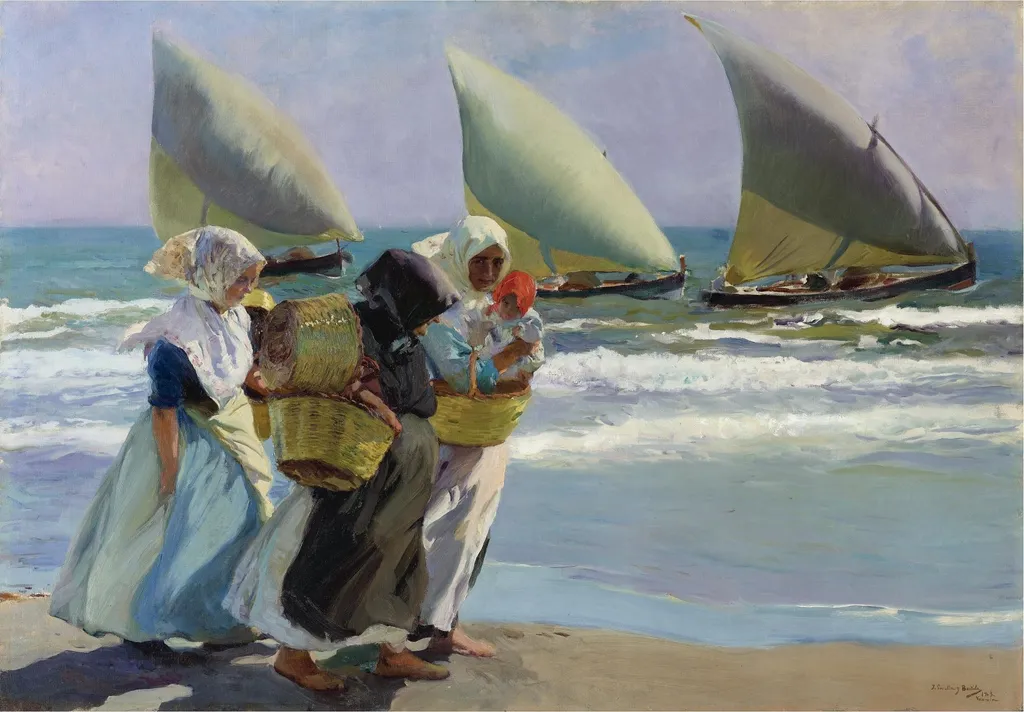
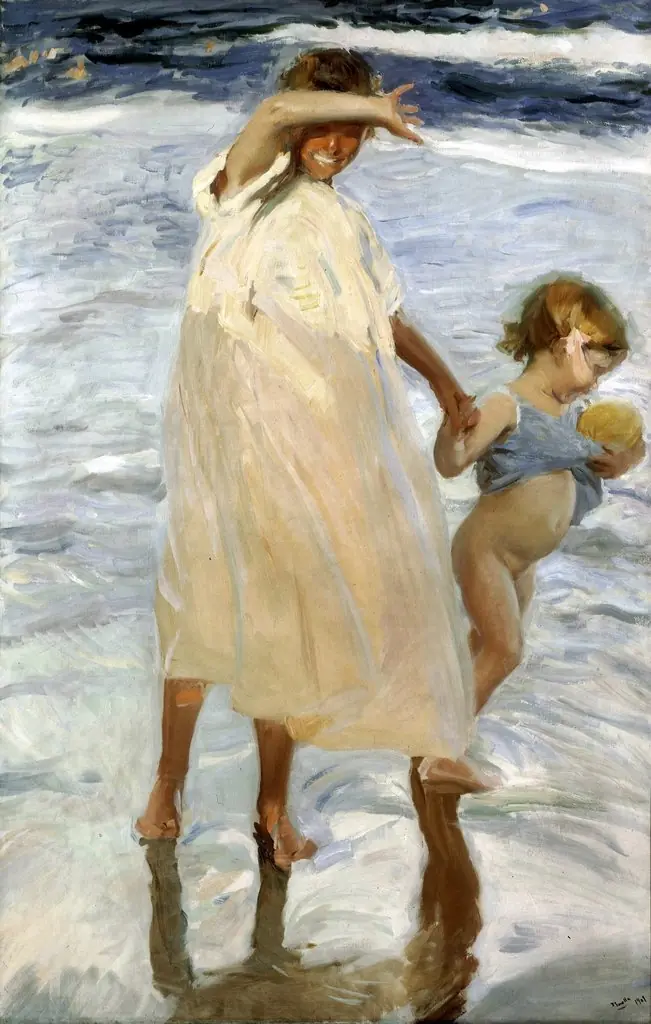
Las tres velas is an oil painting by the Impressionist artist Joaquín Sorolla. It dates from 1903 and is held in the collection of the Gemäldegalerie Alte Meister.
About this work
Overview
Following a century of obscurity and restitution, the painting was sold at auction in 2008 and remains in a private collection.
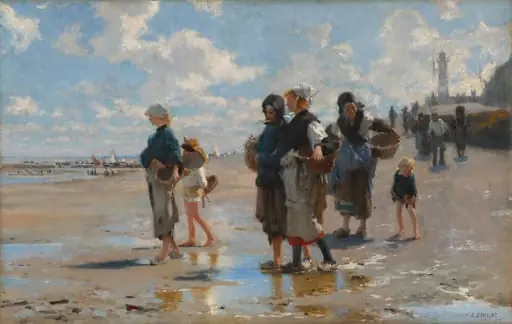
Las tres velas is an oil on canvas painting by the Spanish artist Joaquín Sorolla y Bastida, completed in 1903. Measuring 96.5 by 138 centimeters, the work was painted on the beach at La Malvarrosa in Valencia during a highly prolific summer campaign. The painting depicts three Valencian fisherwomen walking along the shore carrying empty baskets, juxtaposed against three returning fishing boats with distinct triangular sails. Marking a significant progression in Sorolla's treatment of maritime subjects toward a grander, more monumental format, the canvas is signed, dated, and inscribed J. Sorolla y Bastida / 1903 / Valencia in the lower right corner. Following a century of obscurity and restitution, the painting was sold at auction in 2008 and remains in a private collection.
Subject & Meaning
Rooted in Spanish costumbrismo, the scene captures three barefoot fisherwomen striding across the sand against the wind, their empty wicker baskets indicating their imminent meeting with the returning fishing fleet. The composition operates as a frieze representing the three ages of woman: a young girl, a mature mother holding an infant, and an older grandmother. This generational progression pays homage to the endurance and vital role of Valencian women in sustaining the local fishing community over centuries. The title itself underscores the metaphorical and literal significance of the three boats, whose billowing sails lead the women across the pictorial plane, emphasizing the primary role of the men as hunters and the interconnected labor of the community. The scene possesses a photographic spontaneity, as one woman appears to glance unexpectedly toward the viewer, yet the overall effect elevates humble, everyday labor into a monumental narrative of strength and purpose.
Technique & Style
Executed in oil on canvas, the painting demonstrates Sorolla's mature mastery of open-air painting, characterized by agile, impastoed brushwork and a sophisticated, broad palette of color effects. The composition is strikingly asymmetrical and generous in its spatial arrangement, moving away from the cramped, cropped formats of his earlier beach scenes to allow a sweeping, open shoreline and a prominent sky. The palette relies on cool blues, greens, whites, and sandy beiges, punctuated by the vivid red headscarf of the infant, which provides a singular visual accent. Light falls from the upper left, casting soft shadows on the sand and illuminating the figures and the pale greenish-yellow sails. Sorolla handles the water and sky with loose, visible strokes, while the faces and fabrics receive smoother treatment. Wind actively animates the canvas, snapping the women's scarves and twisting their aprons against their legs, while the damp breeze glosses the wicker baskets with prismatic color, making the atmospheric conditions a leading actor in the composition.
History & Provenance
Painted during the summer of 1903, Las tres velas was exhibited at the 1904 Grosse Berliner Kunstausstellung. There, the German banker Max Steinthal acquired it for 2,500 marks. The painting hung in Steinthal's office for over thirty years until the Third Reich attempted to confiscate his property due to his Jewish heritage. To prevent this, Steinthal appointed his non-Jewish son-in-law, Friedrich Vollmann, as executor, who transported the canvas to Dresden. In 1950, East German authorities impounded Vollmann's belongings, forcing him to flee to West Germany, and the painting entered the Gemäldegalerie Dresden. It remained lost in the gallery's basements until severe floods in 2002 prompted an emergency evacuation, uncovering crates labeled Steinthal. Following verification, the work was restituted to the banker's heirs and sold at Sotheby's London in November 2004 for 2.4 million euros. It reappeared at auction in New York in 2008, selling to an anonymous collector for 2.9 million euros.
Context
Las tres velas emerged at the onset of Sorolla's so-called culminating period, a phase when he expanded his focus from purely masculine labor to include women and children. Sorolla's interest in the Valencian fishing community was invigorated by his 1885 encounter with the work of Jules Bastien-Lepage in Paris, whose humble monumentality resonated with Sorolla's own artistic beliefs. While earlier works like La vuelta de la pesca and the cramped Las Sardineras of 1901 focused on the immediate aftermath of the catch, Las tres velas pushed the subject toward a more ambitious, monumental format, displacing the figures to emphasize the landscape and atmosphere. This shift aligned with a broader European interest in regional identities and local artists' communities, such as those in Brittany and Skagen. Sorolla's celebration of his native Valencia was deeply personal, reflecting his hope that the region would stimulate a wider Spanish renaissance. The painting was cataloged by Bernardino de Pantorba in 1970 and Blanca Pons-Sorolla in 1999, though it remained largely known only through a black and white photograph in the Sorolla family archives.
Legacy
Following its century-long disappearance from public view, the dramatic rediscovery and restitution of Las tres velas reinserted a pivotal work into the narrative of Sorolla's career. The painting served as a crucial developmental step, with Sorolla utilizing the successful displacement and monumentalization of the foreground figures seen here in subsequent canvases, such as Pescadoras valencianas. The 2004 exhibition at the Jewish Museum in Berlin, titled Max Steinthal: Ein Bankier und seine Bilder, highlighted not only the artistic merit of the canvas but also the historical significance of its provenance. Its subsequent high-profile sales at Sotheby's in 2004 and 2008 established substantial market records for the artist, cementing the painting's reputation as one of Sorolla's most luminously eloquent and ambitious early successes in the Valencian fisherwoman genre.
Own this work as a print
Artist & collection
Artist
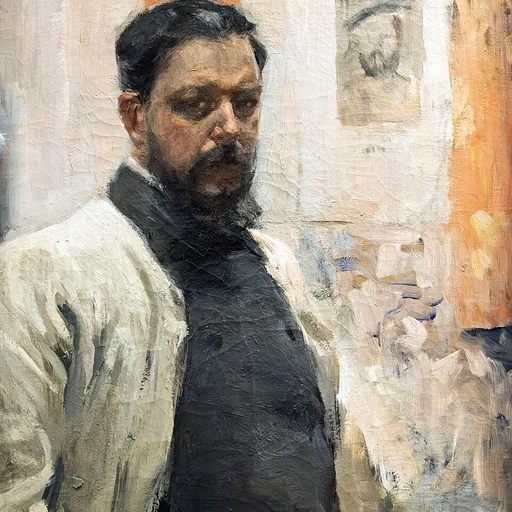
Joaquín Sorolla y Bastida (27 February 1863 – 10 August 1923) was a Spanish painter.