Artwork
The Bath, Jávea
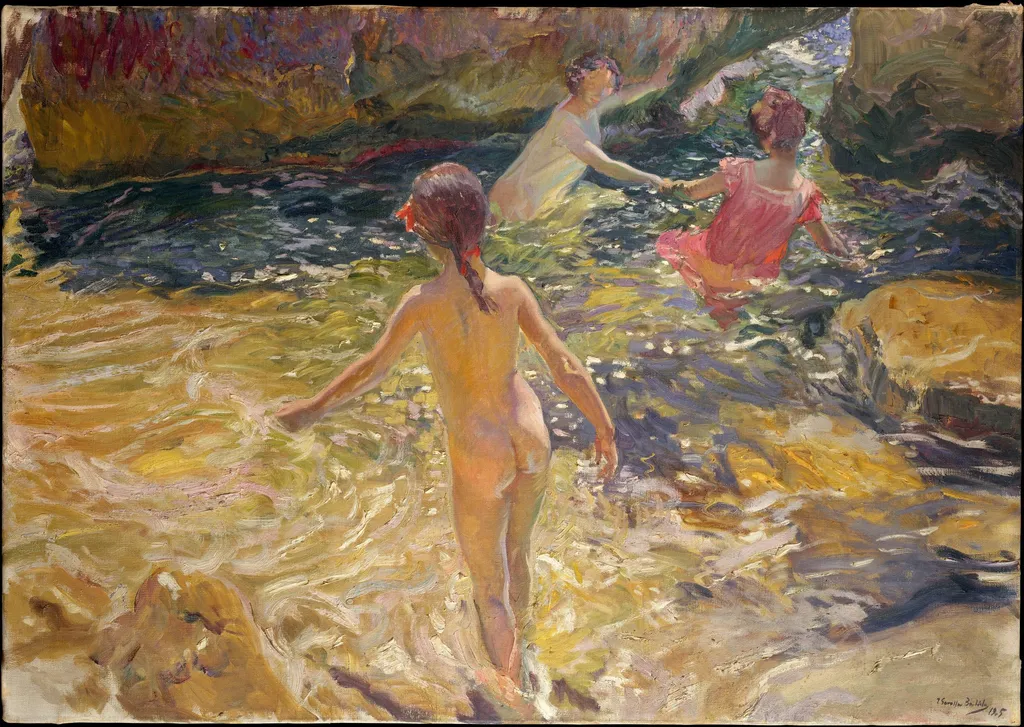
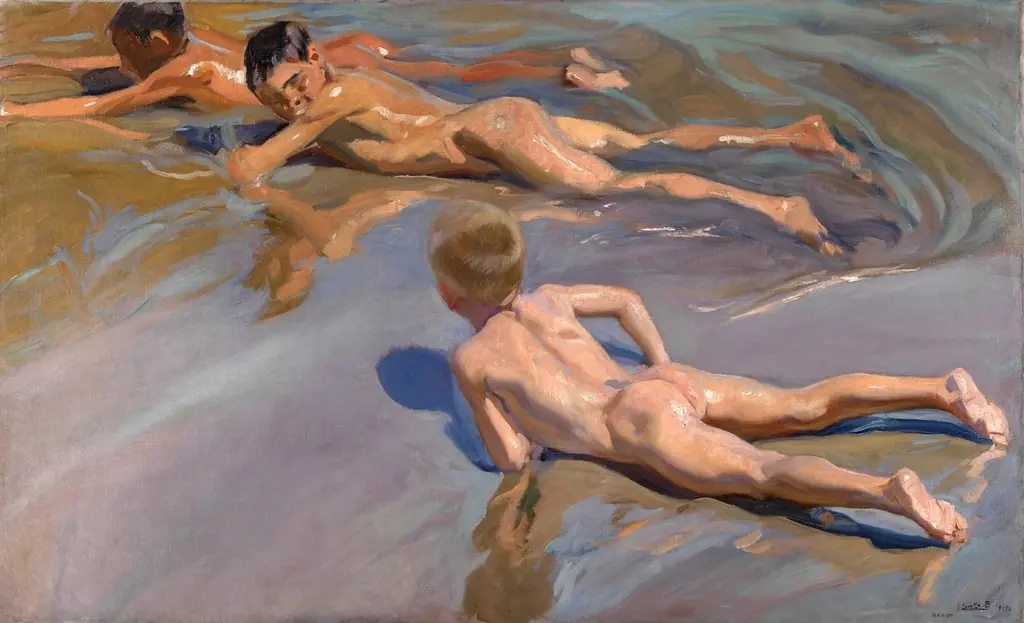
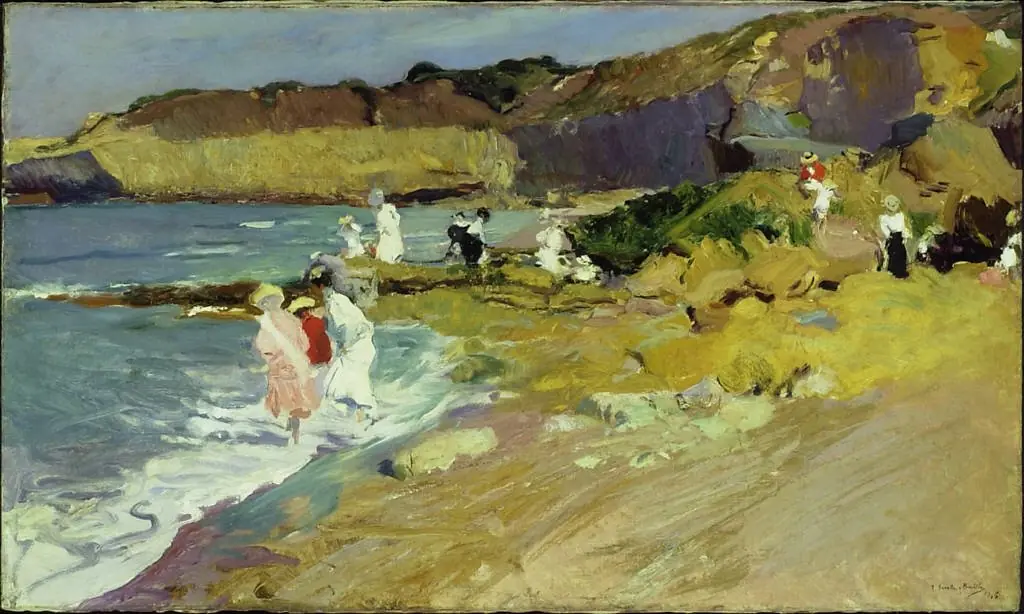
The Bath, Jávea is an oil painting by the Impressionist artist Joaquín Sorolla. It dates from 1905 and is held in the collection of the Metropolitan Museum of Art.
About this work
Subject & Meaning
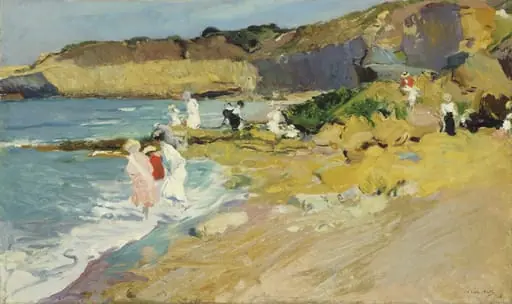
The painting depicts Sorolla’s own family at play in the shallows off a rocky cove near Jávea: in the foreground, his ten-year-old daughter Elena appears nude from the back; behind her, on a dark-blue ground, his wife Clotilde and their elder daughter María wade in the surf; dark cliffs close the horizon. The composition emphasizes the tactile contrast between sunlit sand and the iridescent, foaming sea, aligning the child’s body with the shimmering water and sun-warmed rock. Critics at the time read the image as part of Sorolla’s celebrated series of nude children, interpreting its luminous palette and vigorous brushwork as a celebration of youth and the Mediterranean light, while the inclusion of his family invested it with private, familial affection.
Technique & Style
The piece belongs to a celebrated series of nude children studies, characterized by its depiction of figures interacting with light and water at the seaside.
Executed in 1905, this work is an oil painting on canvas measuring 90.2 by 128.3 centimeters. The composition features a foreground dominated by sandy tones, contrasting with a dark blue background and shadowed rocks that obscure the horizon. Sorolla employs a vibrant palette to render multicolored, foaming water striking against the iridescent surfaces of wet stones.
The piece belongs to a celebrated series of nude children studies, characterized by its depiction of figures interacting with light and water at the seaside. The handling of the medium captures the dynamic movement of the sea and the texture of the rocky environment through distinct color variations and luminous effects.
History & Provenance
Joaquín Sorolla created the oil painting The Bath, Jávea in 1905. The work depicts the artist's wife, Clotilde, and their daughters, Elena and María, playing on a beach in Jávea. This piece is part of a renowned series of nude children paintings that secured a commission from the Hispanic Society.
The Hispanic Society initially exhibited the canvas in 1909, receiving critical acclaim from the New York Times for its depiction of the water and rocks. Following this exhibition, the painting entered the collection of the Metropolitan Museum of Art in New York later that same year, where it has remained since 1909.
The Bath, Jávea is held in the collection of the Metropolitan Museum of Art in New York. Its location is listed as the Metropolitan Museum of Art, and the work entered the museum’s holdings in 1909. The painting was first shown publicly by the Hispanic Society in 1909, and it has remained on view at the Metropolitan Museum of Art ever since. Contemporary press coverage highlighted the vivid water effects and the luminous treatment of light in the scene.
Context
The Bath, Jávea (1905) is part of Sorolla’s celebrated series of nude children, a thematic focus that also secured his major commission from the Hispanic Society. Critics in 1909 praised the painting’s rendering of luminous, foaming sea water striking iridescent wet rocks, singling out the work’s technical brilliance within this group. The inclusion of his wife Clotilde and daughters María and Elena grounded the scene in intimate family life while also advancing Sorolla’s reputation for capturing fleeting light and movement.
Positioned within his broader oeuvre, the work exemplifies his late-career shift toward plein-air figural compositions that fused Spanish luminism with modernist immediacy, foreshadowing later figurative currents in early twentieth-century painting.
Overview
Joaquín Sorolla y Bastida's The Bath, Jávea, painted in 1905, is an oil on canvas that exemplifies the artist's engagement with light and water. This work captures a moment by the Spanish coast, featuring figures immersed in the luminous, shallow sea. As a key piece within the Impressionist movement, it showcases Sorolla's characteristic approach to depicting vibrant scenes bathed in intense sunlight, a recurring theme in his oeuvre.
Own this work as a print
Artist & collection
Artist
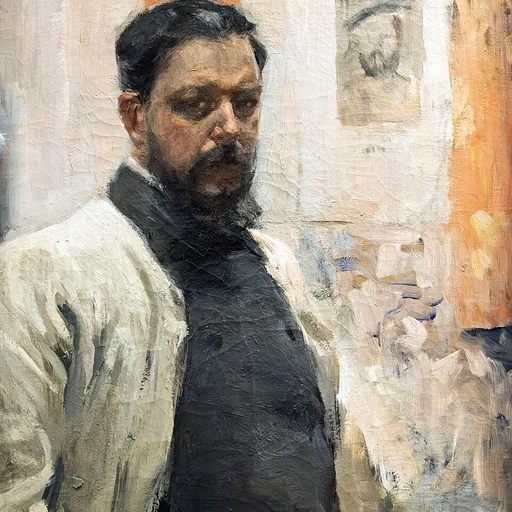
Joaquín Sorolla y Bastida (27 February 1863 – 10 August 1923) was a Spanish painter.