Artwork
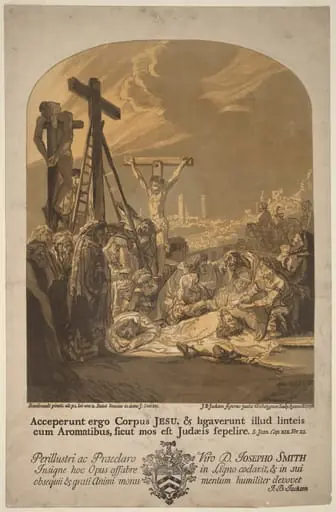
Venetian Set: Entombment of Christ
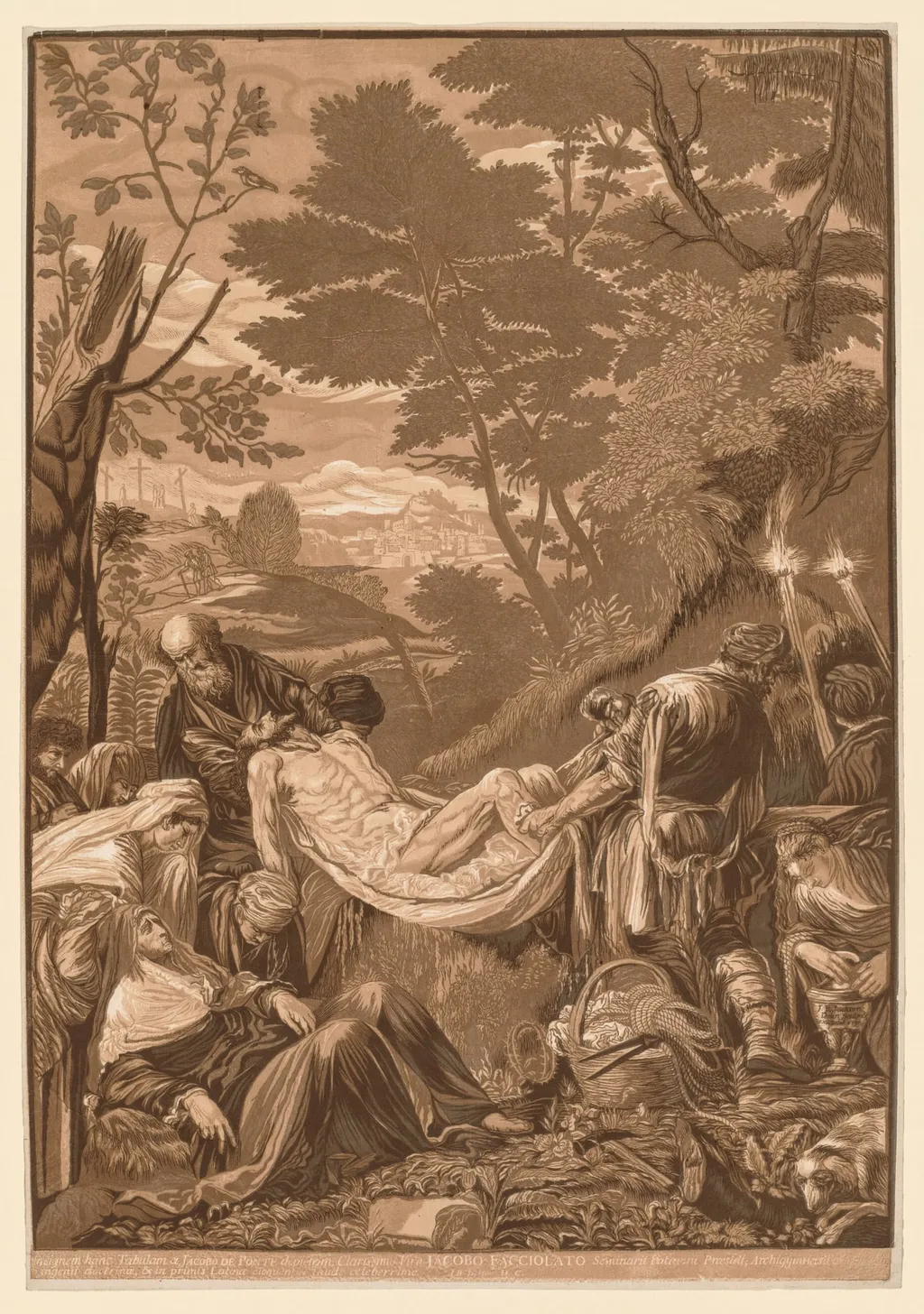
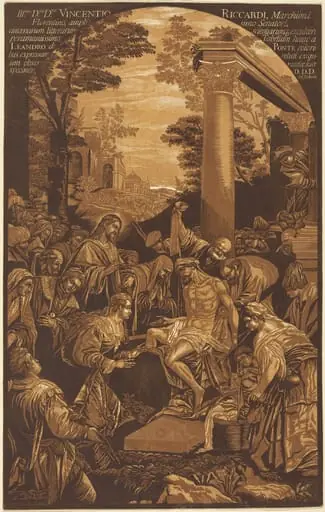
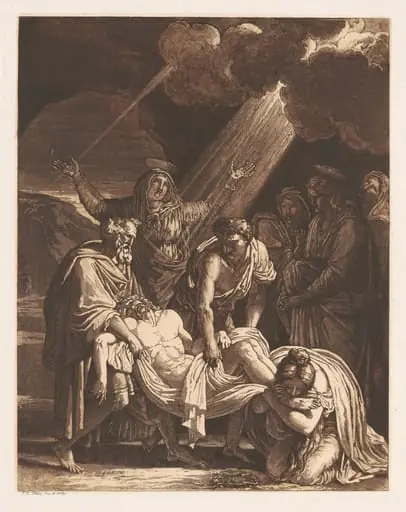
Venetian Set: Entombment of Christ is a print by the Baroque artist John Baptist Jackson. It dates from 1741 and is held in the collection of the Cleveland Museum of Art.
- Accession no.
- 1923.1053
- Credit line
- Charles W. Harkness Endowment Fund
About this work
Overview
The work is a chiaroscuro woodcut titled Venetian Set: Entombment of Christ. Executed by the English printmaker John Jackson, it depicts the burial of Christ with stark contrasts of deep shadow and bright highlight, achieved through a multi‑block printing process that renders light and dark in a single impression.
Subject & Meaning
The composition presents the body of Christ being lowered into a tomb, surrounded by mournful figures. The dramatic chiaroscuro emphasizes the solemnity of the scene, focusing the viewer’s attention on the central figure and the interplay of darkness and illumination that underscores themes of death and redemption.
Technique & Style
Jackson employed the chiaroscuro woodcut method, using several carved blocks inked in varying tones to produce a range of values. The intricate line work and layered printing create a sculptural quality, with deep shadows and luminous highlights that echo the tonal richness of oil paintings, a rarity among English printmakers of the period.
History & Provenance
Jackson, recognized as the leading 18th‑century specialist in chiaroscuro woodcuts, completed the Venetian Set in 1743 after a commission from the English Consul Joseph Smith and two other patrons. The series, published by J. B. Pasquali in 1745 as a bound volume, was intended as a souvenir for Grand Tour travelers.
Context
At a time when woodcuts were declining in popularity in England, Jackson’s work was influenced by Italian printmakers, notably Antonio Zanetti, who introduced him to the medium. The Venetian Set represents the first large‑scale effort to reproduce Venetian oil masterpieces through chiaroscuro woodcut, catering to the educational and aesthetic interests of early‑modern tourists.
Own this work as a print
Artist & collection

Artist
John Baptist Jackson (1701–1780) was a British artist, a woodcut printmaker of the eighteenth century.

![The Marriage at Cana [left plate], by John Baptist Jackson](https://artifactworldgallery.com/img/john-baptist-jackson--the-marriage-at-cana-left-plate--22bae83d46cc40b5-w320.webp)
![The Entombment [recto], by John Baptist Jackson](https://artifactworldgallery.com/img/john-baptist-jackson--the-entombment-recto--a6e32e731f5b1bab-w320.webp)