Artwork
Joan of Arc
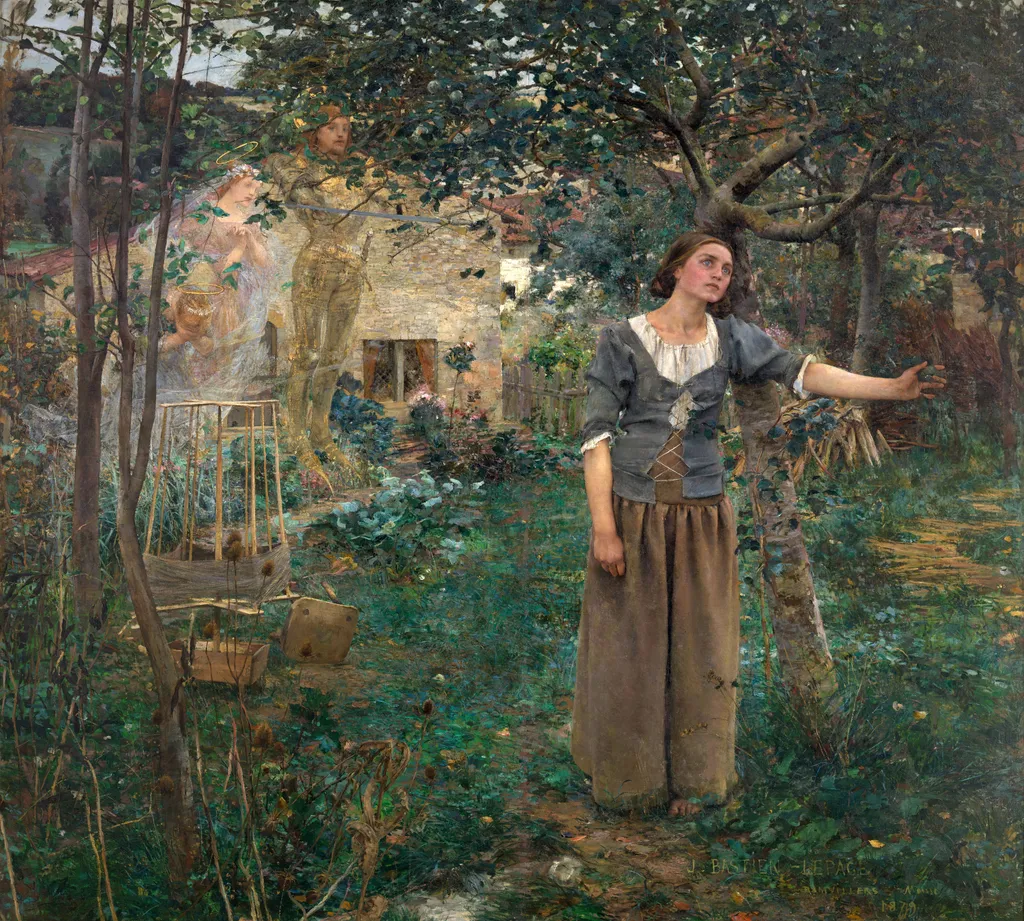
Joan of Arc is an oil painting by the Academic Art artist Jules Bastien-Lepage. It is held in the collection of the Metropolitan Museum of Art.
About this work
Subject & Meaning
The painting depicts the moment when Saints Catherine of Alexandria and Margaret the Virgin, along with the Archangel Michael, appear to the young Joan of Arc in her parents' garden in Domrémy, urging her to take up arms against the English. Bastien-Lepage's composition emphasizes Joan's spiritual awakening through her upward gaze and clasped hands, framed by the rustic setting of her Lorraine homeland. The inclusion of the saints introduces a supernatural dimension that diverges from the artist's otherwise naturalistic style, provoking critical debate at the Salon of 1880, where some reviewers condemned the blend of realism and visionary subject as contrived.
Critics like Joris-Karl Huysmans dismissed it as "false naturalism," while others saw it as a patriotic evocation of Joan as a national symbol in the wake of France's defeat in the Franco-Prussian War and the annexation of eastern Lorraine.
Technique & Style
Stylistically, the piece is noted for its detailed rendering of the figure's pose and facial expression to convey spiritual awakening.
Created in 1879, Jules Bastien-Lepage's Joan of Arc is an oil-on-canvas painting executed within the academic art movement. The work measures 254 by 279.4 centimeters and depicts a naturalistic garden scene. Stylistically, the piece is noted for its detailed rendering of the figure's pose and facial expression to convey spiritual awakening.
While the artist employed a naturalistic approach for the protagonist, the inclusion of the visionary saints Catherine, Margaret, and Michael led some contemporary critics to describe the composition as "false naturalism," viewing it as a departure from his usual style. The painting was first exhibited at the Paris Salon in 1880 before entering the collection of the Metropolitan Museum of Art.
History & Provenance
Jules Bastien-Lepage completed Joan of Arc in 1879. To prepare for the work, the artist visited Domrémy, the village where the subject was born, a location near his own birthplace in Lorraine. The painting was first exhibited at the Salon of 1880 in Paris.
Following this debut, American businessman Erwin Davis purchased the work. The piece was later shown at the Exposition Universelle in Paris in 1889. It eventually entered the collection of the Metropolitan Museum of Art in New York, where it remains housed.
The creation of the work coincided with a resurgence of interest in Joan of Arc within French culture following the Franco-Prussian War and the annexation of Lorraine.
Context
Jules Bastien-Lepage's 1879 painting emerged during a resurgence of Joan of Arc's cultural significance in 1870s France, fueled by the country's defeat in the Franco-Prussian War and the annexation of Lorraine, the native region of both the heroine and the artist. When exhibited at the 1880 Salon, critics praised the depiction of Joan's spiritual awakening through her pose and expression but criticized the inclusion of the saints as a departure from the artist's naturalism; Joris-Karl Huysmans notably dismissed it as "false naturalism." This harsh French reception reportedly drove Bastien-Lepage to Paris for London, abandoning a similarly styled Ophelia.
Artist Marie Bashkirtseff condemned the French critics' failure to appreciate the work, noting it was instead properly "worshipped" in the USA after its purchase by American businessman Erwin Davis. The painting was later exhibited at the 1889 Exposition Universelle in Paris.
Legacy
Following its exhibition at the Salon of 1880, Jules Bastien-Lepage's painting received a polarized critical reception that significantly impacted the artist's trajectory. While critics praised the depiction of Joan's spiritual awakening through her pose and facial expression, they criticized the inclusion of the saints as a departure from his naturalistic style; Joris-Karl Huysmans famously derided it as "false naturalism." This negative French reception reportedly drove Bastien-Lepage to flee Paris for London, abandoning a similarly styled Ophelia painting.
Conversely, the work found a highly appreciative audience across the Atlantic. Purchased by American businessman Erwin Davis, the painting was, as contemporary artist Marie Bashkirtseff noted, effectively "worshipped" in the United States. The work was later exhibited at the Exposition Universelle in Paris in 1889 and ultimately entered the collection of the Metropolitan Museum of Art in New York.
Overview
Jules Bastien-Lepage completed his oil on canvas painting, Joan of Arc, in 1879. This significant work depicts the renowned French historical figure, Jeanne d'Arc, often known as the "Maid of Orléans." Bastien-Lepage's portrayal offers a distinctive interpretation of the national heroine, reflecting the artistic currents of the late 19th century. The painting is recognized for its particular approach to a well-known historical narrative.
Own this work as a print
Artist & collection

Artist
Jules Bastien-Lepage (1 November 1848 – 10 December 1884) was a French painter closely associated with the beginning of Naturalism, an artistic style that grew out of the Realist movement and paved the way for the development of…