Artwork
ANCHORA o INPARO
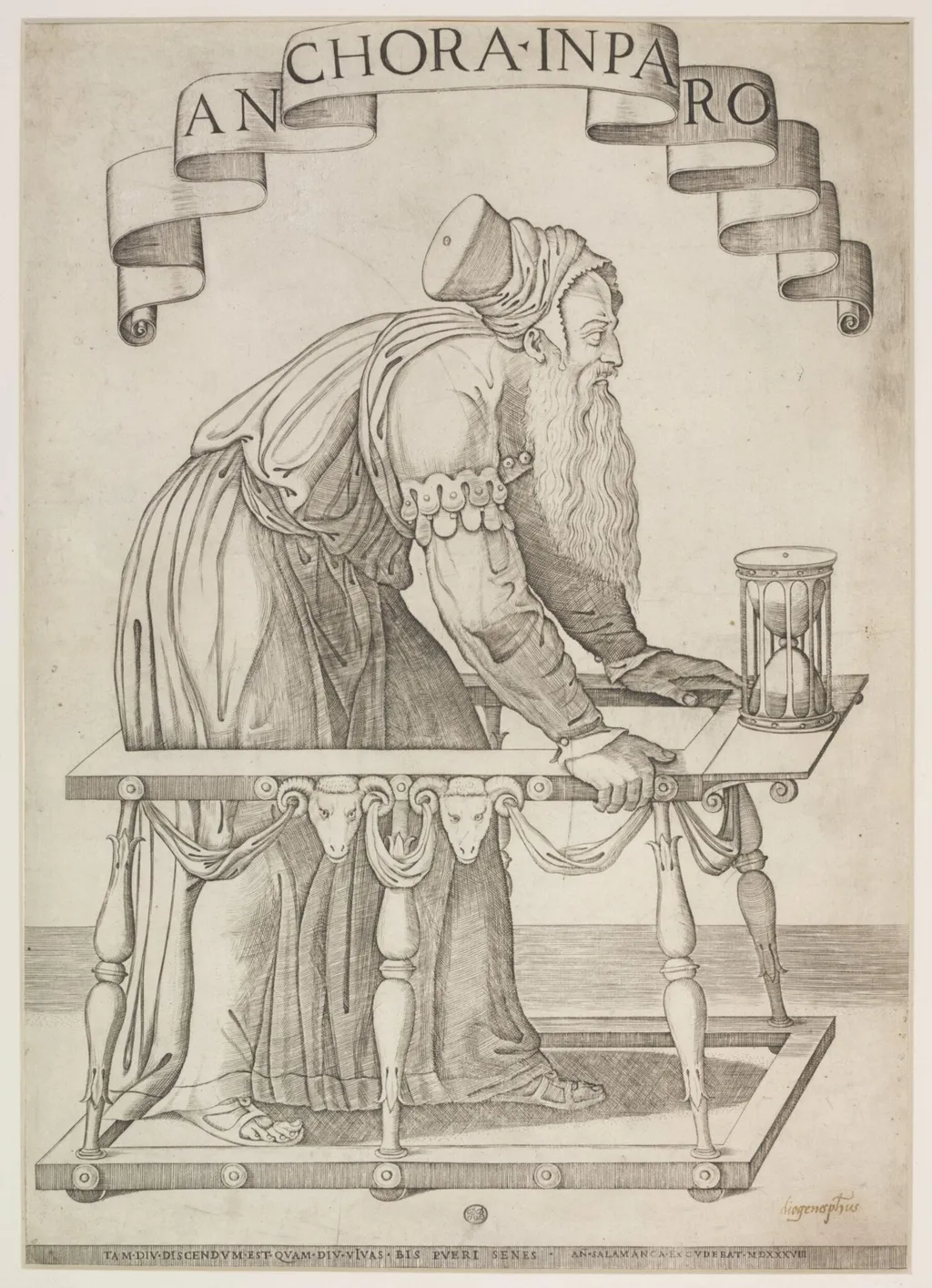
ANCHORA o INPARO is a print by the Renaissance artist Marcantonio Raimondi. It is held in the collection of the Victoria and Albert Museum.
About this work
Overview
An engraving by Marcantonio Raimondi, dated 1538, titled ANCHORA o INPARO, presents a solitary elderly figure in a modest interior setting.
An engraving by Marcantonio Raimondi, dated 1538, titled ANCHORA o INPARO, presents a solitary elderly figure in a modest interior setting. The composition combines symbolic elements, hourglass, goats, and Latin inscriptions, with a stylized portrait that evokes Michelangelo. Rendered in fine linear detail, the print reflects Raimondi’s mastery of reproductive engraving and his engagement with allegorical themes common in Renaissance print culture.
Subject & Meaning
The central figure, aged and weary, holds an hourglass, suggesting the passage of time or mortality. Two goats, rearing on hind legs and bound by a rope beneath the table, may allude to duality, choice, or folly, possibly referencing classical or folkloric motifs. The phrase 'ANCHORA o INPARO' remains enigmatic; interpretations suggest it may be a play on words related to anchoring or inaction.
The inscription 'TAM DIV' could imply a fragment of a Latin phrase, adding to the work’s cryptic tone.
Technique & Style
Raimondi employed precise, controlled linework characteristic of his engraving practice, inherited from his training under Raphael’s circle. The figure’s drapery, facial texture, and the goats’ musculature are rendered with subtle gradations of tone and sharp contouring. The composition is tightly framed, emphasizing the figure’s isolation.
The use of classical proportions and anatomical detail aligns with humanist ideals, even as the subject matter veers into allegorical ambiguity.
History & Provenance
The print bears the date MDXXXVIII (1538) and the name 'Añ. Salamanca,' possibly indicating a publisher or location associated with its production. Raimondi, known for reproducing works by Raphael, turned increasingly to original allegorical subjects in his later career.
This print likely circulated among educated collectors in Italy and beyond, valued for its intellectual complexity rather than its aesthetic appeal alone.
Context
Created during the height of the Italian Renaissance, the print reflects a period when printmakers explored philosophical and moral themes through visual allegory. While religious and mythological subjects dominated, works like this reveal a growing interest in personal reflection, time, and human limitation. The possible reference to Michelangelo situates the image within a network of artistic identity and aging, common concerns among Renaissance intellectuals.
Legacy
Though not widely reproduced or studied, ANCHORA o INPARO stands as an example of Raimondi’s late engagement with symbolic complexity beyond mere reproduction. Its obscurity contrasts with its layered meaning, offering insight into the quieter, more introspective currents of 16th-century printmaking. Scholars continue to debate its intent, preserving its status as a cryptic artifact of Renaissance thought.
Own this work as a print
Artist & collection

Artist
Marcantonio Raimondi, often called simply Marcantonio (c. 1470/82 – c. 1534), was an Italian engraver, known for being the first important printmaker whose body of work consists largely of prints copying paintings. He…