Artwork
The Judgment of Paris
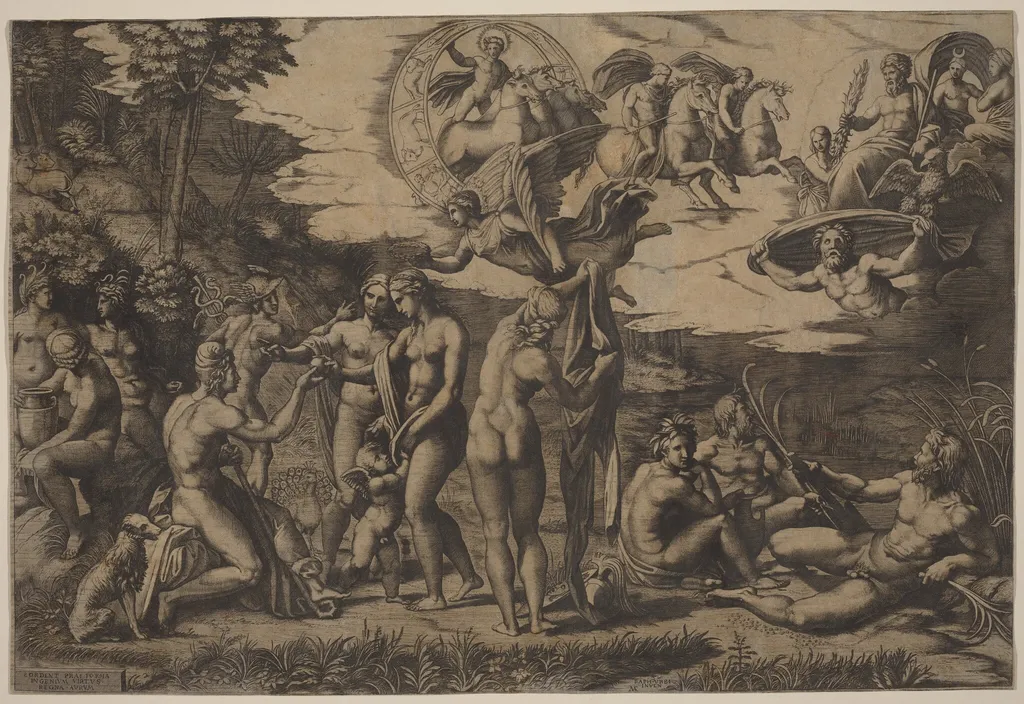
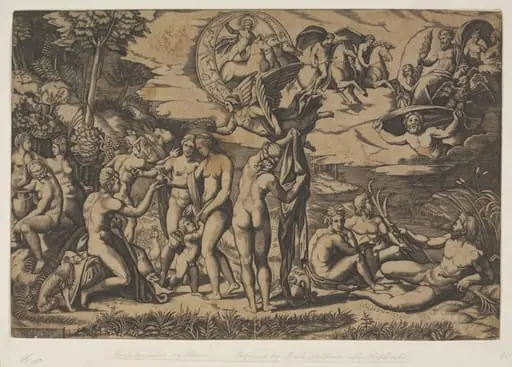
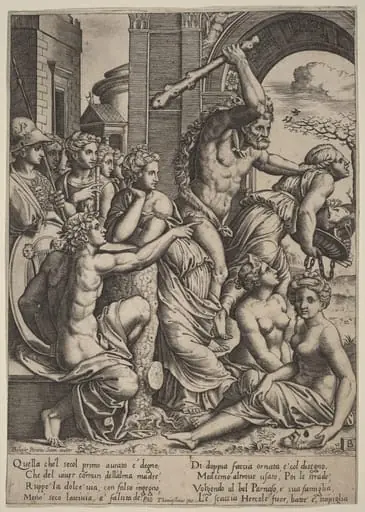
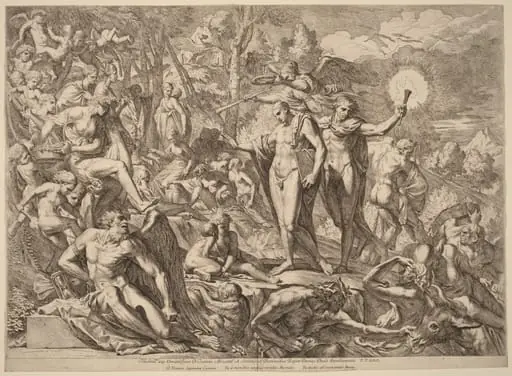
The Judgment of Paris is an ink print by the Renaissance artist Marcantonio Raimondi. It dates from 1515 and is held in the collection of the Metropolitan Museum of Art.
About this work
Subject & Meaning
The subject embodies themes of beauty, judgment, and the origins of conflict in classical mythology.
The Judgment of Paris depicts the mythological moment in which Paris, Prince of Troy, chooses the most beautiful goddess among Juno, Minerva, and Venus, an act that triggers the Trojan War. Venus, shown with Cupid, promises Paris the love of Helen of Troy as reward, while Juno is identified by her peacock and Mercury delivers Jupiter's command to influence the decision. Minerva appears centrally with helmet and shield, flanked by Victory crowning Venus and the sun chariot of Sol accompanied by Castor and Pollux, forming a compositional axis that divides the scene.
The work combines antique sculptural models with Raphael's innovations, such as a freestanding female back view and a dense arrangement of figures to explore human form. Inscriptions on the print reference its design after Raphael and credit the artist's teacher. The subject embodies themes of beauty, judgment, and the origins of conflict in classical mythology.
Technique & Style
The Judgment of Paris is an engraving produced by Marcantonio Raimondi around 1510, based on a lost drawing by Raphael. The work employs chalcography, a technique involving incised lines on a metal plate that are inked and pressed onto paper to create a print. Raimondi’s handling of the plate included raising the background with a burr to produce a warm, velvety tonal ground and polishing selective areas to retain highlights, while horizontal lines unify the compositional elements.
The figures are rendered with a sharp graver and varied hatching, giving the bodies a sculptural quality. Early impressions retain this atmospheric effect, though the plate later wore down and required a new version executed by Marco Dente in the 1520s. The composition draws on ancient sarcophagus reliefs, notably those in the Villa Medici and Villa Doria-Pamphilj, which Raimondi adapted with looser grouping and greater spatial freedom.
Raimondi depicted the gods largely nude, diverging from Roman tradition, and arranged them from multiple viewpoints to suggest three‑dimensional presence within a two‑dimensional medium.
History & Provenance
The engraving The Judgment of Paris was created by Marcantonio Raimondi around 1510, based on a lost drawing by Raphael that drew heavily from ancient Roman sarcophagus reliefs. The composition, which features a central female back view as a Raphael innovation, was designed to be reproduced as a print, with the inscription "RAPH VRBI INVEN" explicitly crediting Raphael of Urbino as the inventor of the design. Raimondi executed the work using a technique involving a pumice-textured plate to achieve a warm tonal ground, a method that led to rapid wear of the copper plate due to high demand.
Consequently, a re-engraved copy was produced by Marco Dente in the 1520s. The creation process reflects a collaborative effort where Raphael provided the artistic conception and Raimondi handled the technical execution of the chalcography.
The engraving is held by multiple institutions: the Staatsgalerie Stuttgart, Museum Boijmans Van Beuningen, the National Gallery of Art in Washington, D.C., and the Metropolitan Museum of Art.
It has appeared in group exhibitions at these museums, notably within holdings of Italian Renaissance prints, though specific exhibition titles and dates are not documented in the referenced sources.
Context
Marcantonio Raimondi's 1510 engraving The Judgment of Paris is recognized as one of the most significant works in the history of printmaking. The composition is based on a lost drawing by Raphael, who adapted the subject from ancient Roman sarcophagus reliefs while introducing a central female back view as a novel artistic innovation. This collaboration exemplifies the high Renaissance practice of translating painterly designs into reproducible media.
Raimondi's technique employed a unique method of roughening the plate with pumice to achieve a warm, atmospheric tonal quality, distinguishing the early impressions from later, technically simpler reissues by Marco Dente in the 1520s. The work's enduring fame is underscored by its presence in major collections such as the National Gallery of Art in Washington, D.C., and the Metropolitan Museum of Art.
Overview
Created circa 1515, this copper engraving presents the mythic episode known as the Judgment of Paris. The composition centers on a chariot drawn by horses, flanked by three goddesses who have gathered to persuade the mortal prince. Raimondi’s linear treatment renders the scene with a clarity that reflects the print’s function as a portable narrative image.
Own this work as a print
Artist & collection

Artist
Marcantonio Raimondi, often called simply Marcantonio (c. 1470/82 – c. 1534), was an Italian engraver, known for being the first important printmaker whose body of work consists largely of prints copying paintings. He…