Artwork
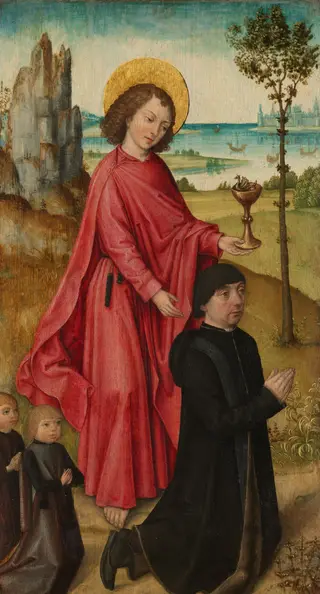
Inner left wing of a triptych with the donor, his two sons and St John the Evangelist
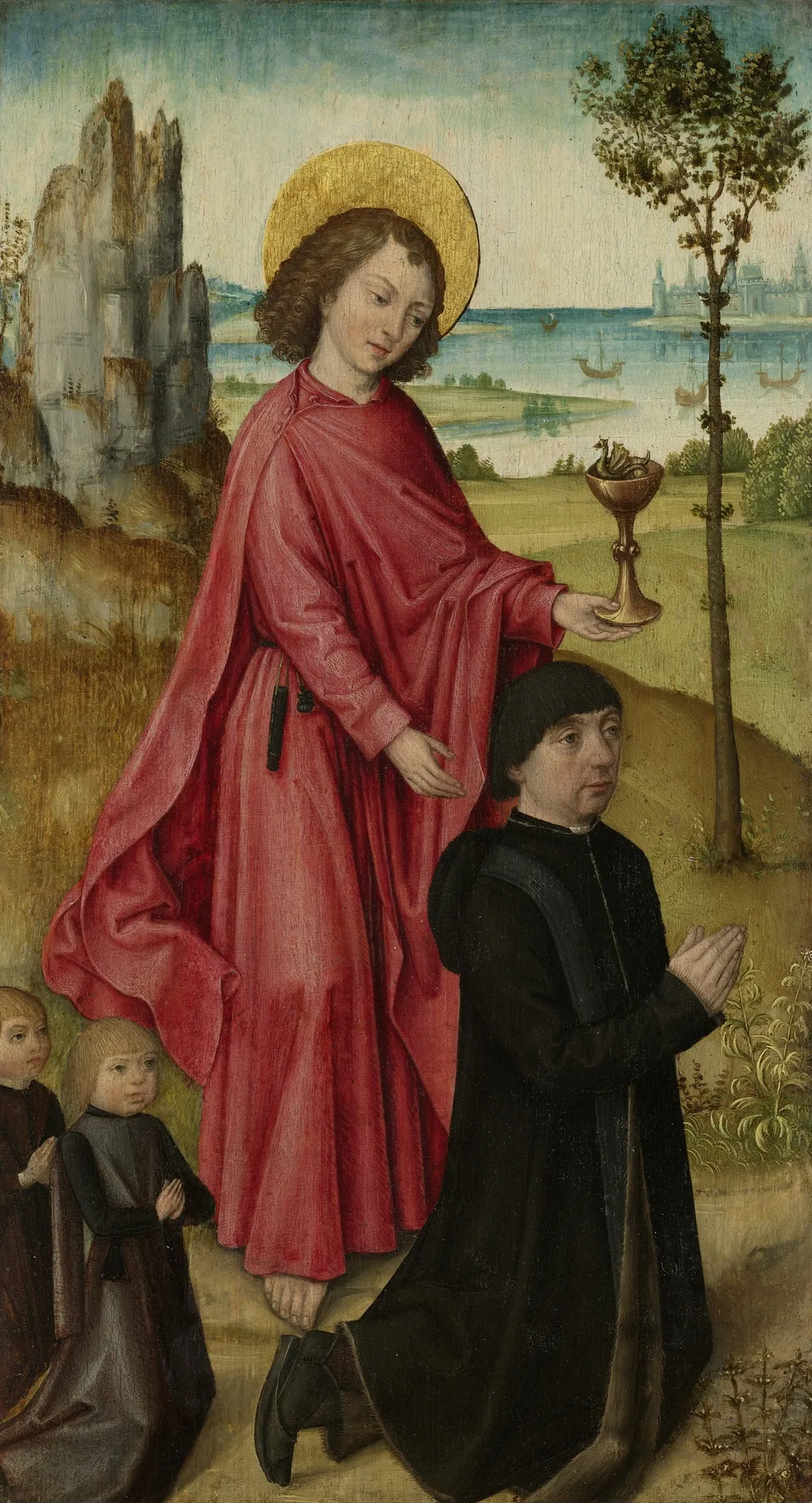
Inner left wing of a triptych with the donor, his two sons and St John the Evangelist is an oil painting by the Northern Renaissance artist Master of the Bruges Legend of St. Ursula. It dates from 1490 and is held in the collection of the Rijksmuseum. This oil painting forms the left panel of a three‑part altarpiece created circa 1490.
About this work
Subject & Meaning
Such imagery was intended to convey both the family's devotional intent and their place within a communal faith practice.
The panel shows a donor with his two sons presented before Saint John the Evangelist, a composition typical of devotional triptychs in late‑medieval religious painting. The inclusion of the donor family emphasizes personal piety and intercessory prayer, while Saint John functions as a spiritual protector and witness to the donor's devotion. The work belongs to the corpus of the Master of the Bruges Legend of St. Ursula, reflecting the regional artistic tradition of the late 15th century.
The depiction combines narrative elements with symbolic attributes: the saint's presence signifies divine favor, and the donor's portrayal underscores earthly status within a sacred context. Such imagery was intended to convey both the family's devotional intent and their place within a communal faith practice.
Technique & Style
Created in 1480, this religious panel painting is executed in oil paint on a wooden support. The work measures 52.2 cm in height and 29 cm in width. Stylistically, it is attributed to the Master of the Bruges Legend of St. Ursula and depicts the donor with his two sons alongside Saint John the Evangelist. The composition functions as the inner left wing of a larger triptych structure.
History & Provenance
The work was created circa 1480 as an oil painting on panel, commissioned by a donor together with his two sons and depicting St John the Evangelist. It forms the inner left wing of a triptych attributed to the Master of the Bruges Legend of St Ursula. After its creation it entered the collection of the Rijksmuseum, where it remains on display in the museum’s galleries.
The painting’s provenance is documented through its acquisition by the Rijksmuseum, which holds it as part of its permanent collection of Dutch and Flemish masterpieces.
The Inner left wing of a triptych with the donor, his two sons and St John the Evangelist is housed in the Rijksmuseum collection and is catalogued under inventory number SK-A-1951. It was created by the Master of the Bruges Legend of St. Ursula in 1480 using oil paint on panel. The work has been exhibited in the Rijksmuseum’s permanent display of Flemish primitives and featured in the 2011 exhibition "Early Netherlandish Painting: Under the Surface" at the museum.
Dimensions are recorded as 52.2 cm in height and 29 cm in width.
Overview
This oil painting forms the left panel of a three‑part altarpiece created circa 1490. Executed by the anonymous Master of the Bruges Legend of St Ursula, it belongs to the Northern Renaissance tradition. The panel portrays a saintly figure, a donor with his children, and a distant urban landscape, and is currently housed in the Rijksmuseum.
Context
The Master of the Bruges Legend of St Ursula is named after a polyptych of Saint Ursula that includes the distinctive belfry and tower of Bruges’ Church of Notre‑Dame, recurring motifs in his oeuvre. This panel shares that architectural backdrop, situating the saints and patrons within a recognizable Flemish environment.
Artist & collection
Artist
Master of the Bruges Legend of St. Ursula
The Master of the Legend of St. Ursula (1436–1505) was a Flemish painter active in the fifteenth century. His name is derived from a polyptych depicting scenes from the life of Saint Ursula painted for the convent of…

 De H. Johannes de Evangelist met Jan de Trompes en zijn zoon
 Saint John the Baptist and Saint Jerome
 Altar Panel with a Portrait of a Donor in Scarlet under the Protection of St Anthony
 Justice of Emperor Otto III: The Trial by Fire
 Virgin and Child Crowned by Angels
 Saint John the Baptist Preaching
 Enthroned Virgin and Child, with Angels
 The Nativity