Artwork
Untitled
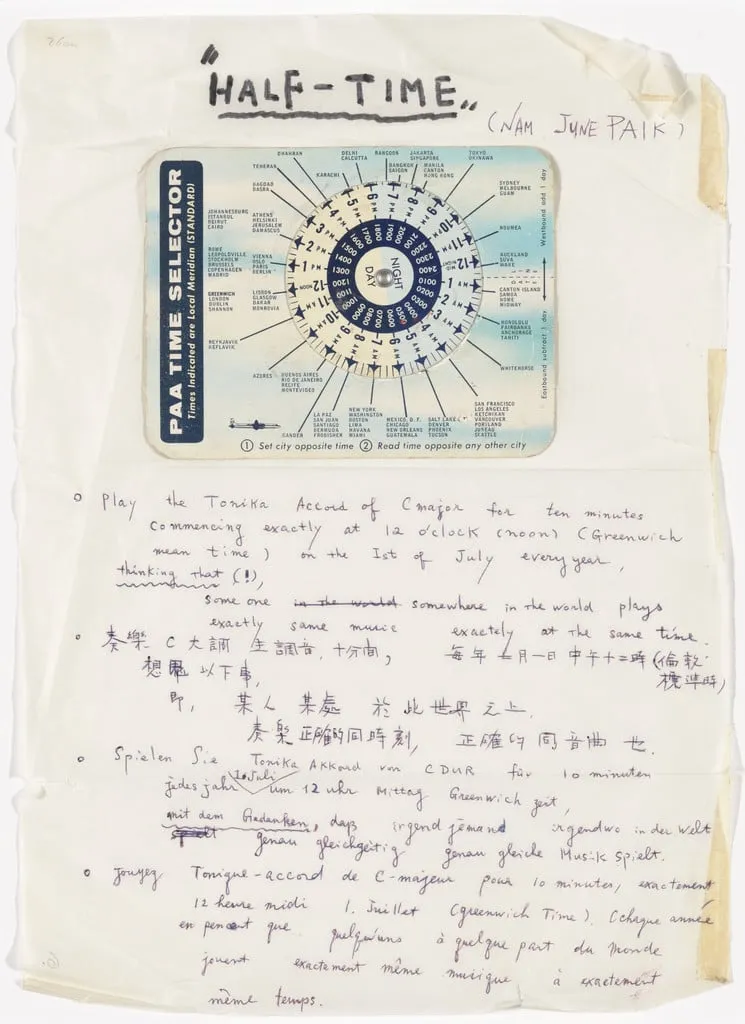
Untitled is a drawing by Nam June Paik. It dates from 1962 and is held in the collection of the Museum of Modern Art.
About this work
Overview
Created in 1962, Nam June Paik's Untitled is a seminal work of early Fluxus art that functions as both a visual document and a set of performance instructions.
Created in 1962, Nam June Paik's Untitled is a seminal work of early Fluxus art that functions as both a visual document and a set of performance instructions. Executed in ballpoint and felt-tip pen on printed paper, the piece centers on a hand-drawn world time zone selector. Surrounding this diagram, Paik inscribes specific directives in five languages: English, Korean, Japanese, German, and French.
The text commands the viewer to play a piece of music at noon Greenwich Mean Time every July 1st, fostering a sense of global simultaneity by imagining a counterpart performing the same action elsewhere. This work exemplifies Paik's transition from a classical musician to a pioneer of video art and conceptual performance, emphasizing the dematerialization of the art object in favor of the idea and the event. By utilizing a mundane medium like a printed paper sheet and multilingual text, Paik challenges traditional notions of authorship and the gallery space, inviting a decentralized, participatory experience that anticipates his later explorations of global communication networks.
The piece remains a crucial artifact in understanding the international scope of the Fluxus movement and Paik's enduring interest in synchronizing human experience across geographical boundaries.
Subject & Meaning
The drawing presents a schematic world clock, with city names replacing numerals, and a note directing the reader to play a specific piece of music at noon GMT on July 1 each year. The instruction appears in five languages, English, Korean, Japanese, German and French, suggesting a universal, participatory gesture that links disparate locations through a shared sonic event.
Technique & Style
Paik employs everyday drawing tools, ballpoint and felt‑tip pens, to render a dense, hand‑written field of text and simple graphic elements. The informal, slightly erratic script coexists with precise schematic symbols, creating a tension between casual notation and systematic design. The use of printed paper as a substrate adds a layer of reproducibility to the otherwise singular drawing.
History & Provenance
The work was produced early in Paik’s career, a period marked by his exploration of media, technology, and communication. After its creation, the drawing entered the collection of the Museum of Modern Art, where it remains on view as part of the institution’s holdings of mid‑twentieth‑century avant‑garde art.
Context
In the early 1960s, Paik was developing concepts that prefigured networked media and global connectivity. This drawing anticipates later projects involving live broadcasts and satellite transmissions, reflecting his interest in synchronizing disparate audiences through time‑based actions. The multilingual instructions underscore the artist’s engagement with cross‑cultural exchange during a period of rapid technological change.
Artist & collection

Artist
Nam June Paik was a South Korean artist. He worked with a variety of media and is considered to be the founder of video art. He is credited with the first use (1974) of the term "electronic super highway" to describe…