Artwork
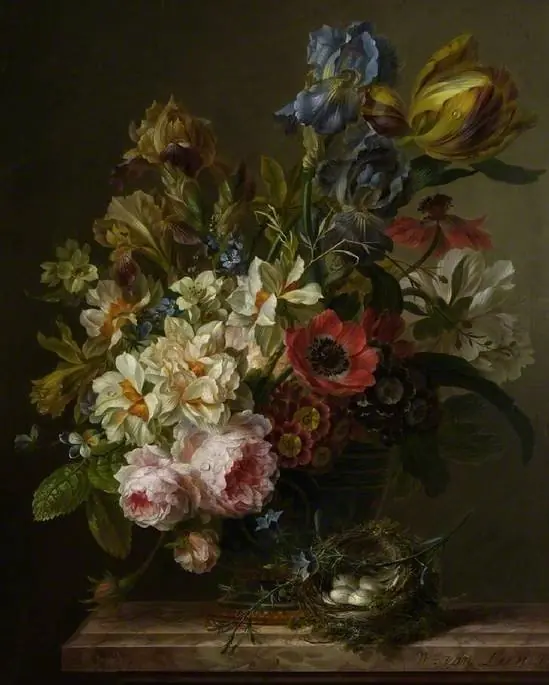
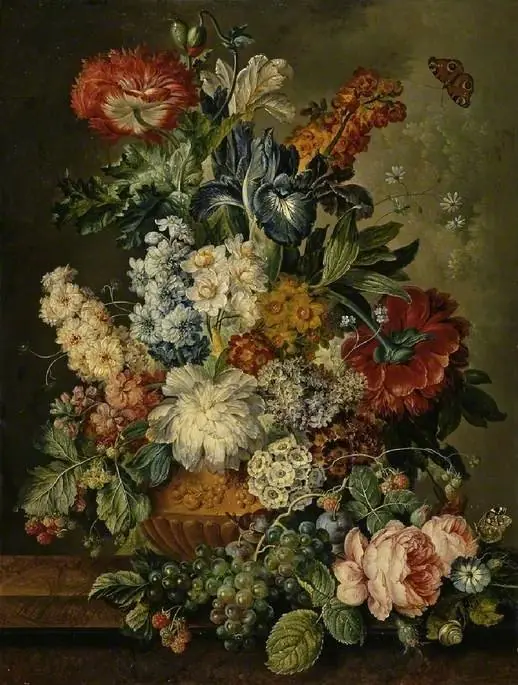
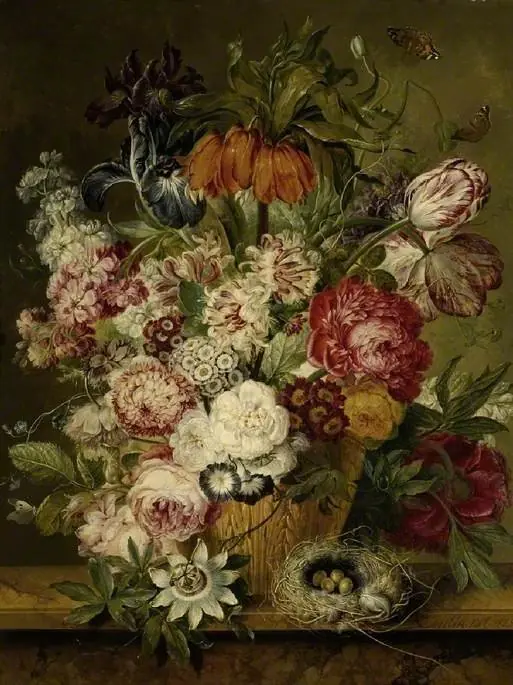
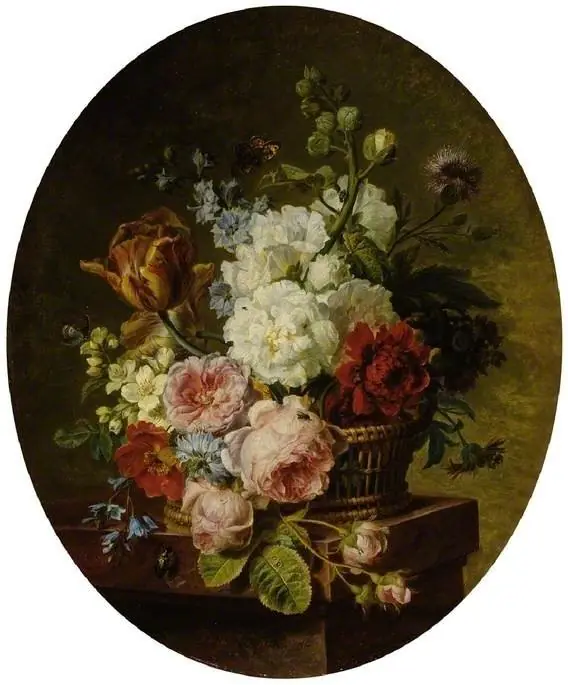
Open wicker basket of mixed flowers, including iris, roses, poppies, hollyhock, marygold, larkspur and convolulus on a marble ledge with an open pomegrante and a goldfinch with its nest
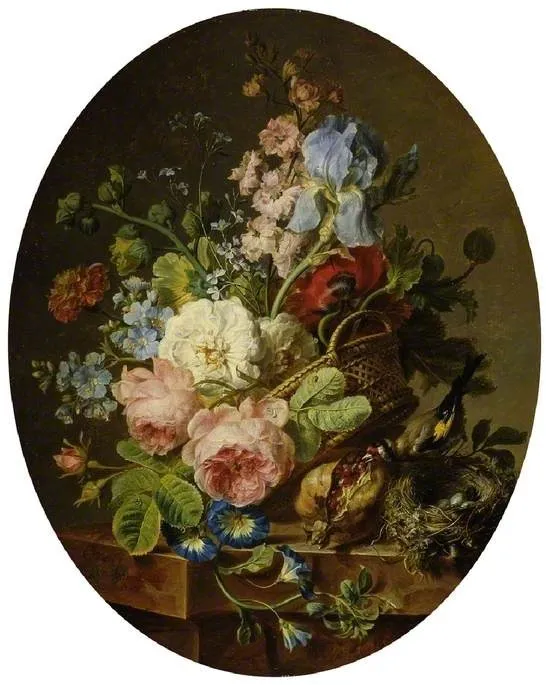
Open wicker basket of mixed flowers, including iris, roses, poppies, hollyhock, marygold, larkspur and convolulus on a marble ledge with an open pomegrante and a goldfinch with its nest is an oil painting by the Rococo painting artist Cornelis van Spaendonck. It dates from 1795 and is held in the collection of the Fitzwilliam Museum.
About this work
Subject & Meaning
Together, these motifs suggest an allegory of spiritual renewal and divine favor, framed within the transience of earthly beauty.
The composition centers on a wicker basket brimming with seasonal blooms, iris, roses, poppies, hollyhock, marigold, larkspur, and convolvulus, arranged on a marble ledge. An open pomegranate, its ruby seeds exposed, and a goldfinch tending a nest introduce traditional Christian symbolism: the pomegranate signals resurrection and eternal life, while the goldfinch, often linked to Christ’s Passion, evokes sacrifice and salvation. Marigolds, associated with the Virgin Mary, reinforce themes of divine presence and protection.
Together, these motifs suggest an allegory of spiritual renewal and divine favor, framed within the transience of earthly beauty.
Technique & Style
The painting is executed in oil on canvas, measuring 47 cm in height and 38 cm in width. Rendered with fine, detailed brushwork, it depicts a wicker basket brimming with a varied floral arrangement, iris, roses, poppies, hollyhock, marigold, larkspur, and convolvulus, set upon a marble ledge. An open pomegranate and a goldfinch with its nest are included as compositional elements.
The handling emphasizes delicate petals and precise textures, while the marble surface and woven basket are rendered with subtle tonal gradations to suggest volume and tactility. The still-life arrangement combines naturalistic observation with a refined, decorative sensibility characteristic of late eighteenth-century Dutch floral painting.
History & Provenance
Cornelis van Spaendonck executed this oil on canvas floral still life in 1789. The artist signed the work with the inscription "Corneille / Van Spaendonck."
The painting entered the collection of the Fitzwilliam Museum in 1973. It was acquired through the bequest of Major the Hon. Henry Rogers Broughton, the Second Lord Fairhaven, and assigned the accession number PD.90-1973.
The painting is held by the Fitzwilliam Museum in Cambridge, where it was accessioned under the number PD.90-1973. The work entered the museum's collection in 1973 following a bequest from Major the Hon. Henry Rogers Broughton, the Second Lord Fairhaven. The provided sources do not list any specific exhibition history for this artwork.
Context
Cornelis van Spaendonck painted this still life in 1789, exemplifying the late 18th-century Dutch-influenced tradition of detailed floral and bird subjects within European art. The work combines meticulous observation of diverse blossoms, iris, roses, poppies, hollyhock, marigold, larkspur, and convolvulus, with symbolic elements like the open pomegranate and the European goldfinch, reflecting contemporary naturalist interests. Displayed at the Fitzwillam Museum, it was bequeathed by Major the Hon. Henry Rogers Broughton, Second Lord Fairhaven, in 1973, underscoring its significance within the museum's collection of British decorative arts.
Its composition bridges Dutch botanical illustration and emerging Romantic sensibilities in British painting, positioning it within the broader trajectory of European still life.
Scholarship emphasizes its technical precision and iconographic richness, particularly the inclusion of multiple flower species and the goldfinch, which art historians link to themes of transience and divine care in 18th-century European art discourse.
Overview
Cornelis van Spaendonck’s 1795 oil painting presents a wicker basket brimming with an assorted bouquet of flowers, iris, roses, poppies, hollyhock, marigold, larkspur and convolvulus, arranged on a marble ledge. An opened pomegranate lies beside the arrangement, its seeds spilling out, while a goldfinch perches near a tiny nest. The composition is rendered with meticulous detail, emphasizing the tactile qualities of each element.
Artist & collection
Artist
Cornelis van Spaendonck (7 December 1756 – 22 December 1839) was a Dutch painter who was a native of Tilburg.