Artwork
Timber Felling in Essex
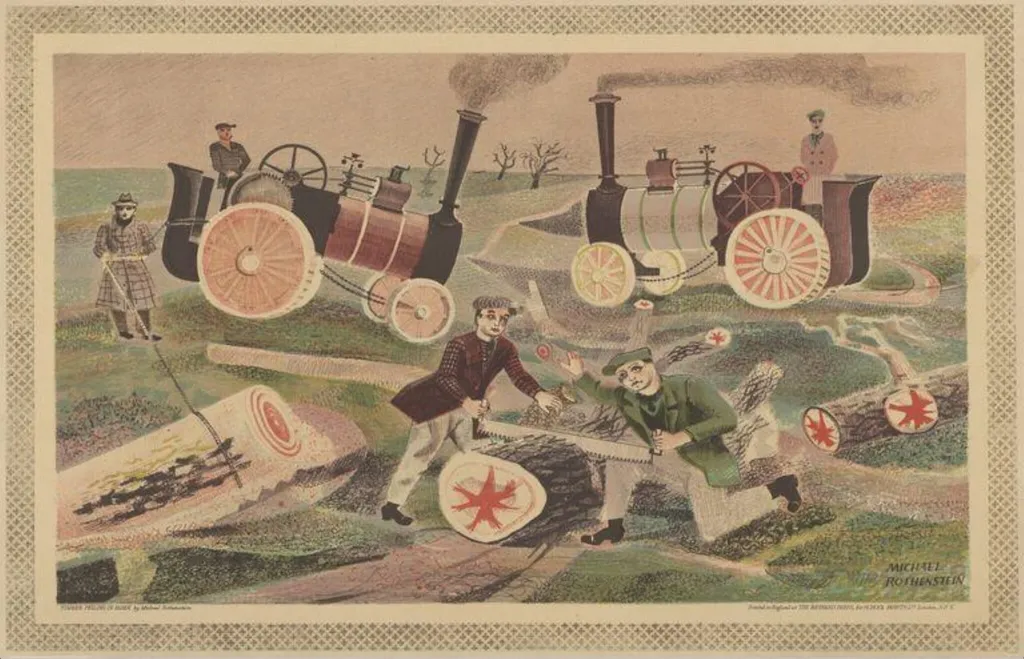
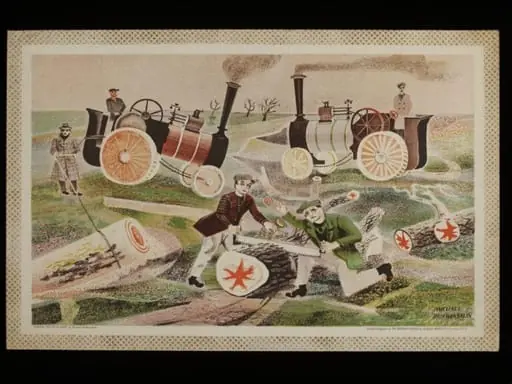
Timber Felling in Essex is an ink print by Michael Rothenstein. It dates from 1946 and is held in the collection of the Victoria and Albert Museum.
About this work
Overview
Timber Felling in Essex stands as a significant example of Rothenstein's documentation of mid-20th century British industry and its impact on the landscape.
Timber Felling in Essex (1946) is a lithograph by British artist Michael Rothenstein depicting the industrial logging operations in Essex during the post-war period. The composition captures a dynamic, chaotic scene where human labor and heavy machinery intersect within a dense woodland setting. In the foreground, a man on horseback wields an axe marked with a red cross, while another figure on the ground struggles to manage a felled tree.
The background is dominated by two large steam engines with prominent wheels, emitting plumes of smoke that contrast with the natural environment. A woman in a long dress stands near the activity, observing the scene. Created in 1946, the work reflects Rothenstein's commitment to documenting the British home front and the realities of wartime and post-war labor.
This piece is characteristic of his social realist approach, where he sought to portray the dignity and hardship of working-class life. The lithographic medium allows for strong contrasts and detailed textures, emphasizing the gritty nature of the subject matter. Timber Felling in Essex stands as a significant example of Rothenstein's documentation of mid-20th century British industry and its impact on the landscape.
Subject & Meaning
The print portrays a chaotic timber‑cutting operation: a rider on horseback brandishes an axe marked with a red cross, a worker wrestles a fallen trunk, and a woman in a long dress holds a stick nearby. Two large‑wheel steam engines emit smoke in the background, suggesting a moment of industrial transition within a rural setting.
Technique & Style
Executed as a lithograph, Rothenstein employs a limited palette and strong line work to convey texture and movement. The subdued coloration emphasizes the gritty atmosphere, while the inclusion of symbolic red crosses on the axe and wheels introduces a visual motif that may allude to rescue or medical connotations.
History & Provenance
Created shortly after World War II, the work entered the collection of the Victoria and Albert Museum, where it remains on display. Its acquisition reflects the museum’s interest in mid‑twentieth‑century British printmaking and the documentation of post‑war industrial landscapes.
Artist & collection

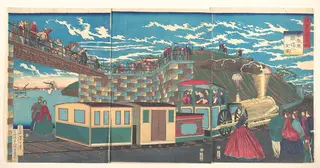 東京名勝高輪 蒸気車鉄道之全図|Illustration of Steam Locomotive Tracks at Takanawa, from the series Famous Places in Tokyo (Tōkyō meishō Takanawa-jōki kikansha no zen zu)
 Untitled
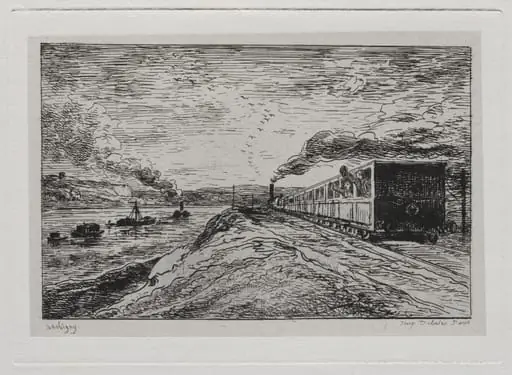 The Boat Trip: The Departure (The Return)
 Untitled
 Fairground
 Halte!!!
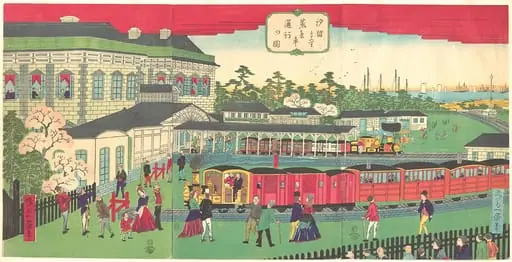
 東京汐留鉄道蒸気車通行図|Illustration of a Steam Locomotive Passing Shiodome in Tokyo (Tōkyō Shiodome testudō jōkisha tsūkō zu)
 Falls Station, Niagara
 Debarcadère des bateaux-omnibus
 Frontispiece for L'Illustration Nouvelle: The Burial of the Burin
 The Cut from Culebra