Artwork
Study of Bay Leaves
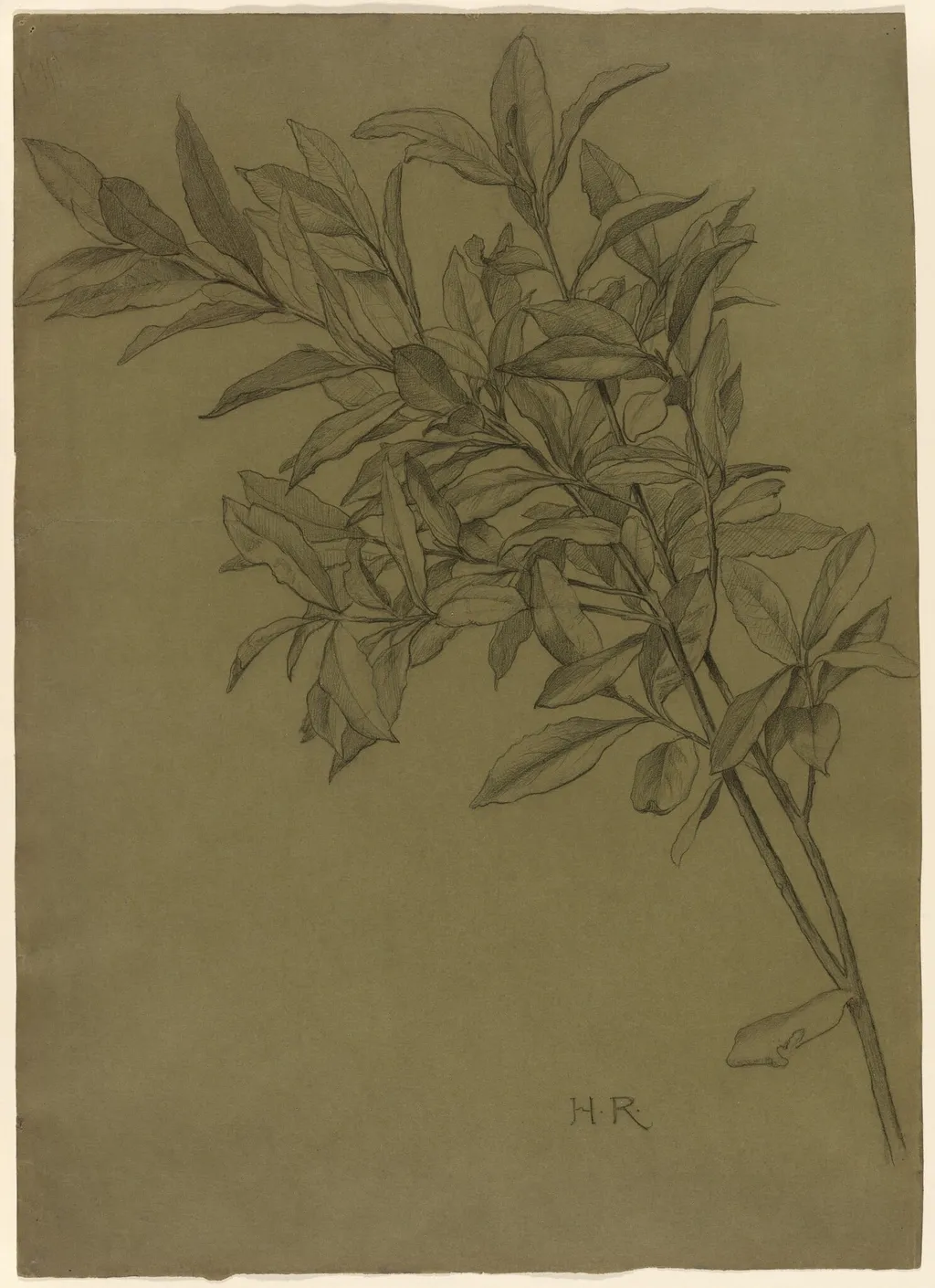
Study of Bay Leaves is a graphite drawing by the Impressionist artist Henry Ryland. It dates from 1898 and is held in the collection of the National Gallery of Art.
About this work
Overview
Created in 1898, the final year of his life, 'Study of Bay Leaves' is a graphite drawing by the British artist Henry Ryland executed on dark green paper.
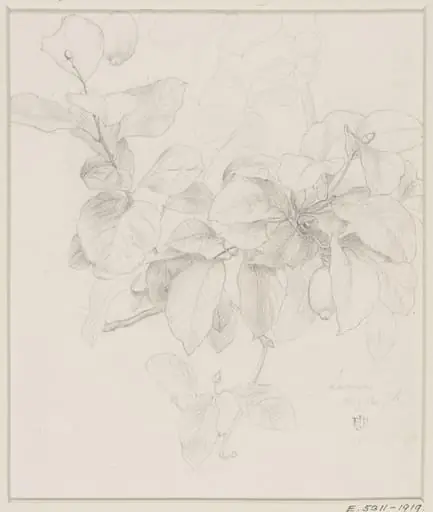
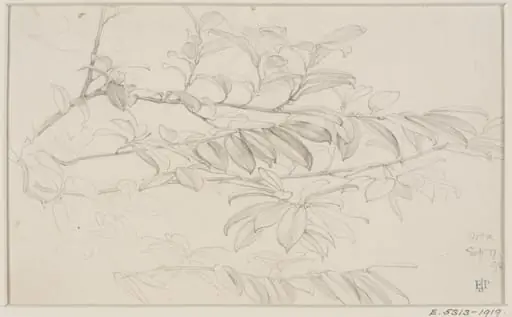
Created in 1898, the final year of his life, 'Study of Bay Leaves' is a graphite drawing by the British artist Henry Ryland executed on dark green paper. The work depicts a dense cluster of bay leaves, arranged with overlapping forms that emphasize their organic texture and natural arrangement. Ryland utilizes the dark ground of the paper as a mid-tone, applying graphite to define the contours and shadows of the foliage.
This technique allows the shadows to blend seamlessly into the background, creating a sense of depth where individual leaves merge into a unified mass. The soft, dark lines contrast with the dull green surface, highlighting the delicate veins and edges of the leaves. As a late work by an artist known for his illustrations and decorative designs, this study reflects Ryland's commitment to precise botanical observation and his mastery of tonal drawing.
It serves as a focused examination of natural form, demonstrating his ability to render complex textures through subtle variations in line weight and shading without relying on high-contrast highlights.
Subject & Meaning
The drawing presents a tightly grouped arrangement of bay leaves, rendered in close-up perspective. By concentrating on the foliage’s texture and form, Ryland invites the viewer to consider the ordinary botanical subject as an object of careful observation, emphasizing the interplay of light, shadow, and the organic complexity of the leaves.
Technique & Style
Ryland employed soft, dark graphite strokes that merge with the green ground, creating a seamless transition between line and paper. Overlapping leaves are suggested through subtle gradations rather than distinct outlines, allowing the shadows to dissolve into the surface. This approach reflects a late‑19th‑century interest in tonal drawing and the study of natural forms through nuanced shading.
History & Provenance
Created toward the end of the 19th century, the drawing entered the National Gallery of Art’s holdings through acquisition in the early 20th century, though the exact path of ownership prior to museum purchase is not extensively documented. Its presence in the collection underscores Ryland’s reputation as a skilled draughtsman of botanical subjects during his career.
Own this work as a print
Artist & collection