Artwork
Mill
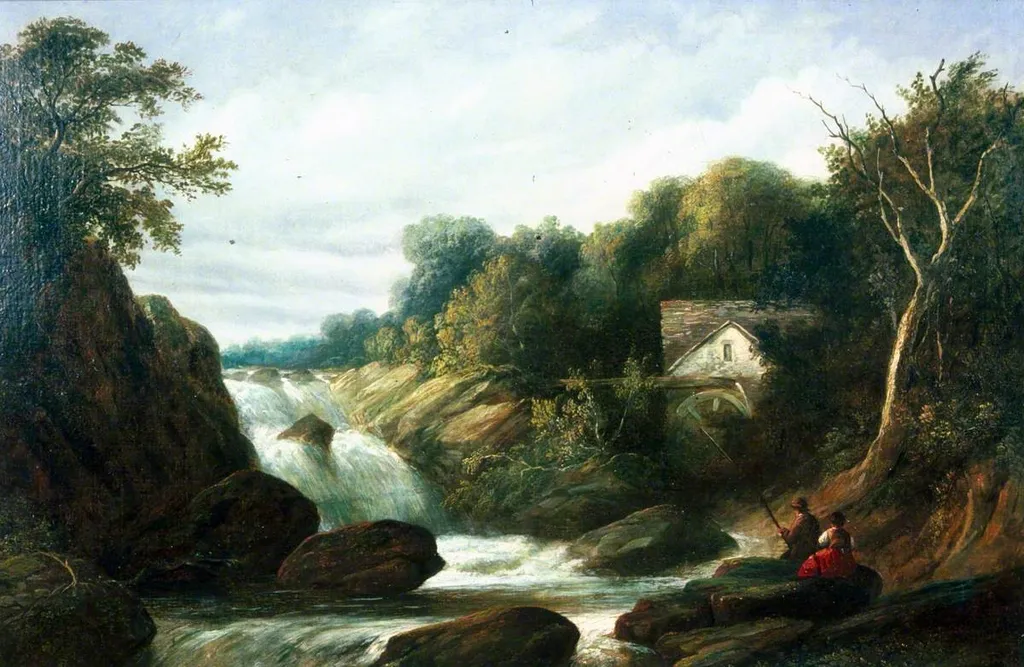
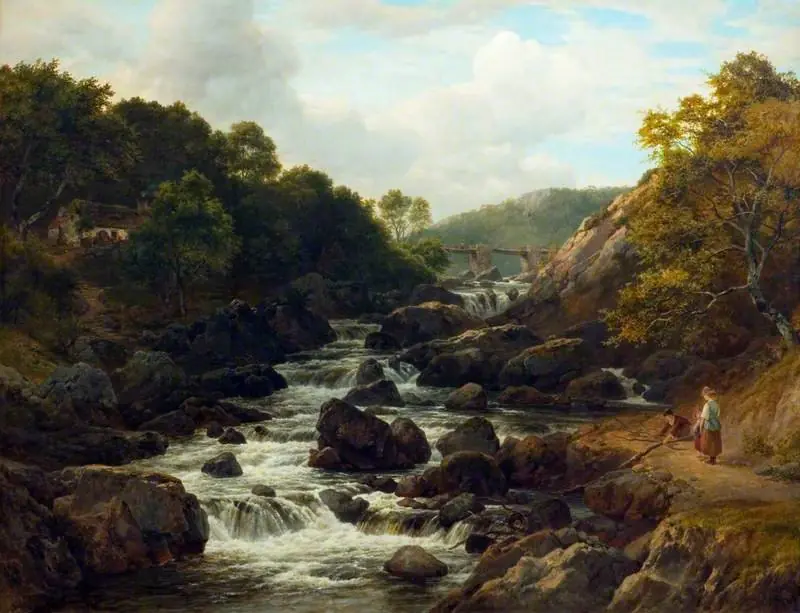
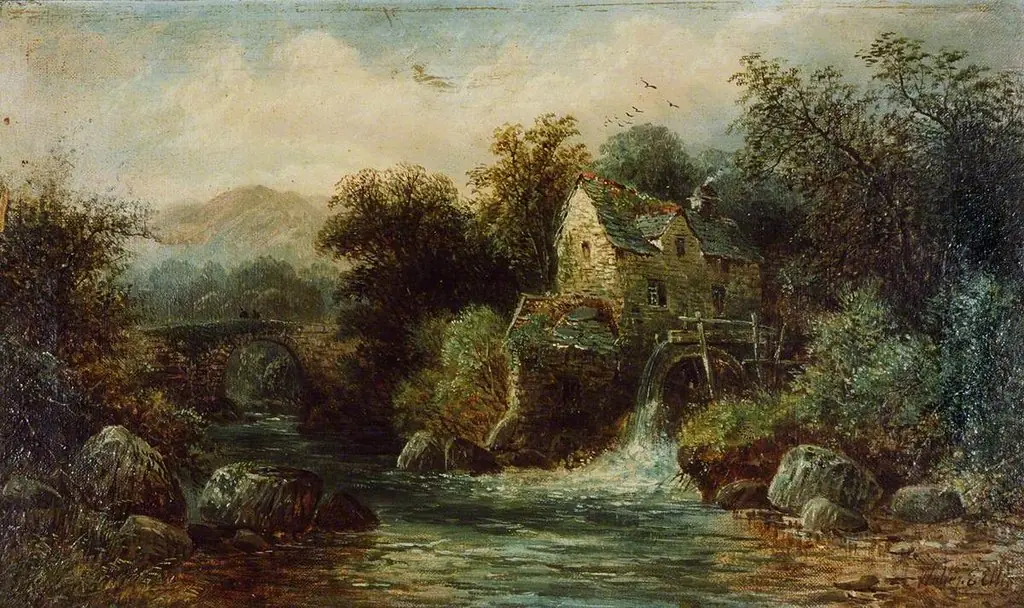
Mill is an oil painting by the Impressionist artist Samuel Phillips Jackson. It dates from 1892 and is held in the collection of the National Library of Wales.
About this work
Overview
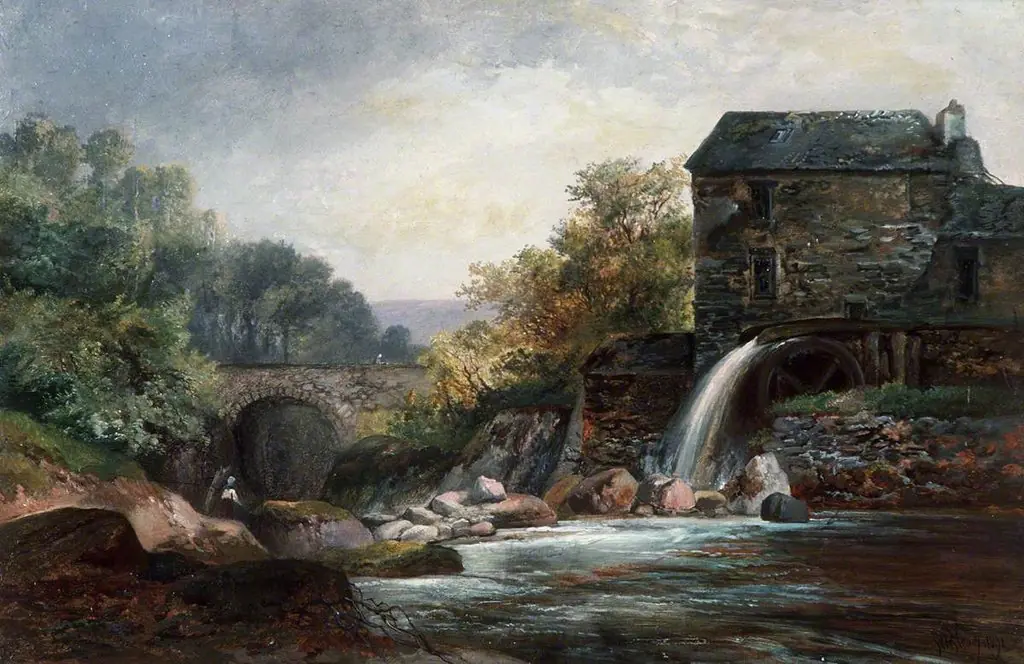
Mill is an oil on canvas landscape painting by the English artist Samuel Phillips Jackson, dated 1883.
Mill is an oil on canvas landscape painting by the English artist Samuel Phillips Jackson, dated 1883. Measuring 59 by 90 cm, the work depicts a watermill beside a rushing stream with figures in the foreground, rendered in the restrained tonal harmonies for which Jackson was known. The painting is held in the National Library of Wales, having entered the collection through the Sir John Williams Bequest in 1926, and is catalogued under accession number PZ03956. While Jackson is primarily remembered as a prolific watercolourist, this oil painting represents a significant example of his continued engagement with the medium later in his career, at a time when he had otherwise largely shifted to watercolour.
Subject & Meaning
The painting presents a waterfall cascading down rocky terrain at the centre left, feeding a turbulent stream that flows toward the foreground. To the right sits a small stone watermill with a single visible window and arched opening, partially concealed by dense trees. Two figures occupy the lower right corner: one stands holding a long pole or rod, while the other, wearing a red garment, sits nearby. A large tree with bare, twisting branches rises prominently on the far right, balanced by a leafy tree crowning a rocky outcrop on the far left. The background reveals layered treetops beneath a pale, cloudy sky. The iconography suggests rural labour and human coexistence with nature, with the mill serving as a symbol of industry integrated into the landscape. The presence of figures with fishing implements hints at leisure or subsistence activity by the water. The Wikidata record additionally identifies the depicted subjects as a watermill, fishing, river, and boulder, reinforcing the reading of a working rural scene.
Technique & Style
Mill is executed in oil on canvas, a medium in which Jackson produced his earlier works before devoting himself primarily to watercolour. The palette consists of deep greens, browns, and muted blues, with touches of white in the rushing water. Light appears diffused, illuminating the central waterfall and mill while casting the foreground rocks and figures into softer shadow. The brushwork varies from smooth blending in the sky to more textured strokes in the foliage and water, demonstrating the firm and careful execution that William Benjamin Owen identified as Jackson's strength. The restrained harmonies of tone and colour, and the handling of atmospheric effects such as the pale, cloudy sky, align with Jackson's characteristic interpretation of placid natural settings. The composition balances dramatic natural elements, the waterfall and turbulent stream, with the quiet human presence of the mill and figures, creating a landscape that is both picturesque and grounded in observed detail.
History & Provenance
The painting is dated 1883, placing it late in Jackson's career. By this period, Jackson had been elected a full member of the Royal Water Colour Society in 1876 and had largely confined himself to watercolours, making this oil painting a notable exception. The work entered the collection of the National Library of Wales through the Sir John Williams Bequest in 1926, and is now part of the National Library of Wales Framed works of art collection. It is available under a Public Domain mark, with the collection requesting photo credit for use. The accession number is PZ03956. No specific exhibition history for this individual work is recorded in the available sources.
Context
Samuel Phillips Jackson was born in Bristol on 4 September 1830, the son of landscape painter Samuel Jackson, from whom he received early instruction. He first exhibited in London at age twenty, showed at the British Institution from 1851, and at the Royal Academy from 1852. In 1853 he became an associate of the Royal Water Colour Society, and from that point concentrated on watercolours, eventually sending some 500 works to the society's exhibitions by 1881. His earlier oil paintings, mainly of Devon and Cornish coast scenes, had won praise from John Ruskin. Jackson moved to Streatley-on-Thames in 1856, then Henley-on-Thames, and subsequently devoted himself chiefly to Thames views. Mill, painted in 1883, thus emerges from an artist whose reputation was built on watercolour landscapes and marine subjects, yet who retained sufficient facility in oils to produce this accomplished canvas. The work reflects the Victorian taste for landscape that combined natural grandeur with signs of human habitation, a tradition in which Jackson, with his training in Bristol and exposure to the West Country school, was well versed.
Legacy
Jackson's broader reputation rests on his prolific output as a watercolourist and his early oil paintings of coastal scenes that attracted Ruskin's admiration. Mill, as a late oil work, does not appear to have figured prominently in critical literature, and its significance lies partly in demonstrating the persistence of his oil painting practice into the 1880s. The painting's accessibility through the National Library of Wales and its Public Domain status have facilitated its use as a document of Victorian landscape painting, though it has not attained the recognition of his exhibited works such as Hazy Morning on the Coast of Devon or his Thames views. Jackson's additional interests, including his invention of an instantaneous photographic shutter for which he received a medal from the Royal Photographic Society, indicate a mind engaged with technical precision across media, a quality evident in the careful execution of this canvas. He died unmarried in Bristol on 27 January 1904, and his work is now primarily of interest to scholars of Victorian landscape and marine painting, and of the Bristol school tradition.
Artist & collection
Artist
Samuel Phillips Jackson painted quiet country scenes in oils during the late 1800s.