Artwork
Bottom cover, from a Manuscript of the Perfection of Wisdom in Eight Thousand Lines (Ashtasahasrika Prajnaparamita-sutra)

Bottom cover, from a Manuscript of the Perfection of Wisdom in Eight Thousand Lines (Ashtasahasrika Prajnaparamita-sutra) is an unspecified painting. It dates from 1119 and is held in the collection of the Cleveland Museum of Art.
About this work
Technique & Style
Its formal style emphasizes rhythmic line work and hierarchical scaling to convey spiritual meaning rather than naturalistic representation.
The painting was created on paper as a miniature illustration of a Buddhist sutra manuscript. It is executed in pigment and gold on paper, forming part of a larger illuminated manuscript. The composition features a decorative border and stylized figures rendered in a flat, symbolic manner characteristic of early 12th-century Buddhist manuscript painting.
The work shows signs of age, including ink fading and minor surface wear, but remains structurally intact. Its formal style emphasizes rhythmic line work and hierarchical scaling to convey spiritual meaning rather than naturalistic representation.
History & Provenance
The bottom cover of the Ashtasahasrika Prajnaparamita manuscript was created in 1119, as indicated by the date inscribed on the object itself. The work is attributed to an unknown artist and was later acquired by the Cleveland Museum of Art, where it remains in the permanent collection. Its creation history is not documented beyond the single date, which serves as the earliest definitive point in its known provenance.
The bottom cover is held by the Cleveland Museum of Art, where it is recorded as an anonymous painting accessioned in 1964.136.
It has been exhibited at the Cleveland Museum of Art in the 2011 presentation Ideal Beauty: Art and Theory in the Early Twelfth Century, where the manuscript cover was shown as part of a focused display on twelfth-century Buddhist manuscript arts.
Overview
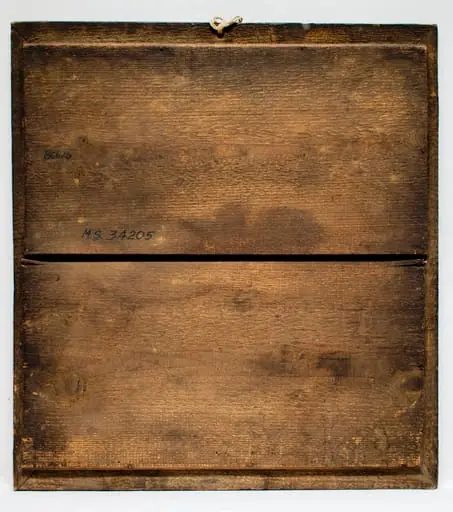
The object is the lower cover of a historic Buddhist manuscript containing the Ashtasahasrika Prajnaparamita, a text known as the Perfection of Wisdom in Eight Thousand Lines. It consists of a rectangular wooden board, dark brown in tone, whose surface shows the wear and texture typical of an aged binding.
Subject & Meaning
The cover itself does not display illustrative imagery; its significance lies in its function as a protective element for a sacred sutra. By safeguarding the text, the board participates in the ritual respect afforded to Buddhist scriptures, embodying the reverence of the tradition.
Context
The manuscript to which this cover belongs belongs to a corpus of Mahayana Buddhist literature that circulated across Asia from the early centuries of the Common Era. Wooden covers such as this were common in South Asian and Tibetan codices, providing durability for texts used in monastic study and ritual.

Artist & collection

- Bottom cover, from a Manuscript of the Perfection of Wisdom in Eight Thousand Lines (Ashtasahasrika Prajnaparamita-sutra)
 Top cover, from a Manuscript of the Perfection of Wisdom in Eight Thousand Lines (Ashtasahasrika Prajnaparamita-sutra)
 Folio 1 (recto), from a Manuscript of the Perfection of Wisdom in Eight Thousand Lines (Ashtasahasrika Prajnaparamita-sutra)
 Suprescu
 Portret în oglindă
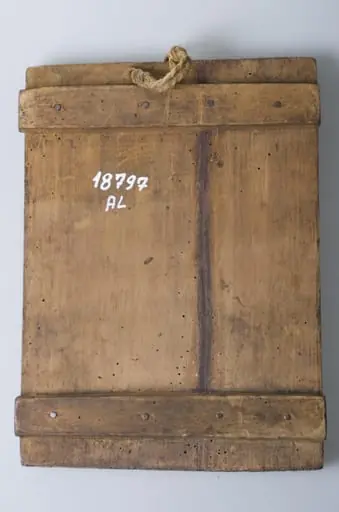 Icoană de formă rectangulară, pictată pe lemn în ulei, reprezentând tema „Izvorul tămăduirii”; Maica Domnului este redată în registrul superior, deasupra unei fântâni; în registrul inferior sunt redate două personaje care o venerează; imaginea este încadrată într-o ramă de culoare aurie înspre interior și albastră înspre exterior; pe verso-ul icoanei sunt prinși doi lați, bătuți în cuie; la partea superioară prezintă sistem de agățare cu funie.
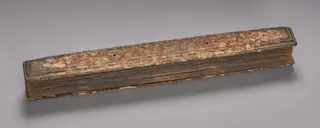 Manuscript of the Perfection of Wisdom in Eight Thousand Lines (Ashtasahasrika Prajnaparamita-sutra)
 Rafter with geometrical, plant, animal and heraldic motifs
 Icoambla
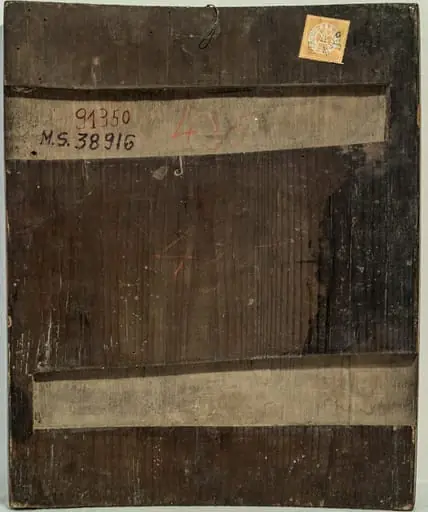 Sfânta Paraschiva încoronată este reprezentată frontal, 3/4, Nimbul trasat cu roșu depășește linia chenarului și partea superioară a coroanei. Tehnica iluminării treptate cu elemente specifice: accentuarea zonei ochilor, tonurile de pământ ale umbrelor. Tunica decorată cu motive fitomorfe ample incizate în stratul de foiță. Mantie închisă în față, cu decor linar și bordură lată cu motive geometrice 3 șiruri de incizii în grund). Pe cap, umeri lăsat pe spate, un maforion de culoare deschisă. În mâna dreaptă, Sfânta ține o cruce mică, rusească, (6 brațe)în stânga un rotulus desfășurat cu inscripția scrisă în limba slavonă: Cred în unul Dumnezeu… alte inscripții: pe chenar de o parte și de alta a nimbului: Chipul Sf. Mucenițe Parascheva Vineri, în colțul stâng al icoanei ѾOН pe nimbul cruciger al lui Iisus, reprezentat ca pe sfântul Keramion. Cromatica: Chenar roșu cu două linii galbene și mărginit cu brun; fond - foița metalică decorată prin incizare, cu chenar multiplu din motive geometrice reteate. Tip Krashnuskha. Pe spate, un timbru al miliței RPR.
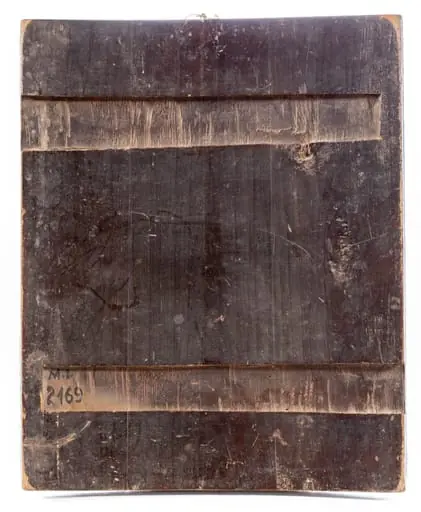 Scene din viața lui Iisus (Coborârea la iad și cele douăsprezece praznice împărătești)
 Text, Folio 8 (recto), from a Manuscript of the Perfection of Wisdom in Eight Thousand Lines (Ashtasahasrika Prajnaparamita-sutra)